
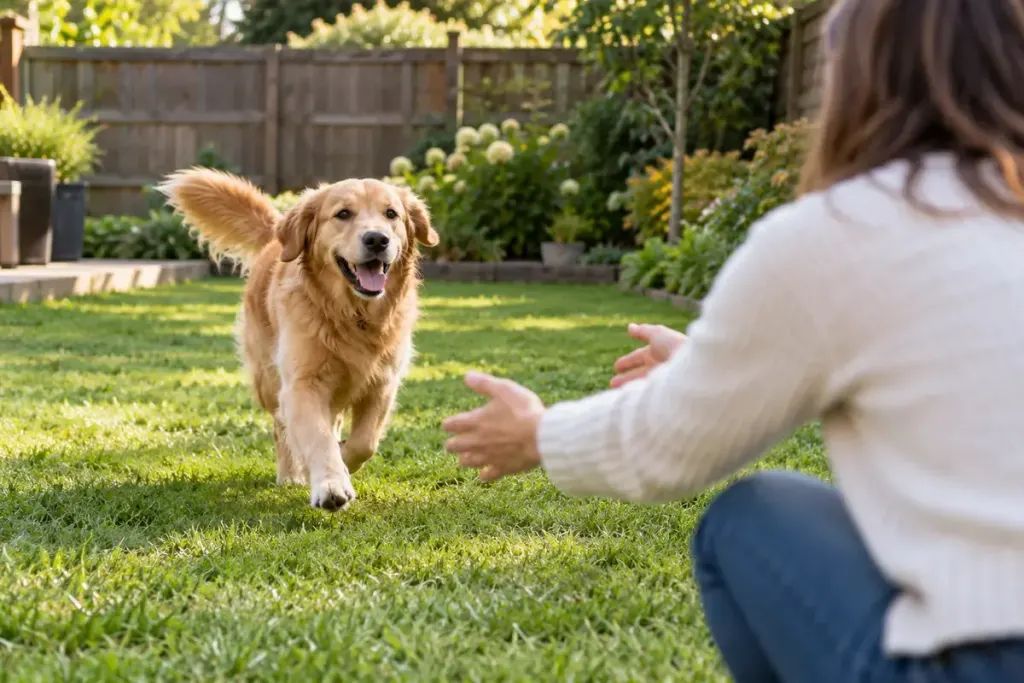
Calling a dog away from an exciting smell is much harder than calling across a quiet room. Start where returning to you is an easy choice, rather than making the busiest park the first test.
Use a secure enclosed area and a reward your dog values. For detailed training help, the Dogs Trust recall guide explains a reward-based approach. Dogs with particular behavioural or health needs may benefit from individual professional advice.
Make one short return worthwhile
Begin at a small distance when the dog is already able to pay attention. Use the chosen cue clearly, encourage the return and reward near you when the dog arrives. Keep the interaction pleasant. Repeating the cue continuously while the dog is occupied can make it harder to tell which word mattered.
For an original practice plan, try a few easy returns indoors, pause, and finish while the dog remains comfortable. Increase only one challenge at a time, such as distance or a mild distraction. A successful quiet-room response does not prove readiness for an unfenced place near traffic.
Do not make arrival predict punishment
If a return takes longer than you hoped, avoid scolding the dog when it finally reaches you. Review the difficulty and your management instead. Sometimes reward and release the dog back to an allowed activity so returning does not always mean that all interesting things end.
If using a long line, learn safe handling and suitable equipment from a qualified trainer. Keep it away from roads, entanglement hazards and other people. A line is a management tool, not permission to set up a situation beyond the dog’s current ability.
Keep the real-world boundary
Follow local lead rules and respect wildlife, livestock and other visitors. Use a lead where a reliable return is uncertain. If recall changes suddenly alongside other behaviour, discuss possible health or hearing concerns with a vet.
Progress is not the loudness of the cue. It is a growing history of manageable situations in which coming back to you works out well for the dog.