
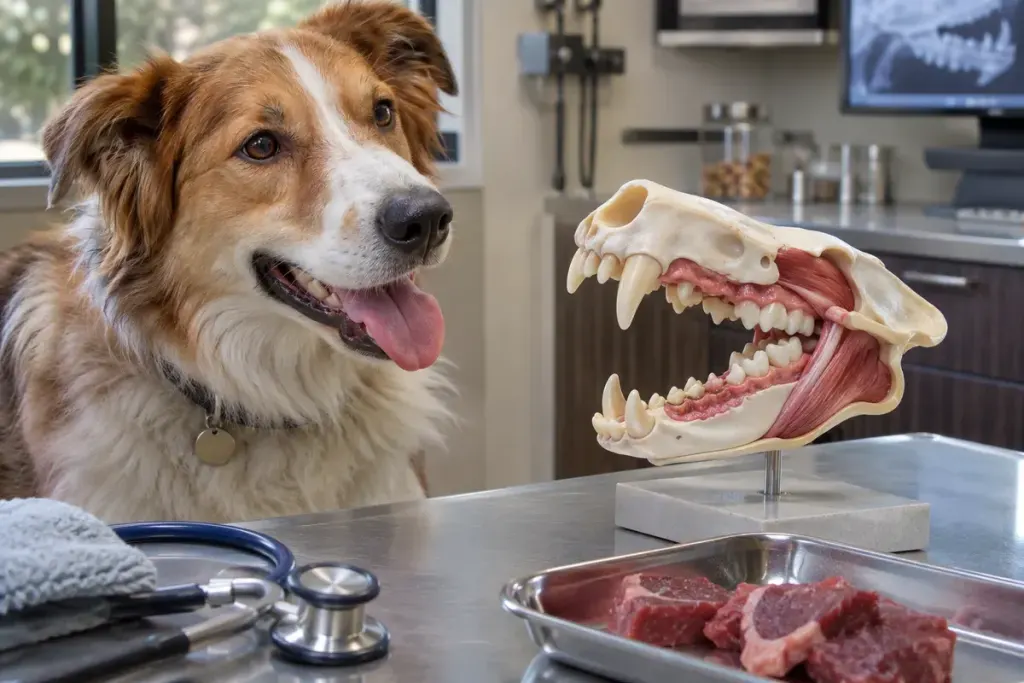
The long pointed teeth at the front of a dog’s mouth are easy to recognise. Farther back, another pair does an important cutting job. The carnassials work with a shearing action as the upper and lower teeth pass one another.
The MSD Veterinary Manual identifies the carnassial pair as the upper fourth premolar and lower first molar. There is a pair on each side. “Carnassial” therefore describes particular teeth and their relationship, rather than a name for every back tooth.
A useful word at a dental appointment
If a veterinarian points out a problem with one of these teeth, ask them to show you its location on a dental chart or model. A description such as “the large tooth at the back” can be ambiguous when you later read a treatment estimate or discuss a follow-up.
Write down which side and which tooth the clinician means. You do not need to memorise every dental number, but connecting the spoken explanation to the written record makes it easier to follow the plan.
Do not force the mouth open to identify the tooth yourself. An uncomfortable dog may resist or bite, and a view of the crown cannot establish what is happening below the gum. VCA’s explanation of an oral examination shows why the veterinary check considers more than the teeth that happen to be visible in a quick home glance.
Report the behaviour, not a home diagnosis
If your dog starts dropping food, chewing differently or avoiding something it previously ate comfortably, describe the change and arrange veterinary advice. Note when it began and whether you noticed swelling, bleeding or a visibly damaged tooth. Continued eating does not prove that every tooth is comfortable.
The MSD discussion of endodontic disease explains that damaged teeth may need specific treatment. The appropriate choice depends on examination and findings. Understanding the carnassials gives you vocabulary for that conversation; it should not turn a household inspection into a decision to wait or to attempt dental treatment at home.