
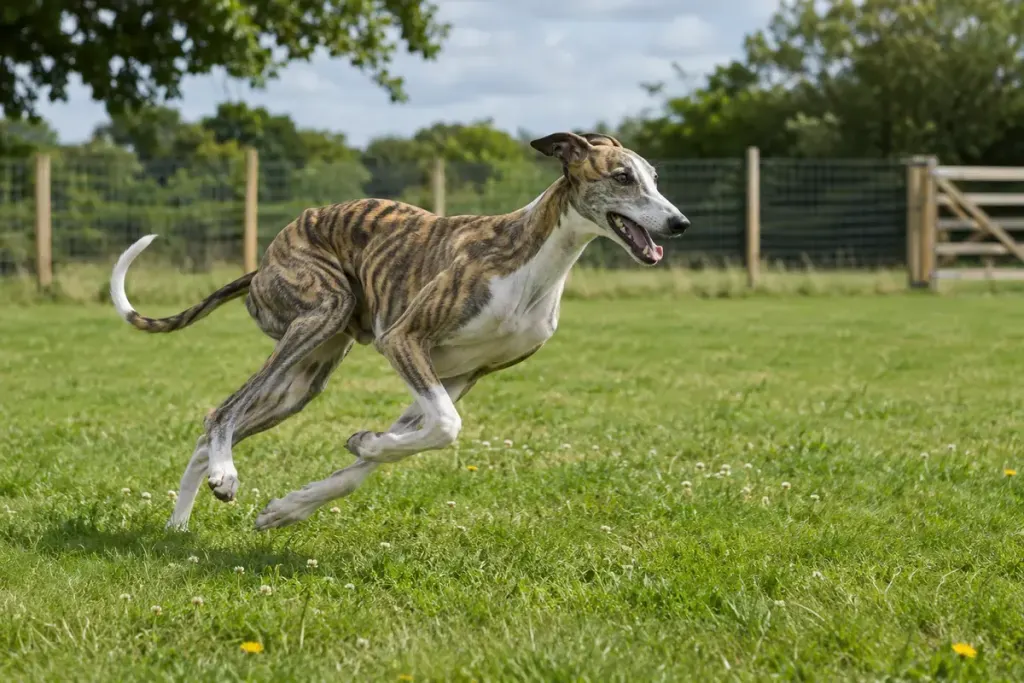
A photograph of a running dog catches only one instant. A sequence reveals something more interesting: in a double-suspension gallop, the dog has two airborne phases within a complete stride. One occurs with the body extended, and another as the limbs gather beneath it.
The American Whippet Club’s illustrated standard describes this movement in its gait appendix. It is especially useful for understanding the flowing outline associated with running sighthounds. The name concerns the pattern of support and flight, not a requirement that every pet demonstrate the same shape.
Follow one stride slowly
Use a clear, legitimate video of a dog already moving comfortably. Choose a side view and follow one complete cycle rather than collecting the most dramatic freeze-frame. Note when paws contact the ground and when none do.
Then look at the spine and the position of the limbs. The extended and gathered phases make more sense as connected moments than as two unrelated poses. A still image can also hide a paw behind another limb, so avoid declaring an airborne phase from an unclear angle.
Observation is not a training target
Do not make a dog sprint repeatedly to obtain a matching photograph. Age, health, breed, surface and the individual animal’s preferences all affect appropriate activity. A movement description is not an exercise prescription.
For an original viewing exercise, compare a short clip of walking with one of galloping and write only what you can see: the order of contacts, the moments of flight and the change in body shape. Avoid converting that small observation into a claim that one dog is fitter or better built than another.
If your own dog develops a limp, reluctance to move or another change in gait, discuss it with a veterinarian. A breed diagram cannot diagnose pain. The reward of learning the terminology is simpler: it helps you notice how a familiar animal coordinates a remarkably complex movement in a fraction of a second.