
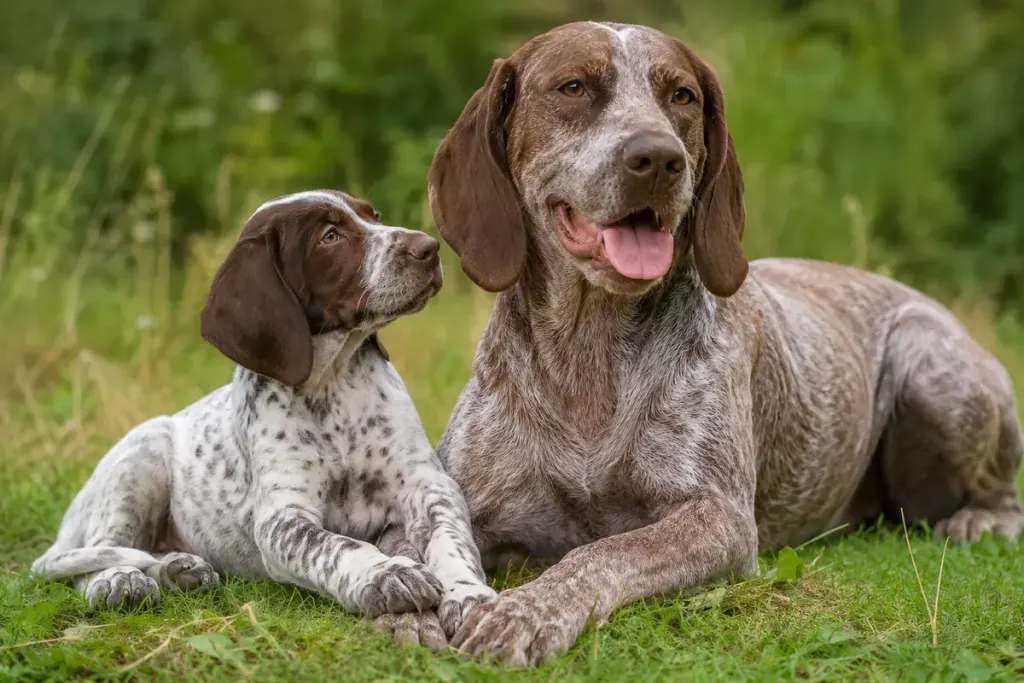
From a distance, a roan dog may look as though its coat is a single softened colour. Move closer and you can see coloured and white hairs intermingled. Ticking usually appears as more distinct coloured spots within white areas. The names describe patterns, not a complete identity for the dog.
A study of roan, ticked and clear canine coats investigated their association with genetic variation near usherin on canine chromosome 38. It illustrates why a coat description and a genetic explanation are related but different tasks. Breed terminology and overlapping visual patterns can make a photograph harder to interpret than a simple colour chart suggests.
Start with what you can see
Describe the larger patches first, then the smaller marks within the white areas. Is the effect a close mixture of hairs, a set of separate speckles, or both? Use photographs taken in similar light if you are documenting how a puppy’s appearance changes.
A useful note might read, “Brown patches with fine brown speckling through the white shoulder area.” It is more informative than choosing a fashionable colour name and assuming everyone uses it in exactly the same way.
A pattern is not a breed test
Several breeds and mixed-breed dogs can share similar markings. Do not treat roaning as proof of ancestry or as a prediction of temperament. Nor should colour be used to infer that a dog is healthy or unhealthy without relevant evidence.
If a DNA result appears inconsistent with a visual description, ask the laboratory which variants its test measures and what its interpretation covers. A test for one trait is not a complete explanation of every visible feature.
For everyday care, pay attention to the skin and coat condition rather than the label. New bald patches, itching or sudden changes deserve veterinary attention; they should not be dismissed as a normal colour pattern. Learning the vocabulary is most useful when it improves observation without turning an attractive coat into an unsupported story.