
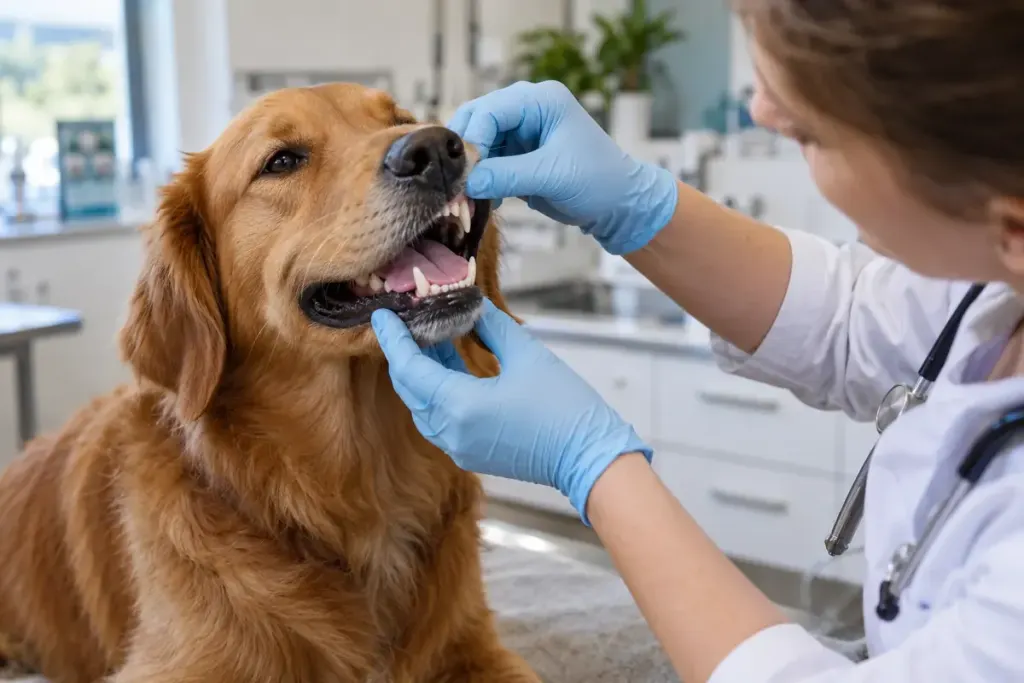
You lift a puppy’s lip gently and notice two pointed teeth where you expected one. It may be a baby tooth remaining while the permanent tooth emerges. That is worth showing the veterinary team rather than waiting for a harder chew to solve it.
The MSD Veterinary Manual’s discussion of retained deciduous teeth explains that retained baby teeth can displace permanent teeth, affect the bite and trap food. Although some breeds are more commonly affected, appearance alone does not establish which tooth you are seeing.
Keep the observation gentle
If your puppy is comfortable with a brief lip lift, note the location and when you first saw the extra tooth. A clear photograph may help the clinic understand the question, but do not force the mouth open or repeatedly handle a painful area to obtain one.
Record practical changes such as difficulty eating, mouth sensitivity, bleeding or reluctance to accept familiar handling. Eating normally does not prove that tooth position is harmless; it is simply another observation to share.
Contact the veterinary clinic promptly for advice about assessment. The clinician can distinguish a retained tooth from another dental issue and decide whether imaging or treatment is needed. Do not delay solely because a later routine appointment is already booked.
Never try to pull, twist or loosen the tooth at home. Avoid improvising with very hard objects intended to knock it out. The surrounding tissues and developing permanent teeth need professional care, and a broken tooth creates another problem.
Ask what the next check should establish
After the examination, clarify which tooth was identified, what action is recommended and when the bite should be reviewed again. If a procedure is proposed, ask about preparation, pain relief and aftercare rather than assuming it is identical to an ordinary cleaning.
A useful puppy dental note names the tooth or location and the clinician’s plan. “Teething” is too broad to explain a persistent double row when the next person caring for the dog looks in its mouth.