
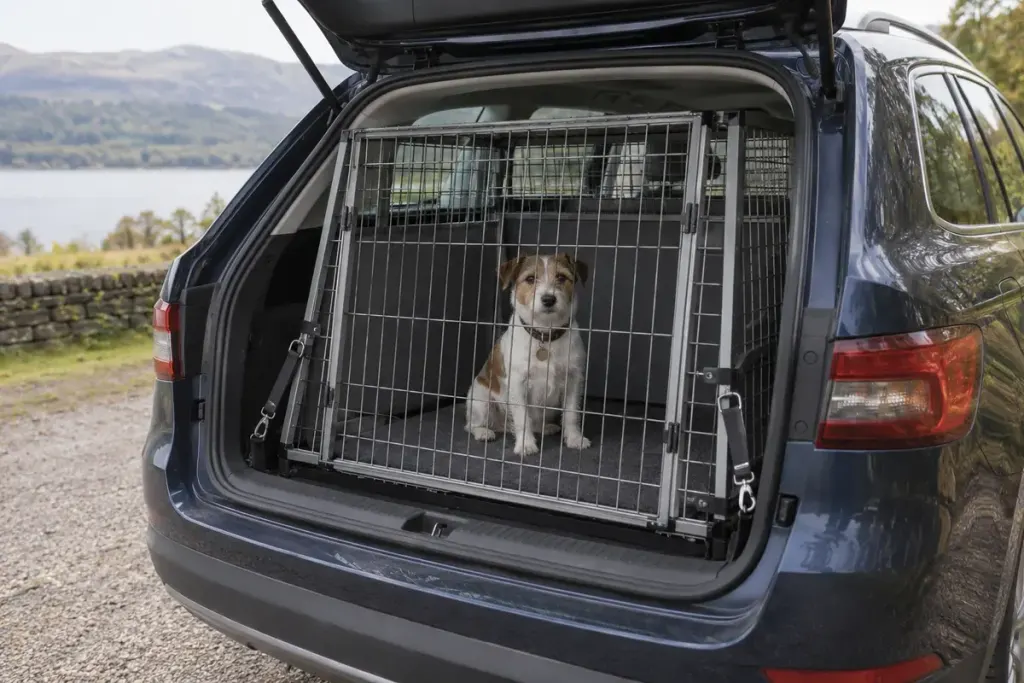
A dog that settles happily on the sofa may find a car’s movement, noise and limited space unsettling. Decide where the dog will travel before loading luggage, rather than fitting the dog into whatever space remains.
The American Veterinary Medical Association’s travel guidance discusses appropriate carriers and restraint. Choose equipment suited to the animal and vehicle, and follow its fitting instructions. A lead clipped to an ordinary collar is not a substitute for a suitable travel restraint.
Make the space familiar while parked
Let the dog investigate a properly secured crate or travel area during calm, short sessions. Reward voluntary entry without forcing a frightened dog inside. Keep ventilation, temperature and safe supervision in mind even when the vehicle is stationary.
Check that the dog has appropriate room and that luggage cannot slide into the space. A crate’s presence alone does not mean it is correctly secured. Keep the release points accessible so the animal can be removed safely at a planned stop.
For an illustrative first outing, a brief familiar route may teach you more than a long trip straight away. Note panting, drooling, restlessness or other changes and discuss persistent travel distress or suspected motion sickness with your vet. Do not give human medicines or improvise a sedating dose.
Plan stops where the dog can be managed safely, with a lead attached before opening an exit. Carry water and keep identification details current. Never leave the dog unattended in a parked vehicle; conditions can become dangerous even when the stop seems brief.
The useful preparation is not making the car look comfortable in a photograph. It is checking that the dog’s position remains secure, practical and tolerable throughout the actual journey.