
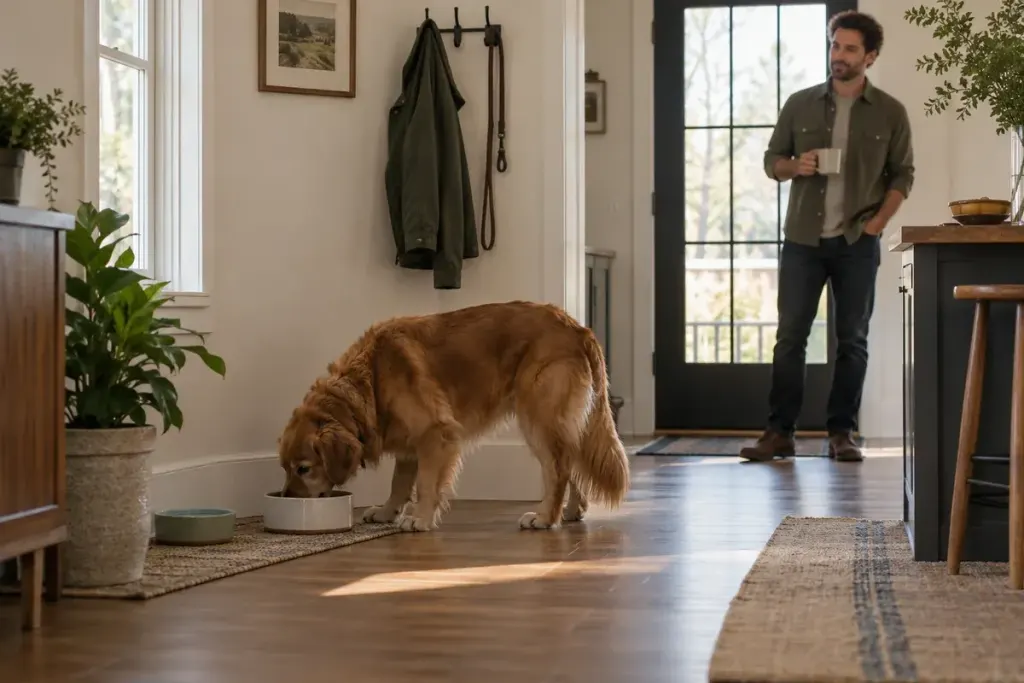
A dog lowers its head over the bowl as someone approaches. A person may be tempted to reach in, move the food or “show who is in charge.” That turns an ordinary meal into a confrontation and can make the situation less safe.
Food-bowl manners start with the people in the room. A dog should not have to defend its meal from repeated interruptions. Respecting space is a useful household habit whether or not guarding has already appeared.
Make eating predictable and undisturbed
Choose a feeding place away from busy walkways and manage access by children and other animals. Do not leave a child to interpret a dog’s warning signals or practise taking food away. Physical separation and adult supervision are more reliable than expecting everyone to remember a rule in a crowded room.
Dogs Trust’s resource-guarding guidance explains why dogs may protect valued things and offers welfare-focused advice. Guarding is not limited to meals; toys, resting places or found objects can also matter.
Observe without creating a test
Notice context from a safe distance: who was nearby, what the dog had and what changed just before the behaviour. A stiff posture, freezing, moving over the item or growling deserves attention. Do not repeatedly approach to see whether the response happens again.
Write a factual note rather than a label such as “being dominant.” For example, “Dog became still when another dog entered the feeding area.” This helps a professional understand the situation without forcing the animal to repeat it for a demonstration.
Get help that addresses the cause
If guarding occurs, contact a veterinarian to consider health factors and ask about an appropriately qualified, reward-based behaviour professional. New or escalating behaviour, a bite risk or children in the household warrants prompt guidance.
Do not punish growling or wrestle an item away. If something dangerous is involved, prioritise distance and professional advice rather than putting a hand near the dog’s mouth. A tailored management and training plan is safer than copying a short internet clip.
For now, the practical improvement may be simple: a quieter feeding area, separate meals for animals and a family rule to leave the bowl alone. Trust around food grows from predictable experiences, not from proving that a person can interrupt every mouthful.