
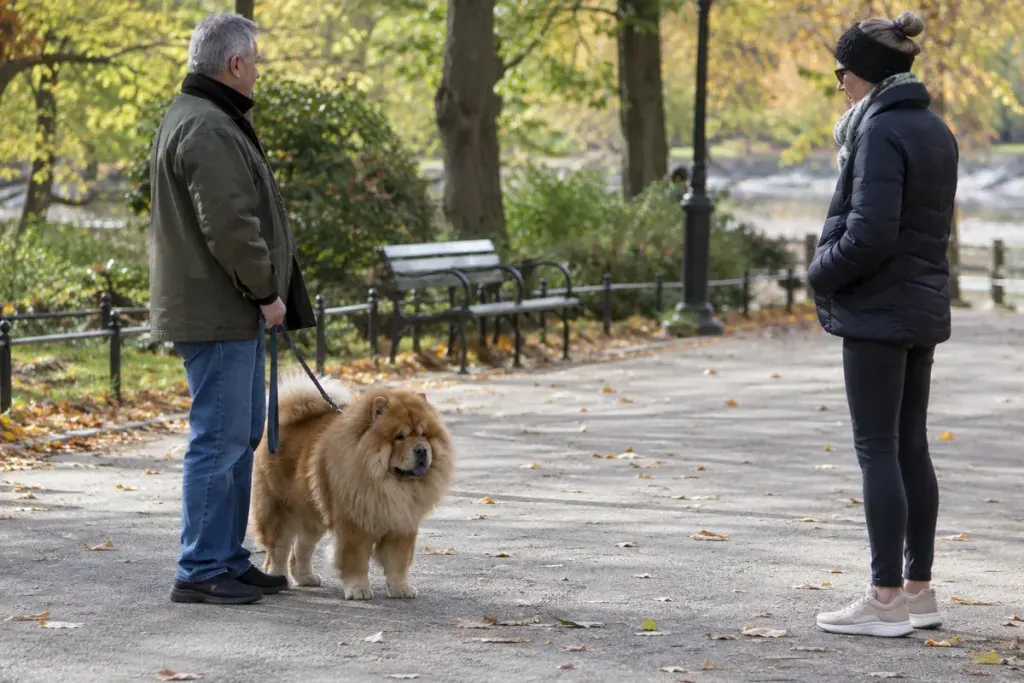
A beautiful dog on a walk can attract attention before the owner has time to speak. A hand reaches out, someone bends over the dog and the greeting is already happening. A more considerate introduction begins earlier, with space and a question.
Not every dog wants contact with every person. That includes dogs who are comfortable with their own family. Breed descriptions can provide background, but they cannot tell you how an individual dog feels in a particular moment.
Ask the person, then observe the dog
Ask the owner whether an interaction is welcome and accept a no without requesting an explanation. If the owner agrees, do not treat that as a reason to move straight into the dog’s face or reach over its head. Give the dog time and room, and follow the owner’s guidance.
The RSPCA’s body-language guide recommends considering the dog’s whole body and the situation. A single feature, such as a moving tail, does not provide a complete account of how the dog feels.
Notice movement away as well as movement toward
If a dog turns away, increases distance or appears tense, do not follow to complete the greeting. Allowing the interaction to end is a useful choice. A dog should not have to become more forceful before people respect its space.
For an illustrative example, imagine a dog standing quietly beside its owner while a stranger approaches. The dog looks away and steps behind the owner. The stranger can stop, turn their attention back to the person and continue the conversation at a distance. Nothing is gained by insisting that the dog “just needs to get used to it.”
Give owners an easy sentence to use
If you are the owner, prepare a short phrase such as “We’re keeping some space today” or “Please don’t reach toward her.” You do not owe a detailed account of your dog’s history. Move to a less crowded position when it is safe to do so, rather than trying to manage several greetings at once.
Keep the lead and the surroundings in mind so that you can maintain control without crowding the dog into an uncomfortable encounter. Busy entrances and narrow paths may be poor places to attempt an introduction.
Keep children’s interactions supervised
Adults should manage the situation and be ready to end contact. Do not ask a child to interpret subtle signals or use an unfamiliar dog as a lesson in bravery. If there is uncertainty about whether an interaction is appropriate, give the dog space.
For a dog that repeatedly struggles with greetings, seek help from a veterinarian and an appropriately qualified behaviour professional. A short article cannot assess the cause or prescribe a training plan for that individual.
A successful walk does not need a greeting count
You can enjoy being around dogs without touching every dog you meet. For owners, a calm pass at a comfortable distance can be a perfectly good outcome. Record what helped if you are trying to understand patterns, but avoid turning a single encounter into a fixed label about the dog’s personality.
Respectful greetings leave room for choice. Sometimes the best way to be friendly is to keep walking and let the dog enjoy the rest of its day.