
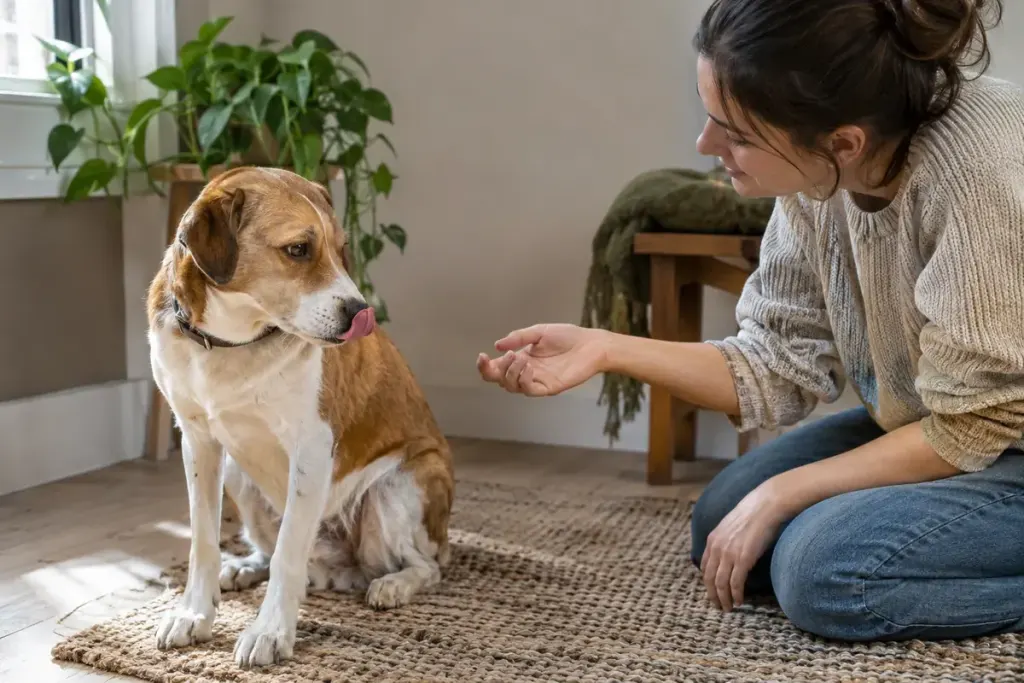
A visitor leans over to greet a dog. The dog turns its head, briefly licks its lips and shifts backward. It is easy to notice only the lick and dismiss it as a food-related habit. The sequence around it is often more useful.
Dogs Trust’s body-language guidance includes lip licking among subtle signs that can accompany anxiety or fear. The same gesture does not have one meaning in every situation, so look at the dog’s whole body and what just happened.
Notice the sequence, not a frozen expression
Ask what changed immediately before the behaviour. Was someone reaching over the dog’s head, bringing a brush closer or blocking a route away? Look for other details such as a turned head, lowered posture, movement away or a tense mouth.
You do not need certainty about the dog’s emotion before making an interaction less demanding. In the visitor example, the person can stop leaning in, turn slightly aside and allow the dog space. Let the dog choose whether to approach again rather than following it across the room.
For children, make the adult responsible for managing the greeting. A dog that remains still is not necessarily inviting more touch, and a child should not be asked to test how much the dog will tolerate.
Keep a useful record if the pattern repeats
Write a brief description of the situation, the action and what happened after pressure was reduced. “Licked lips when the brush approached; moved away; relaxed after we stopped” is more informative than “was naughty about grooming”.
Do not deliberately recreate a distressing situation just to obtain a video. If you already have a safe, naturally occurring recording, it may help a qualified professional understand the sequence.
Dogs Trust also notes that physical health can affect behaviour. Repeated or new licking, especially with other changes, deserves a veterinary conversation rather than an automatic behavioural label. The aim is to notice early information and respond thoughtfully, not to turn a single gesture into a diagnosis.