
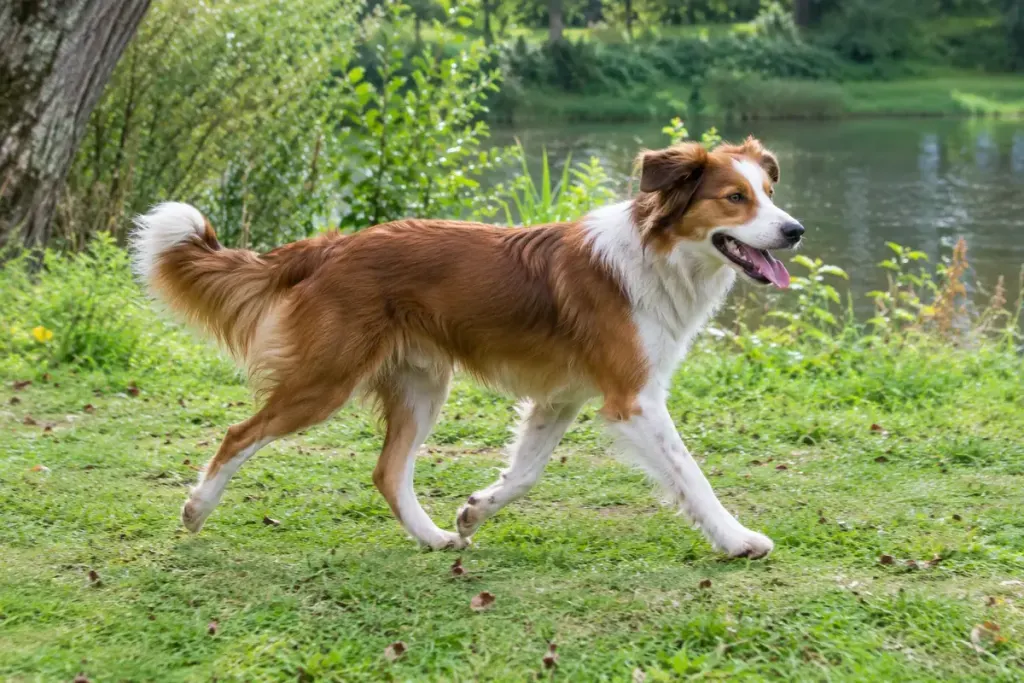
All four paws are off the ground in the photograph. It is a striking moment, but that frame alone does not tell you which gait the dog was using. The order of the contacts before and after it supplies the missing information.
The University of Minnesota’s veterinary anatomy gait glossary describes a flying trot as a trot with a suspension phase. The characteristic diagonal support pattern still matters: the airborne moment is part of a sequence, not a separate definition based on a dramatic picture.
Watch the feet in pairs
Use a clear side-on recording of an ordinary, comfortable movement. Follow one forefoot and the opposite hind foot, then the other diagonal pair. Slow playback can help reveal the order without requiring the dog to repeat the exercise for a camera.
Keep the original-speed clip too. A slowed sequence is useful for observing contacts, while normal speed preserves the rhythm that attracted your attention in the first place.
For a beginner’s observation sheet, make three notes: the visible contact order, whether there is a moment without ground contact, and any part hidden by the camera angle. “I cannot see the far hind foot” is a valid limitation, not a gap that needs to be filled with a guess.
Observation is not a health assessment
Do not push a dog to move faster to produce a suspension phase. The appropriate pace and activity depend on the individual. A show photograph or a neat-looking sequence is not proof that a dog has no pain or movement problem.
If you notice limping, reluctance, a sudden change or signs of discomfort, stop the activity and seek veterinary advice. Keep an existing video if it can help describe the change, rather than repeatedly provoking it for a better recording.
Learning the vocabulary makes dog movement more interesting to watch. It is most useful when it sharpens what you can actually describe: a sequence of contacts, a brief flight and the limits of what the camera shows.