
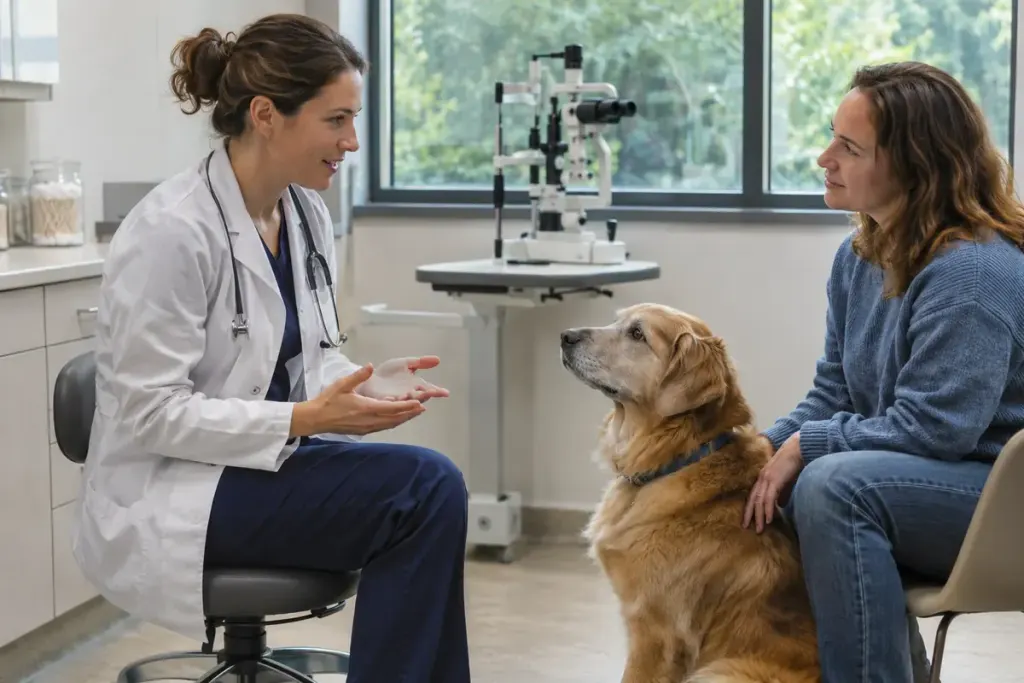
An eye-screening appointment can involve more than checking whether a dog sees well today. Gonioscopy allows a veterinary ophthalmologist to examine the drainage angle inside the eye, including structures that may be relevant to the risk of a particular inherited form of glaucoma.
The British Veterinary Association’s January 2026 guidance explains the examination and its grading within the BVA/RKC/ISDS scheme. Severe abnormality of the pectinate ligament is a risk factor for primary closed-angle glaucoma. A risk assessment is not the same as diagnosing an active pressure crisis.
Ask which examination is being booked
Gonioscopy and measurement of intraocular pressure answer different questions. A pressure reading concerns pressure at the time of measurement; gonioscopy looks at the drainage-angle anatomy. Neither term should be used as shorthand for every part of an eye examination.
The BVA’s owner information on primary glaucoma describes the use of a specialised lens and the expertise required. Confirm availability when booking rather than assuming every routine eye appointment includes it.
Bring a useful history
Take previous eye certificates, relevant veterinary records and the identification documents requested by the scheme. Note any eye medication and any past episodes of redness, discomfort or altered vision. Do not stop prescribed medication in preparation unless the treating veterinarian tells you to do so.
Useful questions include:
- What exactly does this result describe?
- How should it be interpreted for this dog and breed?
- When, if at all, should the examination be repeated?
- What symptoms require urgent veterinary attention?
The scheme’s current FAQs provide practical details, but a dog’s own follow-up plan should come from the clinician. Screening frameworks and breeding advice are jurisdiction- and scheme-specific.
A painful, suddenly red or cloudy eye, or an apparent sudden loss of vision, should not wait for a future screening appointment. Seek prompt veterinary assessment.
Gonioscopy is most useful when its result stays attached to the dog’s history and the ophthalmologist’s explanation. It adds a particular view of eye health; it is not a lifetime guarantee that every form of eye disease has been ruled out.