
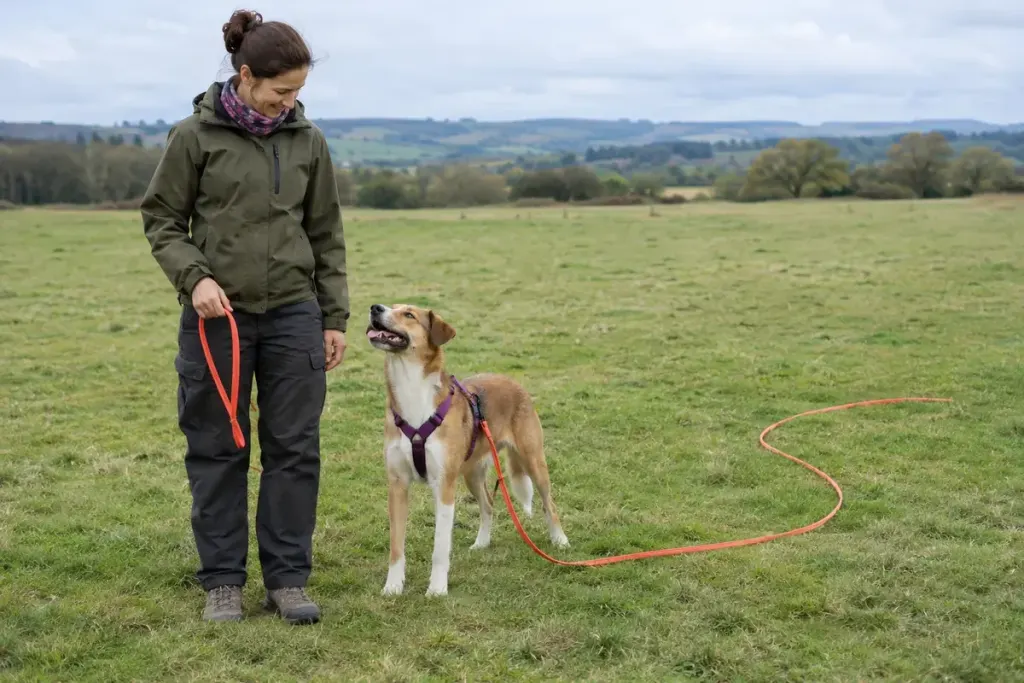
A dog turns to sniff behind you, steps across its line and walks forward again. The lead that was neatly behind its body is now running beneath a leg. With a long line, small changes like this deserve attention before they become a tug or a tangle.
Battersea’s long-line guidance recommends attachment to a harness rather than a collar and taking time to learn how to handle the extra length. A long line is a fixed-length training aid, not the same mechanism as a retractable lead.
Practise where the line can be seen
Begin in a clear space with enough distance from roads, cyclists and other dogs. Use a manageable amount of line before allowing more freedom. Tall vegetation, narrow furniture gaps and busy paths make it harder to see where the lead is travelling.
As the dog changes direction, notice the line’s route as well as the dog. If it passes under a leg or around an object, stop the movement calmly and untangle it. Do not pull the dog through the obstruction to save a few seconds.
A simple practice session can consist of walking, changing direction and collecting spare line while the dog explores nearby. The goal is smooth handling, not immediately using the full length printed on the packaging.
Your hands are part of the setup
Choose a material and width you can hold comfortably, and avoid wrapping spare line tightly around fingers or a wrist. A sudden movement should not trap your hand in a tightening loop. Ask a qualified trainer to demonstrate safe handling if the dog is strong or readily accelerates.
Check the harness fit in motion and follow its manufacturer’s attachment guidance. If recall training is not progressing or the dog becomes distressed, seek appropriate professional help rather than relying on the line to solve the behaviour.
Extra length is useful only when both ends are managed. Keeping track of the line itself helps preserve the freedom you intended to offer.