
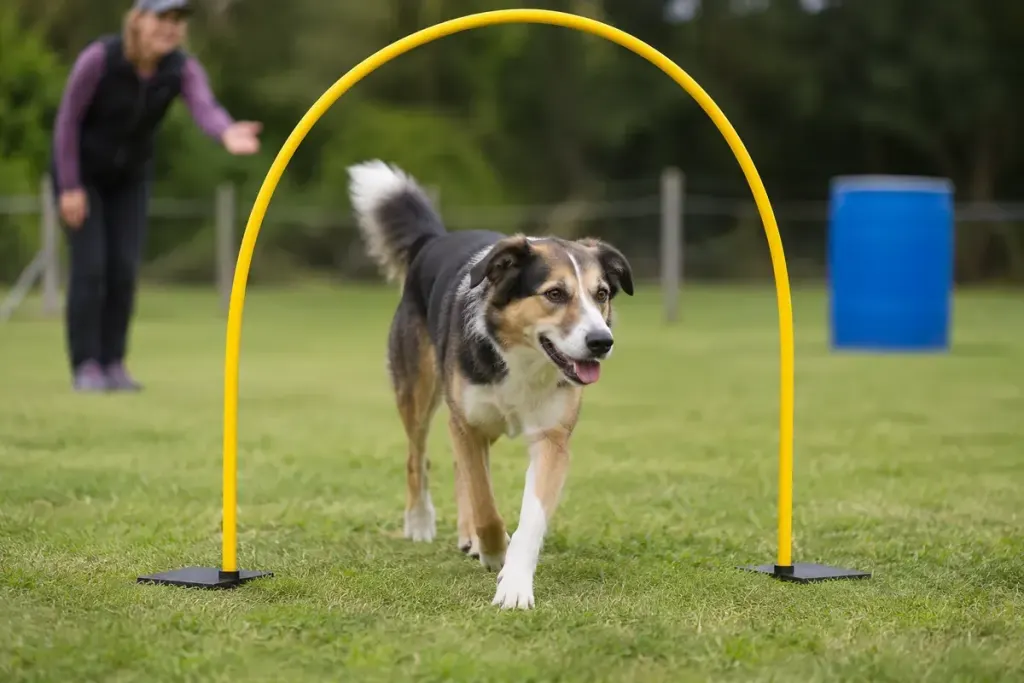
A dog can work through an obstacle course without jumping over a bar. In hoopers, the route passes through low hoops and tunnels and around objects such as barrels, with communication between handler and dog shaping the run.
Island Dog Training Club’s introduction describes a flowing ground-level course without the jumps, weaving poles and elevated contact equipment familiar from agility. The handler may guide the dog from a distance rather than run beside every obstacle.
Watch the communication, not only the speed
During a demonstration, notice when the handler gives a cue and where the dog looks next. The appealing part is often the shared understanding of a route, not the fastest possible sprint.
For a beginner visit, ask to observe a foundation class. A useful session should make space for learning the equipment and for dogs that need a slower introduction. An experienced dog’s full competition run is not a sensible starting assignment for a newcomer.
Questions before joining
- What age, foundation skills and health requirements does this club use?
- How are dogs separated while waiting their turn?
- Can the course and handling method accommodate your own mobility?
- What happens if a dog is worried by a tunnel or loses interest?
Club and competition requirements can differ, so use the organiser’s current rules rather than transferring an age limit from an unrelated webpage. Low impact also does not mean suitable for every dog. Discuss activity with a veterinarian if pain, injury or a health condition could affect participation.
A first-session goal can be deliberately modest: calmly entering the training area, exploring one suitable obstacle and leaving while the dog is still comfortable. Reward-based instruction and breaks matter more than completing a whole course immediately.
Afterwards, note which part your dog seemed willing to repeat and which required more reassurance. That gives the trainer something specific to work with at the next session. Hoopers is most useful as a shared learning activity when the dog’s comfort remains part of the route.