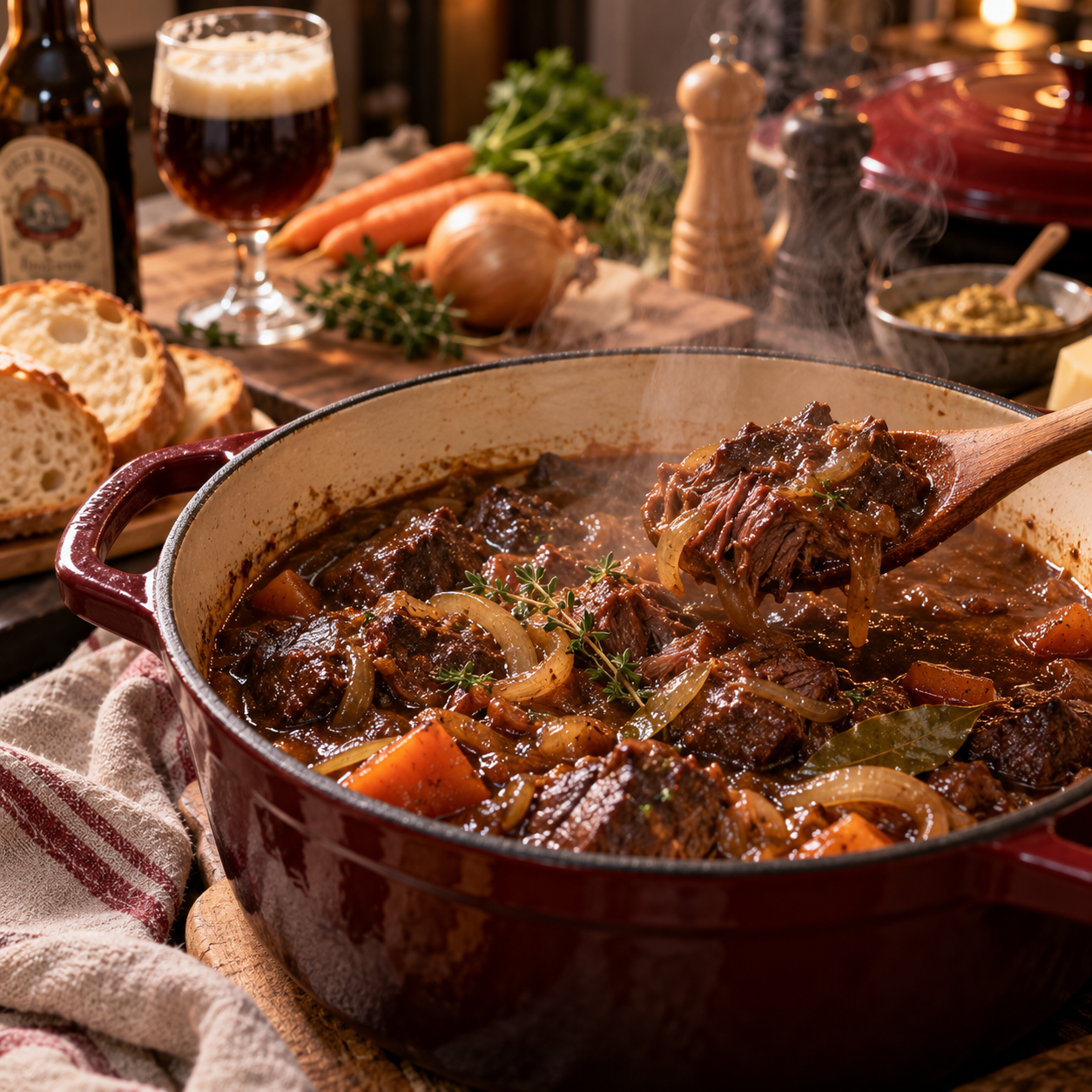
The Stew Has Been Simmering for Hours, So Why Does the Flavor Still Taste Flat?
The pot has been on the stove all afternoon.
The onions were browned.
The meat is tender.
The sauce has reduced.
The kitchen smells incredible.
Everything suggests the stew should taste deep, rich, and comforting.
Then you take the first spoonful.
It is not bad.
But somehow, it feels unfinished.
The sauce tastes heavy rather than complex. The meat is tender but strangely forgettable. Adding more salt helps slightly, yet the dish still lacks the depth you expected after several hours of cooking.
This is where an important lesson about building flavor in stew becomes clear: time alone does not create complexity.
A great stew develops flavor in layers. Browning, aromatics, seasoning, cooking liquid, acidity, bitterness, sweetness, reduction, texture, and the final adjustment all contribute something different.
Belgian cooking offers an especially useful way to understand this idea. Traditional dishes such as carbonnade flamande use slowly braised meat, onions, beer, mustard, herbs, and sometimes bread or other subtly sweet elements to create a balance that is much more interesting than simply “meat cooked for a long time.” National Geographic
Long Cooking Does Not Automatically Mean Deep Flavor
Slow cooking can do several useful things.
It can soften tougher cuts of meat.
It allows ingredients to exchange flavors.
Liquid gradually reduces.
Connective tissue changes.
A sauce can become thicker and more integrated.
But slow cooking cannot create flavors that were never developed in the first place.
If the meat entered the pot without sufficient browning, the aromatics were barely cooked, the liquid lacked character, and the seasoning was never adjusted, four hours of simmering will not magically solve everything.
Time develops what you give it.
That is why the work done before the lid goes on matters so much.
Browning the Meat Builds the First Layer
One of the easiest ways to create a richer stew is to brown the meat properly.
The goal is not simply changing raw meat from pink to grey.
You want actual browning on the surface.
That browned exterior creates roasted, savory flavors that later become part of the sauce.
But there is a common mistake.
The pan is filled with too much meat at once.
The temperature drops.
Moisture escapes.
Instead of browning, the meat begins steaming in its own liquid.
The result will still cook.
It simply loses an opportunity to build another layer of flavor.
Work in Batches When Necessary
If your pan cannot comfortably hold all the meat with some space around the pieces, divide it into batches.
Yes, it takes longer.
But stew is already a slow dish.
Saving five minutes at the beginning can remove an important source of flavor from something you will cook for several hours.
Heat the pan properly.
Add an appropriate amount of cooking fat.
Place the meat down.
Give the surface enough contact time to develop color.
Then turn it.
You are building the foundation before any liquid enters the pot.
Do Not Keep Moving the Meat
Another common problem is impatience.
Meat goes into the pan.
Immediately it gets stirred.
Then stirred again.
And again.
Browning requires contact.
If every piece is constantly moving, the surface spends less time directly against the hot pan.
Put it down.
Give it time.
Check one piece.
If the color is developing properly, continue.
Cooking sometimes improves when we stop touching things.
The Brown Bits in the Pot Are Valuable
After browning meat, the bottom of the pot may look dirty.
Brown residue sticks to the surface.
Do not automatically scrub it away.
Those browned deposits can become part of the sauce.
When liquid is added later, gently scrape the bottom of the pot.
The concentrated browned material dissolves back into the cooking liquid.
This process helps connect the flavor created during searing with the stew itself.
Of course, there is an important distinction.
Brown is useful.
Burned black residue is not.
Burnt Flavor Will Not Become Better After Three Hours
If the bottom of the pot has genuinely burned, continuing the recipe can spread bitterness throughout the entire dish.
Do not assume:
“It will disappear during cooking.”
It probably will not.
If necessary, transfer the usable ingredients to another pot and leave the burned material behind.
A little bitterness can create complexity in certain recipes.
Burnt food is different.
Learning to distinguish deep browning from burning is one of those kitchen skills that becomes easier through repetition.
Onions Need Enough Time Too
Many stew recipes begin with onions.
But “add onions” can produce very different results depending on how they are cooked.
Onions cooked briefly may contribute freshness and a sharper aromatic quality.
Onions cooked longer become softer, sweeter, and deeper.
Neither is universally correct.
For a rich braise, however, giving onions enough time to soften and develop some color can create a stronger foundation.
Carbonnade flamande is a good example of how beef, onions, beer, mustard, and slow cooking can work together rather than relying on meat alone. Belgium
Aromatics Should Support the Dish, Not Compete With It
Garlic.
Onion.
Shallot.
Celery.
Carrot.
Leek.
Herbs.
Spices.
All can contribute flavor.
That does not mean every stew needs all of them.
A common mistake in home cooking is believing complexity requires more ingredients.
Sometimes complexity comes from developing a smaller number of ingredients properly.
Belgian food is particularly interesting in this respect because many traditional dishes appear relatively straightforward while using careful combinations of mustard, herbs, beer, cream, vegetables, or sweet-and-sour elements to create depth. National Geographic
Seasoning Should Happen in Stages
Waiting until the very end to add all the salt can make seasoning more difficult.
Instead, think in layers.
Season the meat appropriately.
Build the aromatic base.
Taste the cooking liquid when practical.
Adjust again toward the end.
This does not mean aggressively salting every stage.
Remember that stew reduces.
As water evaporates, dissolved flavors—including salt—become more concentrated.
A liquid that tastes perfectly salty early in cooking can become too salty after significant reduction.
Season progressively.
Taste repeatedly.
Salt and Flavor Are Not the Same Thing
When food tastes flat, the automatic reaction is often:
“Add more salt.”
Sometimes that is exactly what it needs.
But not always.
A dish can contain enough salt and still feel one-dimensional.
What may be missing is acidity.
Or aromatic freshness.
Or bitterness.
Or sweetness.
Or roasted flavor.
Or simply enough reduction.
Understanding this distinction prevents the endless cycle of adding salt until the dish becomes salty without becoming more interesting.
Acidity Can Wake Up a Heavy Stew
Rich dishes often benefit from some acidity.
Why?
Because fat, gelatin, meat, and long-cooked ingredients can create a very round, heavy flavor profile.
A small acidic element can provide contrast.
Depending on the recipe, this could come from:
vinegar,
mustard,
wine,
certain beers,
tomato,
or another acidic ingredient.
The goal is not necessarily making the stew taste sour.
Often the correct amount is just enough to make everything else taste clearer.
Add Acid Carefully
Suppose a finished stew tastes dull.
Adding a large amount of vinegar directly into the pot is risky.
Instead, take a spoonful of stew into a small bowl.
Add one or two drops of acid.
Taste it.
Did the flavor become brighter?
If yes, you have useful information.
Then adjust the main pot gradually.
This small test is one of the safest ways to troubleshoot food.
Do not experiment with the entire dinner when you can experiment with one spoonful.
Belgian Cooking Understands Sweet-and-Sour Balance
One fascinating feature of Belgian culinary tradition is its use of contrasting flavors.
Historical Belgian cooking commonly combines elements such as mustard, vinegar, dried fruit, spices, and sweet components to create sweet-sour or sweet-salty balances rather than relying on one dominant taste. National Geographic
That principle remains useful even outside traditional Belgian recipes.
Richness becomes more interesting when something contrasts with it.
Sweetness can soften bitterness.
Acidity can cut richness.
Mustard can add sharpness.
Herbs can provide freshness.
The objective is balance, not maximum intensity.
Beer Is More Than Just Liquid
Belgian cuisine provides one of the clearest examples of using beer as an actual cooking ingredient.
In carbonnade flamande, beer contributes flavor to the braising liquid alongside onions and other seasonings. Darker beers can bring malt character, bitterness, sweetness, and roasted notes that water simply cannot provide. Belgium
But this leads to another important principle:
The cooking liquid matters.
If a recipe relies heavily on broth, beer, wine, tomatoes, or another liquid, its flavor will influence the finished sauce.
Do not treat the liquid as meaningless volume.
More Beer Does Not Automatically Mean More Belgian Flavor
If a recipe uses beer, choose it with intention.
Different beers can behave differently.
Some are sweeter.
Some more bitter.
Some lighter.
Some strongly aromatic.
A beer that tastes aggressively bitter before cooking may become even more noticeable after reduction.
The safest approach is following a tested recipe until you understand how the ingredient behaves.
Once you understand the balance, experimentation becomes easier.
Water Is Not Always the Enemy
There is also no need to believe every drop of liquid must be intensely flavored.
Water can be perfectly useful.
Sometimes stock is too salty.
Sometimes beer would overwhelm the dish.
Sometimes the other ingredients already provide enough flavor.
The important question is not:
“Is water allowed?”
It is:
“What does this dish need?”
Good cooking is not about making every ingredient powerful.
It is about making the final combination balanced.
Stock Should Taste Good Before It Enters the Pot
If using stock, taste it.
This sounds obvious, but it is frequently skipped.
Is it very salty?
Very weak?
Extremely concentrated?
Does it have an artificial flavor that may dominate after reduction?
Remember that the liquid will become part of the final sauce.
If you would not want its flavor concentrated, be careful about adding a large amount.
Reduction Concentrates More Than Flavor
Removing water through simmering can deepen a sauce.
But reduction concentrates everything.
Salt.
Bitterness.
Sweetness.
Acidity.
Spices.
If the balance is wrong before reduction, it can become even more wrong afterward.
This is why you should not aggressively season a sauce that still has a long way to reduce.
Allow the cooking process to develop.
Then make the final adjustment.
A Watery Stew May Simply Need More Reduction
The meat is tender.
The vegetables are cooked.
But the sauce looks thin.
Before reaching immediately for flour or starch, consider whether the liquid simply needs additional reduction.
Remove the lid if appropriate.
Simmer gently.
Allow excess water to evaporate.
Taste as it changes.
Sometimes concentration provides both the texture and flavor that were missing.
But Do Not Destroy Perfectly Cooked Meat While Reducing the Sauce
There is another side to this.
If the meat is already beautifully tender but the sauce still needs significant reduction, continuing to boil everything together may overcook the meat.
One option is removing the meat temporarily.
Reduce the sauce separately.
Then return the meat to warm through.
This gives you more control over two different problems:
meat doneness and sauce consistency.
They do not always finish at exactly the same time.
Thick and Flavorful Are Different Things
A thick sauce can still taste bland.
A thin sauce can be intensely flavorful.
Texture influences our experience of food, but thickness should not be confused with concentration.
Adding flour, cornstarch, or another thickener changes consistency.
It does not automatically create depth.
Before thickening, taste.
Does the sauce already have the flavor you want?
If not, fix the flavor first.
Bread Can Be More Than Something Served on the Side
Some traditional versions of Flemish stew use bread—often with mustard—as part of the braise, helping contribute body and flavor to the sauce. Wikipedia
This is a useful reminder that traditional cooking often solves multiple problems with one ingredient.
An ingredient may provide:
flavor,
texture,
thickening,
aroma,
and cultural identity
at the same time.
Understanding function makes recipes easier to adapt intelligently.
Mustard Can Provide More Than Heat
Mustard is another ingredient that appears frequently in Belgian-style savory cooking.
Its role is not simply making food spicy.
Depending on the mustard and quantity, it can contribute acidity, aroma, sharpness, and complexity.
In a long-cooked dish, some of its aggressive raw character may soften while still supporting the sauce.
Again, balance matters.
You should not necessarily taste the stew and immediately think:
“Mustard.”
The ingredient can work quietly in the background.
Sweetness Needs Restraint
Rich savory dishes sometimes benefit from a small amount of sweetness.
Caramelized onions already provide some.
Certain beers add more.
Traditional recipes may incorporate bread, brown sugar, syrup, dried fruit, or spiced bread depending on regional and household variation. Wikipedia
But sweetness should usually support the savory profile rather than turn the stew into dessert.
Add carefully.
Once a savory sauce becomes obviously too sweet, correcting it becomes more difficult.
Bitterness Can Be Useful
Home cooks often treat bitterness as something that must disappear completely.
But controlled bitterness can make food more complex.
Dark beer.
Certain greens.
Caramelization.
Mustard.
Some herbs.
These can contribute subtle bitter notes.
The key word is subtle.
Balanced bitterness can prevent a rich dish from feeling overly sweet or heavy.
Excessive bitterness dominates everything.
Fat Carries Flavor, but Too Much Can Mute It
A stew with some fat often tastes satisfying.
Fat contributes mouthfeel and carries aromatic compounds.
But a thick layer of grease floating on top can make the dish feel heavy and obscure more delicate flavors.
If necessary, skim excessive fat during or after cooking.
Another useful method is chilling the stew.
Once cold, excess fat can solidify at the surface and become easier to remove.
Then the stew can be reheated.
Some Stews Really Do Taste Better the Next Day
This familiar observation has practical reasons.
After cooling and resting, flavors can seem more integrated.
Fat can also be removed more easily.
And because you are no longer tasting the dish after standing over its aroma for several hours, your perception may feel fresher too.
This makes many braised dishes excellent candidates for cooking ahead.
But refrigeration still needs to be handled safely.
Cool and store cooked food appropriately rather than leaving a large warm pot sitting out indefinitely.
Your Nose Can Become Tired Before Dinner
There is a surprisingly simple reason a cook may think a dish lacks aroma.
You have smelled it for three hours.
Everyone entering the house says:
“That smells amazing.”
You taste it and think:
“Really?”
Constant exposure can reduce your perception of an aroma.
Step away from the kitchen for a few minutes.
Drink some water.
Return.
Taste again.
Sometimes the recipe has not changed.
Your senses have.
Fresh Herbs and Long-Cooked Herbs Do Different Jobs
Herbs added early have time to integrate into the cooking liquid.
Their flavor becomes part of the background.
Fresh herbs added near the end can provide a brighter aroma.
That means the same herb can perform different functions depending on timing.
For a long braise, sturdy herbs may be appropriate earlier.
Delicate herbs are often more noticeable when added later.
You do not necessarily have to choose one timing.
Some recipes benefit from both.
Spices Can Lose Their Identity in a Long Cook
Adding every spice at the beginning and simmering for several hours does not guarantee maximum flavor.
Some aromas change substantially with prolonged cooking.
Others become muted.
For recipes that use spices, consider what role each spice is supposed to play.
Deep background warmth?
Add earlier.
Fresh aromatic lift?
A later addition may sometimes be useful.
Again, follow the logic of the recipe rather than assuming longer always means stronger.
Vegetables Need Their Own Timing
Put every vegetable into the pot at the beginning and you may end up with one uniform texture.
That might be exactly what a particular stew requires.
Or it might not.
Root vegetables can usually tolerate longer cooking.
More delicate vegetables may become extremely soft.
If you want different textures in the finished dish, stagger the additions.
Flavor is not only taste and aroma.
Texture changes how we perceive the entire meal.
Waterzooi Shows a Completely Different Kind of Depth
Belgian comfort food is not limited to dark, heavy braises.
Waterzooi, associated with Ghent, demonstrates another approach.
Modern versions are commonly prepared with chicken, although fish versions are also traditional, and the dish combines vegetables with a broth enriched by cream and egg yolk. Brussels Tourism Guide
Its depth is gentler.
There is no requirement for every comforting dish to be dark, intensely roasted, or aggressively reduced.
Richness can also come from delicacy, texture, and careful seasoning.
Do Not Boil Every Creamy Sauce Aggressively
Once dairy or egg-based finishing elements enter a sauce, temperature control becomes especially important.
A violently boiling pot is not automatically better because it looks active.
Gentle heat gives the cook more control.
This is another broader lesson from building flavor in stew:
Different stages require different heat.
High heat may be useful when browning.
Low, steady heat may be better during braising.
Gentle finishing may be appropriate later.
One burner setting does not need to remain unchanged for the entire recipe.
Stoemp Shows Why Texture Matters
Stoemp combines mashed potatoes with vegetables and can be served with various savory accompaniments. It is deliberately more rustic than a perfectly smooth restaurant-style purée. All About City
That texture is part of the experience.
This matters beyond Belgian food.
Home cooks sometimes assume smoother, finer, and more refined automatically mean better.
Not always.
Rustic texture can provide contrast.
Chunks can make a dish feel substantial.
Crispy elements can make something creamy more interesting.
Good cooking controls texture rather than automatically eliminating it.
A Rich Main Dish Often Needs a Simple Companion
If the stew is already intense, the side dish does not always need to compete.
Potatoes.
Bread.
A simple vegetable.
Fries.
Something fresh.
A relatively neutral accompaniment can give a strong sauce somewhere to go.
This is why traditional combinations often make sense beyond habit.
The components balance each other.
Belgian cuisine frequently pairs deeply flavored stews with potatoes or fries, allowing the starch to carry the sauce rather than introducing another equally complicated flavor profile. National Geographic
Taste the Sauce Separately From the Meat
When troubleshooting a stew, taste its components.
Try the sauce alone.
Then the meat.
Then a vegetable.
This can reveal where the problem actually is.
Maybe the sauce is excellent but the meat was underseasoned.
Maybe the meat is flavorful but the liquid is weak.
Maybe everything tastes good individually but the sauce is too fatty.
Breaking the dish into parts makes diagnosis easier.
Ask What Is Missing, Not Just Whether It Is Good
Instead of tasting and thinking:
“I don’t like it.”
Ask more specific questions.
Does it need salt?
Acidity?
Sweetness?
Aroma?
More reduction?
More body?
Freshness?
Is it too bitter?
Too fatty?
Too salty?
Too sweet?
Specific questions lead to specific corrections.
Vague dissatisfaction often leads to random additions.
Fix One Problem at a Time
Imagine the stew tastes flat.
You add salt, vinegar, sugar, mustard, pepper, and herbs all at once.
Now it tastes different.
But you have no idea which adjustment helped.
Instead, change one variable.
Taste.
Then decide what happens next.
This is one of the easiest ways to become a better cook.
Treat the pot like an experiment.
Observe before changing it.
Use a Small Bowl for Risky Adjustments
Unsure whether mustard will help?
Take a spoonful out.
Unsure about vinegar?
Test it separately.
Wondering whether a little sweetness would balance the bitterness?
Experiment with a small portion.
If it tastes terrible, you lost one spoonful.
If it works, you now have a direction for the entire pot.
This habit dramatically reduces the fear of adjusting recipes.
Do Not Keep Adding Ingredients Just Because the Flavor Is Complex
Complexity does not come from ingredient count.
A stew containing twenty seasonings can taste confused.
A dish containing six carefully developed ingredients can taste deep.
Carbonnade is a good illustration: its identity comes from the relationship among braised meat, onions, beer, mustard, aromatics, and slow cooking—not from an enormous spice cabinet being emptied into the pot. Belgium
Restraint allows individual flavors to remain understandable.
The Final Five Minutes Matter
After hours of cooking, it is tempting to think the work is finished.
The meat is tender.
Dinner is ready.
Not quite.
Taste the sauce one final time.
Check salt.
Check acidity.
Check consistency.
Check sweetness.
Remove excessive fat if necessary.
Add any fresh finishing element the recipe requires.
The final adjustment can be the difference between a stew that tastes merely cooked and one that tastes complete.
Garnish Should Have a Purpose
A garnish is not automatically useful because it makes the bowl prettier.
Fresh herbs can provide aroma.
Something crisp can add texture.
A small acidic component can balance richness.
Bread can carry sauce.
A creamy element can soften spice.
Choose garnish because it improves the eating experience.
Not because an empty corner of the bowl makes you uncomfortable.
Traditional Food Is a Technique Library
Belgian dishes are valuable not only because they are traditional.
They demonstrate principles that can be used elsewhere.
Carbonnade teaches how beer, browning, slow cooking, mustard, and contrasting flavors can build a dark braise.
Waterzooi shows how broth, vegetables, cream, and egg can produce a gentler form of comfort food.
Stoemp demonstrates how humble ingredients and rustic texture can become satisfying when handled thoughtfully. Brussels Tourism Guide
Learning traditional recipes is therefore not just about reproducing them.
It teaches us how cooks solved flavor problems long before modern kitchen gadgets existed.
Do Not Confuse Authenticity With One Universal Recipe
Traditional food changes between regions, families, restaurants, and generations.
Carbonnade alone has numerous variations in beer choice, sweetening ingredients, seasoning, and thickening methods. Wikipedia
That does not mean technique is irrelevant.
It means food culture is living.
Learn the traditional structure first.
Understand what each ingredient contributes.
Then adaptations become informed choices rather than random substitutions.
Write Down What Worked
If you make an excellent stew, record what you did.
Which cut of meat?
How much liquid?
Which cooking vessel?
How long did you brown the onions?
How long did it simmer?
Lid on or off?
What adjustment did you make at the end?
Home cooking often relies on memory.
Memory is less reliable than we think.
A few notes can turn one lucky dinner into a repeatable recipe.
The Goal Is Not Maximum Flavor
This sounds strange, but it matters.
More salt.
More acidity.
More caramelization.
More spices.
More beer.
More herbs.
More reduction.
If every element is pushed to maximum intensity, the dish can become exhausting.
Great food is not always loud.
The goal is balance.
You should be able to take another bite without one element constantly demanding attention.
Sometimes the ingredient a stew needs most is not another ingredient.
It is restraint.
Conclusion
A stew can simmer for hours and still taste flat because building flavor in stew depends on much more than cooking time.
Deep flavor begins before the liquid even enters the pot.
Brown the meat properly.
Give aromatics enough attention.
Use cooking liquid intentionally.
Season in stages.
Understand how reduction concentrates everything.
Balance richness with acidity, bitterness, sweetness, and freshness when the recipe calls for them.
Then taste again before serving.
Belgian dishes such as carbonnade flamande are useful reminders that humble ingredients can produce remarkable complexity when each one has a clear purpose. National Geographic
The secret is not simply leaving a pot on the stove longer.
It is knowing what should happen during those hours.
Because the best slow-cooked food is not merely tender.
Every spoonful tastes as though each layer had enough time—and enough attention—to become part of the whole.
