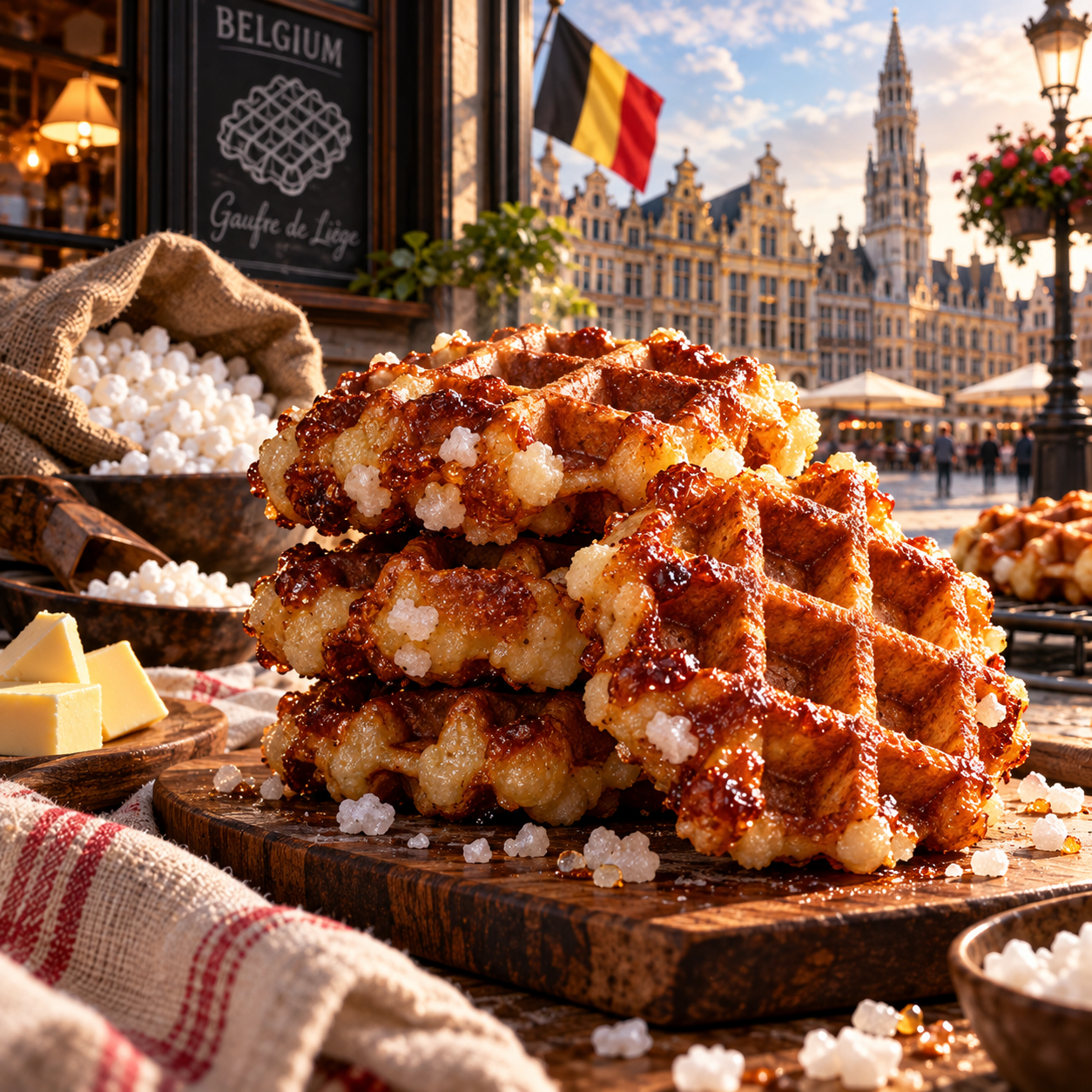
Liege Waffle Recipe: How to Get the Caramelized Pearl Sugar Crust
A Liège waffle is not made from batter. It is a yeasted, butter-rich dough, close to brioche, with chunks of Belgian pearl sugar kneaded in after the first rise. On a hot iron those chunks melt at the surface and turn into the glassy, amber crust the waffle is known for. The inside stays soft and chewy.
The crust depends on three things: real Belgian pearl sugar, adding it late so it doesn’t dissolve into the dough, and an iron hot enough to caramelize the sugar without burning it. The rest is basic bread-making.
The recipe below is scaled up from the French travel guide Routard’s recipe for gaufres liégeoises, and its proportions sit inside the range used by other Belgian and French home recipes.
What makes a Liège waffle different
Most waffles in the US, and the Brussels waffle too, come from a pourable batter. The Liège waffle comes from Wallonia, the French-speaking south of Belgium. It is smaller and more rounded than the rectangular Brussels waffle, and it is denser. Belgians usually eat it plain, often as street food, because the sugar crust already does the work toppings would do on a Brussels waffle. The Wikipedia entry on the Liège waffle also notes that it is good warm or at room temperature, which a batter waffle is not.
A popular story credits the cook of an 18th-century Prince-Bishop of Liège with inventing it. Treat that as legend. What matters for your kitchen is that the waffle only works with pearl sugar.
About pearl sugar
Pearl sugar is compressed sugar sold as hard, irregular nuggets. Get the Belgian kind, which comes in large, chunky pieces. Swedish pearl sugar looks similar on the shelf, but the grains are small and meant for sprinkling on buns. In a Liège dough they melt too fast, so you lose the crunchy pockets.
Don’t substitute crushed sugar cubes or granulated sugar. Sugar cubes break into powder and granulated sugar dissolves into the dough, so you get a sweet, sticky waffle that browns too fast and has no crust.
Ingredients (about 20 small waffles)
These quantities are Routard’s recipe doubled, so the dough is worth the rising time.
| Ingredient | Amount |
|---|---|
| All-purpose flour | 500 g (about 4 cups) |
| Milk, lukewarm | 300 ml (about 1¼ cups) |
| Active dry yeast | 2 teaspoons |
| Eggs | 2 large |
| Butter, very soft | 200 g (about 1¾ sticks) |
| Salt | 2 pinches |
| Belgian pearl sugar | 240 g |
| Neutral oil, for the iron | a little |
Optional additions that show up in many Belgian home recipes: 30–50 g of light brown sugar (cassonade) in the dough for more caramel flavor, and a teaspoon of vanilla extract.
Published Belgian and French home recipes use anywhere from about 150 g to 270 g of pearl sugar per 500 g of flour. More sugar means more crunch, but it also means more caramel to burn and to clean off the iron.
Step-by-step method
1. Activate the yeast
Warm the milk until it feels just warm on your wrist, not hot. Stir in the yeast and leave it for 5–10 minutes. You should see a little foam on top. If nothing happens, the yeast is probably dead. Start again with fresh yeast before you waste the butter.
2. Mix and knead the dough
Put the flour and salt in a large bowl (or the bowl of a stand mixer) and make a well in the middle. Add the eggs and the yeasted milk, plus the brown sugar and vanilla if you’re using them. Knead until the dough is smooth and elastic. This takes about 8–10 minutes by hand, or about 5 minutes with a mixer on medium speed and a dough hook.
3. Work in the butter
Add the soft butter a piece at a time and knead after each addition until it disappears. At first the dough will look greasy and fall apart. Keep going and it will come back together, glossy and soft. This step is what gives you the brioche texture, so don’t cut it short.
4. First rise
Cover the bowl with a towel and leave it somewhere warm. Routard calls for 30 minutes. In a cool kitchen it can take longer. You’re looking for dough that has clearly puffed up, ideally close to double its size.
To get deeper flavor, you can cover the bowl and refrigerate the dough overnight at this point. Several published recipes do this. Cold dough is also firmer, which makes the next step easier.
5. Add the pearl sugar
Only now do you add the pearl sugar. Knead or fold it in just until it is spread through the dough. If you add the sugar at the start, it spends the whole rise dissolving and you lose the crust you are making this for.
Let the dough rest for another 15 minutes. If you have a lot of dough or a small iron, keep the part you aren’t cooking in the fridge. That stops the sugar from melting into the dough while you work.
6. Portion
Divide the dough into balls. Routard uses small portions of about a tablespoon of dough. Many US recipes use 85–115 g (3–4 oz) balls for a full-size deep-pocket iron. Pick a size that fills about two-thirds of one grid on your iron. The dough spreads as it cooks.
7. Cook
Preheat the waffle iron fully and brush the plates lightly with oil. Put a dough ball in the center of each grid, close the lid, and cook until the outside is deep golden with amber spots of caramel. In Routard’s recipe this takes about 3 minutes. It depends on your iron and the size of your portions, so go by color, not the clock.
Lift the waffles out with a fork or tongs, never your fingers. The melted sugar is far hotter than the waffle itself. Let them cool on a wire rack for a minute or two, so the caramel sets crisp instead of turning sticky against a plate.
Getting the crust right: troubleshooting
| Problem | Likely cause | Fix |
|---|---|---|
| No crunchy pockets | Swedish or granulated sugar, or sugar added too early | Use Belgian pearl sugar and add it after the first rise |
| Black, bitter spots | Iron too hot | Lower the setting one notch, or open the lid a little earlier |
| Pale and doughy inside | Iron too cool, or portions too big | Preheat fully, use smaller balls |
| Dense, bready waffle | Underproofed dough | Give the first rise more time in a warmer spot |
| Sugar weeping out of the dough | Dough sat too long at room temperature after the sugar went in | Keep the dough you aren’t cooking chilled |
Cleaning the iron
Caramelized sugar is the price you pay for the crust. Some of it will stick to the plates. Don’t scrape it off cold, because it sets rock-hard. After the last batch, unplug the iron and lay a damp, folded towel between the warm plates. Close the lid and leave it for a few minutes. The steam softens the sugar so you can wipe it away. Check your iron’s manual before using water or any tool on a nonstick surface.
Storing and reheating
Liège waffles keep better than batter waffles because the dough is so rich. Store cooled waffles in an airtight container at room temperature for a day or two, or freeze them in a single layer and then bag them. To bring the crust back, reheat in a toaster or a moderate oven for a few minutes, until the outside is crisp again. A microwave will make the sugar soft and chewy.
Serving
Eat them the way Liège does first: plain, warm, maybe with a coffee. Then experiment. Melted dark chocolate, whipped cream, or fresh strawberries all work. Speculoos spread is a popular Belgian pairing. Because the waffle is already sweet, a small amount of topping goes a long way.