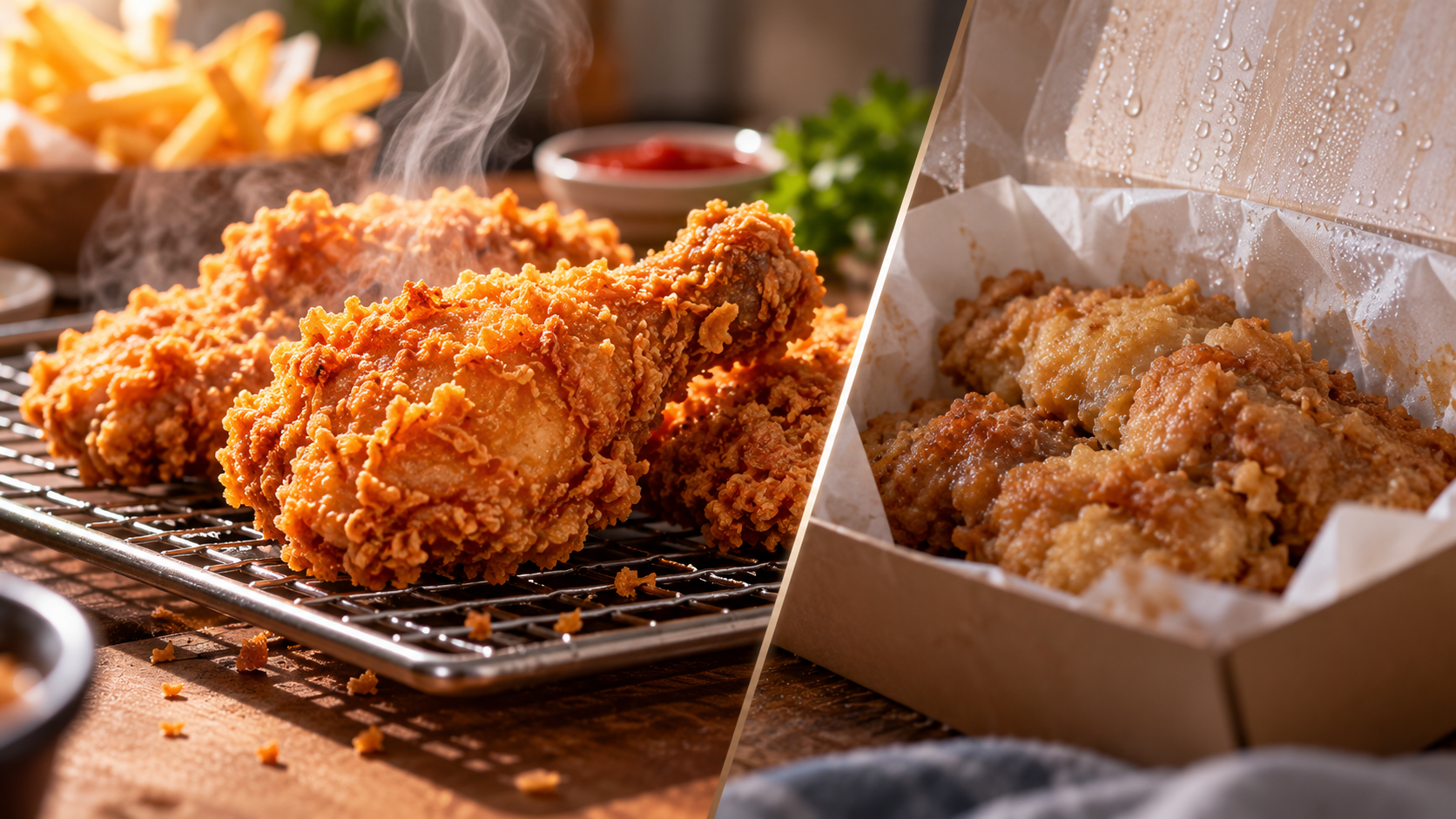
Why Does Crispy Food Turn Soggy? The Science of Keeping Food Crunchy
There is a frustrating moment almost every home cook has experienced. Fries leave the oil golden and crisp, fried chicken makes a satisfying crackle when it reaches the plate, or roasted potatoes develop a beautifully crunchy exterior. Then, only a short time later, that texture begins to disappear.
The fries become limp. The coating on the chicken softens. Tempura that once shattered with every bite starts bending instead. Even foods that were cooked correctly can lose their crunch surprisingly fast.
It is tempting to blame temperature. After all, crispy food often tastes best while it is hot.
However, cooling is only part of what happens.
The bigger issue is moisture.
A crisp surface exists because cooking removes enough water from the exterior to create a dry, rigid structure. Yet the inside of the food usually remains moist. Once cooking ends, that moisture does not simply stay where it is. Steam continues moving outward, humidity builds around the food, and the dry crust begins absorbing water again.
That is the basic reason crispy food turns soggy.
Still, the process becomes much more interesting when we look at what happens during frying, cooling, serving, storage, and reheating. Understanding those stages can help you protect crunch without relying on excessive oil or simply cooking food longer.
What Actually Makes Food Crispy?
Crispiness is largely about structure and moisture.
Think about the difference between a raw potato and a French fry. The raw potato contains plenty of water and has a dense, firm texture. During frying, heat rapidly changes the outer layers.
Water near the surface begins evaporating. Meanwhile, starches change structure, the exterior dries, and browning reactions develop flavor and color.
Eventually, the surface becomes rigid enough to fracture when bitten.
That fracture produces the crunch we associate with crispy food.
A similar principle applies to breaded chicken, battered fish, tempura, roasted vegetables, toasted bread, crackers, and many other foods. Their ingredients differ, but successful crispness generally requires a surface that contains much less available moisture than before cooking.
The important detail is that the entire food does not become dry.
Only the exterior needs to become dry enough to create the desired texture.
Inside, we usually want exactly the opposite.
Good fried chicken should remain juicy. A French fry should have a fluffy interior. Tempura vegetables should retain tenderness beneath the batter.
That contrast makes crispy food enjoyable.
Unfortunately, it also creates the conditions that eventually destroy the crunch.
Moisture Begins Moving as Soon as Cooking Stops
Imagine a freshly fried piece of chicken.
The coating is extremely hot and relatively dry. Beneath it sits hot, moist meat.
After the chicken leaves the fryer, heat remains trapped inside. Water within the meat continues evaporating and producing vapor.
That vapor naturally moves outward.
Eventually, some of it reaches the crust.
If steam can escape freely into the surrounding air, the exterior may stay crisp for a reasonable period. However, if moisture becomes trapped around the chicken, humidity rises near the surface.
The crust then begins absorbing water.
As it absorbs moisture, its rigid structure becomes softer and more flexible.
Crunch gradually disappears.
This explains something that initially seems strange: food can become soggy without anyone adding water to it.
The water was already inside the food.
It simply moved.
Steam Is the Hidden Enemy After Frying
During cooking, steam can be useful.
Rapid evaporation helps remove water from the surface and contributes to the formation of a crisp crust.
After cooking, however, the same steam can work against you.
Place freshly fried food in a deep bowl and watch what happens.
The pieces at the bottom become surrounded by hot food. Steam rises from every surface, but airflow around the lower pieces remains limited.
As a result, humidity increases.
The pile effectively creates its own small, warm, moist environment.
Now compare that with food spread in a single layer on an elevated rack.
Steam has multiple directions in which it can escape. Air reaches the top, sides, and underside.
The difference may look minor, yet it can have a major effect on texture.
This is why handling food after frying matters almost as much as the frying itself.
Why Stacking Crispy Food Makes It Soft Faster
A large pile of fries looks generous and appealing.
From a texture perspective, however, it creates problems.
Every contact point between two fries reduces exposed surface area. Moisture that would otherwise escape becomes trapped between them.
The same thing happens with fried chicken pieces stacked in a bowl.
Food at the bottom receives steam from everything above it while having relatively little access to moving air.
Furthermore, its own moisture has difficulty escaping.
Consequently, the bottom of the pile often becomes soft first.
Whenever maintaining crunch matters, spreading food out usually works better than piling it high.
You do not necessarily need enormous amounts of space. Even reducing the number of pieces touching one another can help.
A Flat Plate Can Trap Moisture Underneath
Suppose you remove a perfectly crisp cutlet from the pan and place it directly on a ceramic plate.
The top remains exposed to air.
The bottom does not.
Steam escaping downward meets the plate and becomes trapped between the hot crust and the solid surface. Meanwhile, small amounts of oil and moisture may collect underneath.
After several minutes, the upper surface can remain reasonably crisp while the underside becomes noticeably softer.
This is one reason a wire rack works so well.
A rack elevates the food.
Air can move underneath, allowing steam to escape rather than accumulating against the crust.
For foods where the bottom surface matters—fried chicken, cutlets, tempura, waffles, roasted potatoes, and similar items—the difference can be substantial.
Paper Towels Solve One Problem but Can Create Another
Many people transfer fried food directly onto paper towels.
The logic makes sense.
Paper absorbs excess oil from the surface, which can prevent food from feeling greasy.
For a short draining period, this can work well.
However, paper also absorbs moisture.
As steam leaves the hot food, the towel underneath can become damp. If the food remains there, its bottom crust sits directly against that moisture.
Therefore, paper towels involve a trade-off.
They are useful for removing excess surface oil, but they are not always the ideal place to hold crispy food for an extended period.
A practical approach is to drain briefly when necessary and then move the food to a rack.
That gives excess oil somewhere to go while restoring airflow underneath.
Why Covering Crispy Food Usually Makes the Problem Worse
Imagine you want to keep fried chicken warm while waiting for the rest of dinner.
Covering it seems logical.
Unfortunately, a lid, tightly wrapped foil, or another sealed cover traps steam.
Hot food continues releasing moisture. Instead of escaping into the room, that moisture remains inside the enclosed space.
Humidity rises rapidly.
Some vapor may even condense on the cooler lid before falling or migrating back toward the food.
The result is excellent moisture retention—which is exactly what you do not want when preserving a dry crust.
This creates an important trade-off.
Methods that keep food moist and hot are not necessarily methods that keep it crisp.
For many fried foods, a slightly cooler but dry crust can be more enjoyable than a very hot but soggy one.
Why Takeout Fries Become Soggy So Quickly
Takeout food demonstrates this problem perfectly.
Fries leave the fryer crisp.
Almost immediately, they go into a container.
Then the container goes into a bag.
During the journey, the potatoes continue releasing steam.
If the packaging has limited ventilation, that moisture cannot escape efficiently. Instead, it increases the humidity surrounding the fries.
By the time the food reaches its destination, the fries may still be warm, but their surface has absorbed moisture.
This creates a difficult packaging problem for restaurants.
A tightly closed package helps retain heat.
Yet that same package can trap humidity.
More ventilation allows steam to escape, although the food may cool faster.
Therefore, keeping takeout food both extremely hot and extremely crisp is harder than it appears.
Why Fried Chicken Handles Waiting Better Than Thin Fries
Not every crispy food becomes soggy at the same speed.
Structure matters.
A thin French fry has a large amount of surface area relative to its size. Moisture can move through it quickly, and the crisp exterior is relatively delicate.
A thick piece of fried chicken has a more substantial crust.
Depending on the breading and cooking method, that crust may remain structurally crisp even after absorbing some moisture.
Similarly, a thick breadcrumb coating behaves differently from a delicate tempura batter.
This explains why some fried foods can sit for 20 minutes and remain enjoyable while others lose their ideal texture within minutes.
The thickness and composition of the crust influence how quickly moisture changes it.
Different Coatings Create Different Types of Crunch
“Crispy” is not a single texture.
Breadcrumbs can create a coarse, crunchy exterior.
A flour coating may produce irregular flakes and ridges.
Starch-heavy batters can become thin and brittle.
Tempura aims for a particularly light, delicate structure.
Each coating contains different proportions of starch, protein, fat, and water.
Therefore, each reacts differently during frying and cooling.
For example, a very delicate crust may provide spectacular crunch immediately after cooking but lose it relatively quickly.
A thicker coating may not feel as light, yet it can remain crisp longer.
This is why changing a coating can dramatically alter not only how food tastes when fresh but also how well it survives waiting, delivery, or reheating.
Frying Temperature Affects the Crust From the Beginning
You cannot preserve a crust that never developed properly.
Oil temperature plays an important role.
When food enters sufficiently hot oil, surface moisture rapidly turns to vapor. The exterior begins setting while browning develops.
If the oil is too cool, the process becomes slower.
The coating may spend longer absorbing oil while moisture leaves less efficiently. Instead of developing a light, crisp structure, the exterior can become heavy.
However, hotter is not always better.
Excessive heat can darken the surface before the interior cooks properly.
The goal is controlled heat, not maximum heat.
Different foods require different conditions, which is why recipes often specify a temperature range rather than simply telling you to make the oil “very hot.”
Overcrowding the Pan Can Reduce Crispness
Even if the oil begins at the correct temperature, adding too much food at once can change it dramatically.
Cold or room-temperature ingredients absorb heat when they enter the oil.
Add a few pieces and the oil recovers quickly.
Add too many and the temperature may fall significantly.
Now the food cooks under different conditions than intended.
Moisture leaves more slowly, browning takes longer, and the coating may become heavier.
Crowding also makes pieces touch one another, which interferes with even exposure to hot oil.
Therefore, cooking in smaller batches often produces better results.
It requires more patience, but each batch experiences more stable conditions.
Double Frying Can Create a More Durable Exterior
Some foods benefit from being fried twice.
French fries are a classic example.
The first cooking stage primarily cooks the interior and begins changing the structure of the potato. After a resting period, a second fry at a different temperature can drive additional moisture from the surface and strengthen the exterior.
The result is often a more pronounced contrast between fluffy interior and crisp shell.
This does not mean every fried food should be cooked twice.
However, the technique demonstrates an important principle.
A crust becomes more resilient when its surface structure develops properly and contains sufficiently little moisture.
Sauce Changes Everything
Steam slowly introduces moisture to a crust.
Sauce can do it immediately.
Pour a liquid sauce over crispy food and it begins contacting the dry surface directly.
The crust absorbs some of that liquid.
Depending on its structure, the texture may begin changing within seconds.
This is why dishes involving both crispy food and sauce often have such a narrow ideal serving window.
The first few bites may offer dramatic crunch.
Later, the coating becomes softer as it absorbs more liquid.
Neither texture is necessarily wrong.
However, if crunch is the priority, timing becomes critical.
Serving Sauce Separately Gives You More Control
One simple way to preserve texture is to serve wet components separately.
Instead of coating every piece of fried food in advance, place sauce on the side.
Now each bite can be dipped immediately before eating.
The crust remains dry for much longer.
This approach works particularly well for foods where crunch is a central part of the experience.
Alternatively, drizzle rather than completely coat the food.
A smaller contact area allows some parts of the crust to remain dry.
Texture becomes another reason to think about how sauce is served, not just what sauce you use.
Even Steam From Other Food Can Soften the Crust
Sometimes the crispy item is not the source of the problem.
Imagine placing fried chicken next to steaming vegetables or hot rice inside a closed container.
Those foods release moisture too.
The chicken may have been perfectly crisp when packed, but now it shares a humid environment with other hot components.
Likewise, putting crunchy toppings onto steaming food too early can soften them before the dish reaches the table.
This is why restaurants sometimes package crispy garnishes separately.
Keeping dry and moist components apart until the last moment preserves contrast.
Why Crispy Toppings Should Often Be Added Last
Croutons, fried onions, tortilla strips, toasted breadcrumbs, crispy shallots, and similar toppings all depend on low moisture for their texture.
Place them on a wet salad too early and dressing begins soaking into them.
Add them to soup long before serving and they absorb broth.
Scatter them over a steaming casserole, then cover it, and condensation can soften them.
The solution is straightforward.
Add delicate crispy elements near serving time.
That way, the contrast survives long enough for diners to experience it.
Salt and Seasoning Have Their Own Timing
Freshly fried food often gets seasoned immediately.
There is a good reason for this: seasonings adhere well while the surface still carries a small amount of hot oil.
However, salt interacts with water and can influence moisture at the surface.
For food eaten immediately, this is rarely a major concern.
If crispy food needs to sit for a long period, though, timing becomes more relevant.
The ideal strategy depends on the food.
The broader lesson is that seasoning is not completely separate from texture. Ingredients placed on the surface can affect what happens there over time.
Humid Weather Can Make Crunch Harder to Maintain
The surrounding air matters too.
A dry crispy surface naturally interacts with atmospheric moisture.
When humidity is high, the difference between the dry food and moist air becomes important.
Over time, dry foods can absorb moisture from their surroundings.
You can observe this clearly with crackers or chips left uncovered.
On a dry day, they may stay crisp for quite a while.
In a humid environment, they can become noticeably softer.
Fresh fried food faces an additional challenge because moisture is also escaping from its interior.
Therefore, the exact amount of time food remains crisp can vary even when you follow the same recipe.
Why the Microwave Struggles With Crispy Leftovers
The microwave is extremely convenient for reheating food.
For crispness, however, it often disappoints.
Microwave energy heats water inside food efficiently.
That generates steam.
The food becomes hot quickly, but the environment does not necessarily dry the exterior enough to rebuild a brittle crust.
Consequently, yesterday’s fried chicken may become hot yet soft.
Pizza crust can become chewy.
Fries may feel limp rather than crunchy.
The microwave successfully solves the temperature problem while leaving the moisture problem largely unresolved.
That distinction explains why “hot” and “crispy” should not be treated as synonyms.
Why an Oven Can Restore Crunch Better
An oven reheats food using dry surrounding heat.
As the surface warms, moisture can evaporate.
Given enough airflow and appropriate temperature, the exterior begins drying again.
This can restore some of the rigidity that was lost during storage.
Using a rack may improve the process further because the underside receives more airflow.
However, reheating still requires balance.
Leave the food too long and the interior can dry out.
Remove it too early and the crust may remain soft.
The ideal time depends on the thickness and composition of the food.
Why Air Fryers Work Well for Crispy Leftovers
An air fryer applies a similar principle but uses rapidly circulating hot air in a relatively small chamber.
The moving air helps transfer heat while carrying moisture away from the surface.
That combination makes it useful for reheating many fried or roasted foods.
Leftover fries, breaded chicken, pizza, and roasted potatoes can often regain part of their original texture.
They may not become identical to freshly cooked food.
Nevertheless, the result can be substantially crisper than microwave reheating.
The reason is not mysterious.
Once again, the process comes back to surface moisture and airflow.
A Pan Can Also Revive Certain Foods
Not every leftover needs an appliance designed specifically for reheating.
Some foods respond well to a skillet.
Pizza is a good example.
Direct heat can recrisp the bottom crust while the toppings warm more gradually.
Other foods with one important crispy surface can benefit from the same idea.
The limitation is obvious: a pan mainly heats the side touching it.
Foods that need crispness across many irregular surfaces may respond better to circulating hot air.
Still, understanding which part of the food needs to become dry and crisp can help you choose the right method.
Refrigeration Changes the Crust Even When Food Is Stored Correctly
Once crispy food becomes leftovers, some texture loss is difficult to avoid.
Moisture continues redistributing during cooling and storage.
The crust absorbs water from the interior.
Condensation may develop.
Fats change consistency as temperatures fall.
Starches also undergo changes during storage.
By the next day, the food can feel completely different despite having been excellent when fresh.
This does not necessarily mean it was stored incorrectly.
Freshly fried texture is inherently temporary.
Good storage can reduce certain problems, but reheating often matters more than trying to preserve the original crunch unchanged.
Trapping Hot Food Immediately Can Increase Condensation
Suppose very hot fried food goes directly into a sealed storage container.
Steam continues escaping from the food.
Because the container is closed, the moisture remains inside.
As everything cools, some vapor condenses.
Now the crust spends its storage period in a much more humid environment.
Allowing excess steam to dissipate before sealing can reduce this issue, while perishable foods should still be handled and refrigerated appropriately rather than left at room temperature for extended periods.
The goal is not prolonged cooling.
It is simply avoiding unnecessary steam entrapment.
Freezing Can Sometimes Preserve Food Better Than Expected
Freezing introduces another interesting situation.
Certain breaded or fried foods freeze quite well, particularly when reheated with dry heat afterward.
The key is minimizing excess surface moisture and protecting the food from freezer exposure.
When reheated directly or appropriately from frozen, the exterior can sometimes become crisp again because hot air removes surface moisture while the interior warms.
Results vary considerably by food.
Still, this demonstrates that texture loss during storage does not always have to be permanent.
The reheating method can determine whether the crust stays soft or regains some of its structure.
Holding Crispy Food Warm Requires a Different Strategy
Restaurants and home cooks sometimes need to prepare several batches before serving.
Keeping the first batch warm without making it soggy can be difficult.
A low oven can help in some situations.
Rather than sealing the food in a covered dish, placing it on a rack in a warm, dry environment allows excess steam to escape while reducing heat loss.
Again, the exact temperature depends on the food.
The principle matters more than one universal setting.
Warmth should not come at the cost of trapping moisture.
Do Not Confuse Greasiness With Moisture
Soggy fried food is often described as “oily,” but oil and water create different texture problems.
A poorly fried coating may indeed absorb too much oil.
However, perfectly fried food can also become soft later because of steam.
That means adding more draining time will not necessarily solve every sogginess problem.
If the crust was crisp when it left the fryer but softened ten minutes later, post-cooking moisture is a strong suspect.
If it was heavy and soft from the beginning, frying conditions may be more important.
Knowing when the texture changed helps identify the cause.
The Interior and Exterior Are Competing With Each Other
Great crispy food often depends on an interesting contradiction.
We want the outside dry.
We want the inside moist.
For a brief period after cooking, both conditions coexist.
That is the ideal moment.
Over time, however, moisture naturally tries to redistribute.
The very thing that makes the interior juicy eventually threatens the crust.
This is why perfect crunch cannot always be preserved indefinitely.
Cooking creates a temporary imbalance between a dry exterior and moist interior.
Eventually, the system begins moving toward equilibrium.
Understanding that makes the limited lifespan of crispness much easier to appreciate.
Texture Is Also About Contrast
Why do we care so much when a crust becomes slightly softer?
Because eating is not only about flavor.
Texture creates contrast.
Crispy chicken works because a brittle exterior surrounds tender meat.
French fries combine a firm shell with a soft potato center.
A crunchy topping becomes interesting because it sits against something creamy or moist.
When the crust absorbs water, that contrast becomes weaker.
The food may contain exactly the same salt, spices, fat, and aromas.
Yet it feels less satisfying because one of its major sensory dimensions has changed.
That is why two pieces of food with nearly identical flavor can produce very different eating experiences.
Sound Contributes to the Perception of Freshness
Crunch is not experienced only through the mouth.
We hear it.
A crisp crust fractures and produces sound as we bite.
That sound contributes to our perception of texture and freshness.
When the same surface becomes soft, the acoustic feedback changes.
The bite feels quieter and less brittle.
Our brain combines that sound with pressure, resistance, aroma, temperature, and flavor.
Therefore, maintaining crunch can influence the overall perception of a dish more strongly than its physical structure alone might suggest.
The Best Strategy Depends on When the Food Will Be Eaten
There is no single technique that keeps every crispy food perfect.
Instead, think about the time between cooking and eating.
If food will be served immediately, focus on proper cooking and brief draining.
If it needs to wait 15 or 20 minutes, airflow becomes increasingly important.
If it needs to travel, packaging and ventilation matter.
If it will become leftovers, storage and reheating become the main concerns.
This way of thinking is more useful than searching for one universal “crispy food hack.”
The problem changes depending on the stage.
A Simple Way to Protect Crunch at Home
When preparing several components of a meal, plan the crispy item near the end.
Cook sauces, vegetables, grains, and other elements first whenever practical.
Then prepare the fried or roasted component closer to serving time.
After cooking, avoid immediately piling it into a bowl.
Instead, use a rack or a wide surface that allows airflow.
Keep wet sauces separate until serving when the recipe permits.
If multiple batches are necessary, hold earlier batches in conditions that allow steam to escape rather than sealing them tightly.
These small decisions can preserve more crunch without changing the recipe itself.
Crispy Food Does Not Need to Stay Crispy Forever
It is also worth accepting that some textures are temporary.
Fresh bread loses its just-baked crust.
Toast eventually absorbs moisture.
Fried food softens.
Crackers go stale when exposed to humid air.
Food constantly exchanges heat and moisture with its surroundings.
Rather than expecting a crust to remain unchanged indefinitely, good cooking often means serving food during the period when its texture is at its best.
That is why timing matters so much in professional kitchens.
The final minutes before serving can be just as important as the first stages of preparation.
Sometimes Sogginess Is Actually Part of the Dish
Interestingly, softening is not always undesirable.
Some dishes intentionally combine a crisp element with liquid and allow the texture to evolve.
A fried component may absorb sauce and become flavorful while retaining a little crunch at the edges.
Bread may soak up broth.
Crispy toppings can gradually soften into a creamy base.
These dishes use the transition itself as part of the eating experience.
Therefore, the goal is not to declare soft food inferior.
Instead, understand whether crunch is supposed to remain central to the dish.
If it is, moisture must be controlled.
If the recipe intentionally allows absorption, softening can be part of the design.
Once You Understand Moisture, Most Crispy-Food Advice Makes Sense
Many kitchen rules seem unrelated when learned individually.
Do not overcrowd the fryer.
Use a wire rack.
Avoid stacking hot food.
Do not seal fries immediately.
Keep sauce separate.
Add crispy toppings at the end.
Use dry heat to reheat leftovers.
Yet all of these recommendations point toward the same underlying principle.
Crisp surfaces need to remain relatively dry.
During cooking, heat removes water from the exterior.
After cooking, your job changes.
Now you need to prevent moisture from returning too quickly.
Once that principle becomes clear, you no longer need to memorize dozens of isolated tricks.
You can look at a situation and ask one simple question:
Where is the moisture going?
If steam has nowhere to escape, expect softening.
If a wet ingredient sits directly against the crust, expect absorption.
If air can circulate and carry moisture away, crunch has a better chance of surviving.
Conclusion
So, why does crispy food turn soggy?
The answer begins with the same ingredient that helped create the food in the first place: water.
Cooking removes enough moisture from the surface to produce a dry, rigid crust. However, the interior usually remains moist. Once the food leaves the heat, that internal moisture continues moving outward as steam.
If steam escapes, the crust can remain crisp longer.
If it becomes trapped by stacking, tight packaging, lids, flat surfaces, or other hot foods, humidity builds around the exterior. The crust absorbs moisture and gradually loses the brittle structure responsible for its crunch.
Sauces accelerate the process by placing liquid directly against the surface. Refrigeration redistributes moisture further, while microwave reheating can make the problem more noticeable because it warms water without necessarily drying the exterior.
Fortunately, the same science also suggests practical solutions.
Give freshly cooked food room to breathe. Use a rack when appropriate. Avoid stacking it immediately. Keep wet components separate until close to serving. When reheating leftovers, choose methods that can remove surface moisture as well as restore heat.
Most importantly, remember that crispy food has an ideal serving window.
A perfect crust is not a permanent state. It is a temporary balance between a dry exterior and a moist interior.
Once you understand that balance, keeping food crunchy becomes much less mysterious—and many common kitchen habits suddenly make a lot more sense.