Archives 2026

It Looks Like a Simple Brown Biscuit—So Why Does Belgian Speculoos Taste So Distinctive?

At first glance, speculoos does not look particularly complicated.

It is thin, crisp, brown, and often shaped with decorative patterns. There is no thick chocolate coating, cream filling, or elaborate decoration needed to announce what it is.

Then you bite into one.

Caramelized sweetness arrives first, followed by warm spice and a toasted flavor that seems surprisingly complex for such a small biscuit. Served beside coffee, those flavors become even more noticeable.

That distinctive character is what makes Belgian speculoos more than an ordinary sweet biscuit. Its identity comes from the interaction between sugar, spice, browning, texture, and a baking tradition that developed long before speculoos became an internationally familiar flavor.

Speculoos Is Closely Connected to Belgian Food Culture

Speculoos has historical roots in the Low Countries and is strongly associated with Belgium.

Traditionally, spiced biscuits were connected with celebrations surrounding Saint Nicholas. Decorative wooden molds could be used to create detailed figures and patterns before the dough went into the oven.

Over time, the biscuit moved beyond a seasonal role.

Today, versions of speculoos are eaten throughout the year, frequently appearing beside coffee or tea. The flavor has also expanded into desserts, spreads, ice cream, pastries, and other sweets.

Yet the crisp biscuit remains the foundation of the tradition.

Speculoos and Speculaas Are Related, but Not Always Identical

The names can become confusing outside Belgium and the Netherlands.

Speculoos and speculaas belong to the same broader family of traditional spiced biscuits, but regional recipes can differ considerably.

Dutch-style speculaas is often associated with a more pronounced mixture of spices. Belgian speculoos has traditionally been described as using a simpler spice profile in some regional recipes, although modern versions vary widely.

That variation is important.

There is no reason to assume every biscuit labeled speculoos will taste exactly the same. Commercial products, bakeries, and home recipes may emphasize different combinations of caramelization and spice.

Brown Sugar Does More Than Make the Biscuit Sweet

Sugar is central to the personality of speculoos.

It obviously provides sweetness, but during baking it also contributes to color, aroma, texture, and the biscuit’s characteristic caramelized character.

Different sugars can influence the final result.

Brown or less-refined sugars may contribute deeper molasses-like notes, while other formulations produce a cleaner caramel flavor.

This is one reason simply adding cinnamon to an ordinary sugar cookie does not automatically create convincing Belgian speculoos.

The flavor depends on the entire dough and how it behaves in the oven.

The Spice Should Support the Biscuit, Not Overpower It

Warm spices are among the first things people associate with speculoos.

Cinnamon is common, while recipes may also include ingredients such as cloves, nutmeg, ginger, cardamom, or other aromatic spices depending on the style.

More spice, however, does not automatically mean better speculoos.

Too much can overwhelm the caramelized flavor and leave the biscuit tasting harsh or medicinal.

The most satisfying versions usually feel balanced. You notice warmth and aroma, but you can still taste the baked sugar, flour, and toasted notes underneath.

Thinness Changes the Entire Eating Experience

Speculoos is generally associated with a crisp texture rather than a soft cookie interior.

That distinction affects flavor perception.

A relatively thin biscuit loses moisture quickly during baking. More of each bite is exposed to browning, and the finished texture creates a clean snap rather than a soft chew.

The crispness also makes speculoos particularly suited to coffee.

Instead of becoming a heavy dessert, one or two biscuits can provide a small contrast to a warm drink.

Texture is therefore not secondary to the recipe.

It is part of the identity.

Browning Creates Flavor You Cannot Add With Spice Alone

Imagine two batches made from similar dough.

One is removed before sufficient browning develops. The other reaches a deeper golden-brown color without burning.

They can taste surprisingly different.

Heat triggers chemical reactions that create new aromatic compounds as the biscuit bakes. This contributes toasted and caramel-like notes that cannot be recreated simply by increasing the amount of cinnamon.

The challenge is finding the right point.

Too little baking and the flavor may seem flat while the texture remains softer than intended.

Too much and bitterness can begin replacing the delicate caramelized notes.

Why Speculoos Works So Well With Coffee

The pairing is partly about contrast.

Coffee can bring bitterness, acidity, roasted aromas, and warmth. Speculoos adds sweetness, spice, and crispness.

Neither needs to be especially complicated for the combination to work.

A small biscuit can soften the perception of bitterness in the coffee, while the coffee can prevent the sweetness of the biscuit from becoming monotonous.

This helps explain why a speculoos-style biscuit beside a cup of coffee feels so natural.

It is not simply decoration on the saucer.

The two flavors complement each other.

Dipping Changes the Biscuit Quickly

A crisp biscuit and hot coffee create an interesting texture transition.

Dip it briefly and the surface begins absorbing liquid while the center can remain crisp.

Leave it too long and the structure softens dramatically.

Some people love that contrast. Others would rather preserve the snap and alternate between bites and sips.

Neither approach is more authentic as an eating experience.

But it demonstrates how much the appeal of speculoos depends on texture. The same biscuit can feel completely different after only a few seconds in a hot drink.

The Decorative Patterns Were Not Originally Just Branding

Traditional molded biscuits could feature elaborate shapes and figures.

Wooden molds were used to press imagery into the dough, creating biscuits that were visually recognizable before modern packaging existed.

The detail also demonstrates something interesting about the dough itself.

A dough intended for molding needs to retain enough definition during baking for the design to remain visible. Excessive spreading can blur the pattern.

This means appearance and baking behavior are connected.

Those decorative surfaces are not merely an aesthetic addition placed on top of an unrelated cookie recipe.

Resting the Dough Can Affect the Result

Many spiced biscuit recipes benefit from giving the dough time before baking.

Resting allows moisture to distribute more evenly and gives aromatic ingredients time to integrate throughout the dough.

For home bakers, it can also make planning easier.

The dough can be prepared ahead, chilled according to the recipe, then rolled or shaped later.

The exact resting time depends on the formulation, so there is no universal number that every speculoos recipe must follow.

What matters is understanding that flavor development does not happen only inside the oven.

Crisp Biscuits Need Protection From Humidity

The moment a crisp biscuit leaves the oven, moisture becomes its enemy.

If speculoos is left exposed in a humid environment, it can gradually lose the snap that defines much of its appeal.

Once completely cooled, storing the biscuits in a well-sealed container helps protect their texture.

This is especially important if they are baked ahead for serving later.

A perfectly flavored biscuit that has absorbed moisture can still feel disappointing because the expected contrast is gone.

With speculoos, storage is part of maintaining quality.

Cookie Butter Changed How the World Recognizes the Flavor

For many people outside Belgium, their first encounter with the speculoos flavor may not have been a traditional biscuit.

It may have been a spread.

Speculoos-based cookie spreads transform the familiar caramelized biscuit into a smooth or crunchy product that can be spread on bread, added to desserts, or eaten in countless other ways.

Its international popularity helped turn the flavor profile into something recognizable far beyond its regional origins.

That global popularity is interesting because the modern spread reverses one of the defining characteristics of the original biscuit.

Speculoos begins as something celebrated for being crisp.

Cookie butter deliberately turns it into something creamy.

The Flavor Now Appears Almost Everywhere

Once a traditional flavor becomes internationally popular, adaptation follows.

Speculoos can now appear in cheesecake crusts, ice cream, tiramisu-inspired desserts, milkshakes, cakes, brownies, pastries, and dessert sauces.

Some combinations work beautifully.

Others use the biscuit primarily because the flavor is fashionable.

From a culinary perspective, the best adaptations usually preserve what makes speculoos recognizable: warm spice, caramelized sweetness, and enough contrast to keep the dessert from becoming uniformly sweet.

Using more speculoos does not necessarily make a dessert better.

Balance still matters.

Homemade Speculoos Does Not Need to Copy a Factory Biscuit

People sometimes judge homemade versions by whether they taste exactly like a famous packaged brand.

That can miss the point.

Commercial biscuits are designed for consistency, large-scale production, transportation, and shelf life. A small bakery or home kitchen operates under different conditions.

Homemade Belgian speculoos can emphasize fresh spice aroma, deeper browning, a slightly different thickness, or decorative molding.

It may not reproduce the commercial version precisely.

It does not need to.

Traditional foods often exist as families of recipes rather than one universally correct formula.

Fresh Spices Make a Noticeable Difference

A jar of ground spice can remain in a cupboard for a long time without appearing spoiled.

Its aroma, however, gradually weakens.

Because speculoos relies heavily on aromatic ingredients, tired spices can make the finished biscuit seem strangely flat even when the proportions are technically correct.

Smell the spices before using them.

If the aroma is barely noticeable in the jar, baking will not magically restore everything that has faded.

For a recipe built around relatively simple ingredients, ingredient freshness becomes more noticeable.

More Complexity Is Not Always Better

It is tempting to build a huge spice mixture because speculoos is supposed to taste aromatic.

But complexity is not the same as balance.

If cinnamon, clove, nutmeg, ginger, cardamom, pepper, and several other spices are all competing at high intensity, the biscuit can lose its clarity.

A simpler combination with carefully chosen proportions may taste more distinctive.

The goal is not for someone to identify ten spices in one bite.

The goal is for the biscuit to taste complete.

Speculoos Shows Why Simple Foods Can Be Difficult to Replicate

A biscuit made from familiar pantry ingredients sounds easy.

And mechanically, it can be.

The challenge is that there are few places for mistakes to hide.

Thickness changes crispness.

Sugar changes both sweetness and texture.

Spice ratios change aroma.

Baking time changes caramelization.

Storage changes the final snap.

A small adjustment in any one of those variables can produce a noticeably different biscuit.

That is what makes simple traditional foods so interesting.

Their complexity often comes from technique rather than a long ingredient list.

It Is Also a Story of How Regional Foods Travel

Speculoos began with a specific regional and cultural context.

Today, its flavor can appear in cafés and supermarkets far from Belgium.

That journey changes how people understand the food.

Someone may first discover it through cookie butter, then encounter the biscuit, then eventually learn about the older tradition behind it.

Global popularity can transform a regional specialty into a flavor category.

But looking backward reveals something more interesting than the trend.

Behind the spreads and elaborate desserts is a thin, crisp biscuit whose appeal was already strong enough to survive for generations.

Conclusion

The distinctive taste of Belgian speculoos does not come from one secret ingredient.

It comes from balance.

Sugar develops caramelized depth. Warm spices create aroma. Careful baking adds toasted notes. Thin shaping produces crispness, while proper storage preserves the snap that makes the biscuit so satisfying beside coffee.

That combination also explains why speculoos has adapted so successfully into modern desserts and spreads.

Its flavor is recognizable enough to travel.

Yet the traditional biscuit remains one of the clearest ways to understand why it became popular in the first place.

Sometimes a small brown biscuit does not need filling, frosting, or elaborate decoration to be memorable.

It just needs sugar, spice, heat—and the right amount of each.

You Ordered a Belgian Waffle—So Why Does It Look Completely Different From the One You Had Yesterday?

Yesterday’s waffle was large, rectangular, crisp around the edges, and surprisingly light inside. It arrived on a plate with toppings and looked almost architectural, with deep, perfectly defined pockets.

Today’s version is smaller.

It is denser, irregular around the edges, slightly chewy, and sweet enough that it barely needs anything on top. Small caramelized pieces of sugar appear across its golden surface.

Both were sold as Belgian waffles.

Neither necessarily mislabeled the food.

The confusion comes from treating “Belgian waffle” as though it describes one standardized recipe. In Belgium, two of the best-known styles—Brussels and Liège—are quite different. Understanding Brussels waffles vs Liège waffles reveals how ingredients and preparation can transform foods that appear to belong to the same category.

“Belgian Waffle” Is a Broad Description

Outside Belgium, the term Belgian waffle often brings one specific image to mind: a large waffle with deep pockets, perhaps covered with fruit, whipped cream, chocolate, or syrup.

That image does not tell the whole story.

Belgian waffle traditions include regional styles with different recipes and textures. Brussels waffles and Liège waffles are among the most recognizable examples, but they should not be treated as two names for the same thing.

They differ before they even reach the waffle iron.

One begins more like a batter. The other behaves much more like a rich yeasted dough.

Brussels Waffles Are the Lighter Style

A Brussels waffle is generally associated with a light interior and crisp exterior.

Its recognizable shape is usually rectangular, with relatively straight edges and deep pockets created by the waffle iron.

When prepared well, the contrast is one of its defining qualities.

The outside provides delicate crispness while the interior remains airy rather than dense.

That texture also makes the waffle a useful base for toppings because the waffle itself does not have to dominate everything placed on it.

Liège Waffles Begin With a Very Different Idea

A Liège waffle is usually smaller, heavier, and more irregular in shape.

Instead of a pourable batter, it is made from a rich yeasted dough.

That difference alone changes the eating experience significantly.

The interior tends to be more substantial and chewy, while the outside develops deeply browned areas during cooking.

Then comes the ingredient that makes the style especially distinctive: pearl sugar.

Pearl Sugar Changes the Entire Waffle

Pearl sugar consists of relatively large pieces of sugar that can remain distinct inside the dough rather than immediately disappearing like ordinary granulated sugar.

When a Liège waffle cooks, some of these sugar pieces soften and caramelize against the hot iron.

The result is not simply “a sweeter waffle.”

The sugar contributes texture.

Some bites contain small pockets of sweetness, while the exterior develops caramelized areas that create a different kind of crust from the lighter crispness associated with Brussels waffles.

This is why substituting ordinary sugar does not automatically produce the same result.

Batter Versus Dough Explains Much of the Difference

If you watched both waffles being prepared before cooking, you might immediately understand why the final products feel so different.

Brussels waffles are produced from a batter that can spread through the waffle iron.

Liège waffles use portions of dough placed into the iron.

That dough already has more structure before cooking begins.

As heat and pressure act on it, the dough expands while maintaining a more compact form.

The difference is similar to comparing two baked foods that happen to share a cooking tool but are built from different formulas.

The waffle iron gives both their characteristic grid.

It does not make them the same food.

Yeast Helps Build Their Character

Both styles are traditionally associated with yeast-leavened preparations, although modern recipes can vary.

Fermentation contributes more than volume.

It affects structure, aroma, and the way the waffle develops during cooking.

This is particularly noticeable when comparing traditional waffle styles with quick recipes that rely entirely on chemical leavening.

Neither method needs to be dismissed automatically, especially in home cooking, but they can produce different results.

If you are trying to recreate a waffle remembered from Belgium, identifying the style is more useful than simply searching for any recipe labeled “Belgian waffle.”

Shape Can Give You an Early Clue

Before taking a bite, appearance can already tell you something.

Brussels waffles are commonly larger and more geometric.

Their rectangular form and defined edges make them easy to recognize.

Liège waffles are often smaller with rounded or irregular edges because portions of dough do not necessarily spread all the way into a perfect rectangle.

Shape alone is not absolute proof of a recipe.

Restaurants and manufacturers can use different equipment.

But when combined with texture and sweetness, it becomes a useful clue.

The Texture Is Even More Revealing

Break open a Brussels waffle and the interior should feel relatively light.

Break open a Liège waffle and you encounter something more substantial.

That distinction matters because people sometimes try to recreate one style while expecting the texture of the other.

If your goal is a light Brussels-style waffle, making the batter increasingly rich and dense can move you in the wrong direction.

If you want the chewy richness of Liège, a thin breakfast-waffle batter will not suddenly become equivalent because pearl sugar was scattered on top.

Start with the correct style rather than trying to force one recipe to behave like another.

Liège Waffles Can Stand on Their Own

Because the dough itself is rich and pearl sugar contributes significant sweetness, a Liège waffle can be enjoyable without an elaborate topping arrangement.

That makes it particularly convenient as something eaten by hand.

The caramelized exterior is already a major part of the experience.

Adding toppings is certainly possible, but they are not required to create flavor.

For travelers accustomed to waffles as a plate-based breakfast covered in syrup, eating a warm waffle with nothing more than a paper wrapper can feel surprisingly different.

Brussels Waffles Invite a Different Kind of Serving

The lighter structure of a Brussels waffle works well with accompaniments.

Powdered sugar is a simple option, while cafés and restaurants may offer fruit, cream, chocolate, or other toppings.

But more is not automatically better.

A waffle buried under an enormous pile of toppings can make it difficult to appreciate the waffle itself.

If you are trying one for the first time, a simpler presentation can make its texture easier to understand.

Taste the base before turning the plate into a dessert construction project.

Why Tourist Versions Can Create Confusion

Travelers often encounter foods through businesses serving international visitors.

Those businesses may use familiar terminology because it is easier to understand.

A menu saying “Belgian waffle” requires less explanation than a detailed lesson about regional waffle traditions.

Outside Belgium, the term becomes even broader.

Restaurants may use it primarily to describe a thick waffle with deep pockets rather than a historically specific Belgian preparation.

As a result, two dishes carrying the same English name can have very different relationships to Brussels or Liège traditions.

American-Style “Belgian Waffles” Became Their Own Thing

The international story becomes especially interesting in the United States, where the idea of the Belgian waffle developed into a recognizable restaurant and breakfast style of its own.

Large, deep-pocketed waffles became associated with the Belgian name even when recipes and serving styles evolved.

That does not make every American Belgian waffle fraudulent.

Food changes when it travels.

But it explains why a traveler who knows the term primarily from hotel breakfast buffets may encounter something quite different in Belgium.

The name survived while the culinary context shifted.

Food Names Often Become Simpler When They Travel

This happens far beyond waffles.

A regional dish leaves its original context and becomes known internationally under a broader name.

Local distinctions that were obvious to people in the place of origin disappear.

Eventually, consumers abroad may believe the broad category represents one exact traditional recipe.

Then they visit the place itself and discover multiple versions.

Rather than treating this as inconsistency, it can be one of the most interesting parts of culinary travel.

The familiar food suddenly becomes more specific.

Which Waffle Should You Try?

There is no useful reason to turn Brussels waffles vs Liège waffles into a competition.

They are designed around different qualities.

Choose Brussels when you want something lighter and crisp, particularly if you enjoy pairing the waffle with toppings.

Choose Liège when you want a richer, denser waffle with caramelized sweetness built directly into the dough.

Better still, try both without expecting one to behave like the other.

The comparison becomes much more interesting when you pay attention to texture rather than simply deciding which one is sweeter.

Eat Them While They Are Fresh

Waffles rely heavily on texture.

A crisp exterior gradually changes as the waffle cools and absorbs moisture. A freshly cooked Liège waffle also has a particular contrast between its warm interior and caramelized sugar.

That makes timing important.

If you have the option of eating a waffle shortly after it leaves the iron, take it.

A beautiful waffle that has been sitting for a long time may tell you less about the style than a simple one served fresh.

Reheating Changes the Experience

This is also why packaged waffles should not automatically be judged against freshly cooked versions.

Packaged products serve a different purpose.

They need to survive storage and transportation, which naturally affects texture.

A Liège-style waffle can work particularly well as a packaged snack because its denser structure and sweetness remain appealing, but it will not be identical to one served warm.

When comparing food experiences, compare like with like whenever possible.

If You Make Them at Home, Choose the Style First

Do not begin by searching for “the best Belgian waffle recipe.”

Decide what you are actually trying to make.

For Brussels waffles, pay attention to the light structure, fermentation, and crisp finish.

For Liège waffles, the enriched dough and pearl sugar become central to the result.

Your waffle iron also matters because grid depth, shape, and heat behavior affect cooking.

The first batch may not perfectly reproduce something eaten during a trip, but choosing the correct family of waffle puts the experiment on much firmer ground.

The Difference Tells a Bigger Food Story

The interesting part of Belgian waffles is not merely that one is rectangular and another has pearl sugar.

They demonstrate how misleading broad food categories can become.

Two foods can share a country, a cooking device, and an English name while producing noticeably different eating experiences.

That is why culinary culture becomes more interesting when we move beyond labels.

“Belgian waffle” is useful when ordering breakfast.

Understanding what kind of Belgian waffle you are eating tells you much more.

Conclusion

The difference between Brussels waffles vs Liège waffles begins long before either one reaches the plate.

Brussels waffles are known for a larger, more regular shape with a light interior and crisp exterior. Liège waffles are made from richer yeasted dough, tend to be smaller and denser, and gain their distinctive caramelized sweetness from pearl sugar.

Neither style is the definitive Belgian waffle.

They represent different traditions and different eating experiences.

So if the waffle you order tomorrow looks nothing like the one you ate today, do not immediately assume somebody made it incorrectly.

Look at the shape.

Break it open.

Notice the texture.

Taste the crust.

You may not have received a strange version of the same waffle at all.

You may simply have discovered that “Belgian waffle” was a much bigger category than you thought.

They’re Just Potatoes—So Why Are Belgian Fries Fried Twice?

A plate of fries sounds almost too simple to require a technique.

Cut potatoes. Heat oil. Fry them until golden. Add salt.

Yet great fries have a surprisingly difficult texture to reproduce. The outside should be crisp enough to make a noticeable crunch, while the center remains soft and fluffy rather than dry or hollow.

In Belgium, fries are strongly associated with the frituur or friterie, where the cooking process commonly involves frying the potatoes in two stages rather than trying to achieve everything in one long fry.

Understanding why Belgian fries are fried twice reveals that the method is not simply tradition for tradition’s sake. The two frying stages perform different jobs.

One Fry Has Two Conflicting Jobs

A raw potato contains a significant amount of water along with starch and other components.

When it enters hot fat, several things need to happen. The interior has to cook until tender, moisture needs to migrate outward, and the exterior eventually needs to become crisp and browned.

Trying to accomplish all of that in a single stage creates a problem.

Use relatively gentle heat and the potato can cook through without developing the crisp exterior you want. Use aggressive heat from the beginning and the outside can brown before the center has developed the right texture.

Double frying separates those jobs.

The First Fry Is Primarily About Cooking the Potato

The first frying stage is generally performed at a lower temperature than the finishing fry.

At this point, dramatic browning is not the main objective.

Heat begins cooking the potato through. The interior softens as its structure changes, while moisture begins moving from inside toward the surface.

The fries may look surprisingly unimpressive when removed.

They can be pale and soft, almost as though they are unfinished.

That is exactly the point.

The first fry prepares the interior and creates the conditions needed for the second stage.

Resting Between Fries Matters

After the first fry, the potatoes are removed from the hot fat and allowed to rest.

This pause is more important than it might appear.

The internal heat and moisture continue redistributing, while the exterior begins losing some surface moisture. The structure also has an opportunity to stabilize before being exposed to higher heat.

The exact resting method and timing can vary between cooks and establishments.

What matters conceptually is that the potato is no longer being asked to transform from completely raw to perfectly crisp in one uninterrupted process.

The Second Fry Creates the Crunch

Now comes the finishing stage.

The oil or frying fat is hotter, and the already-cooked fries return for a shorter fry.

Because the interior has largely been handled during the first stage, the second fry can focus much more heavily on the surface.

Moisture escapes rapidly.

The exterior becomes drier and more rigid, while browning reactions create the golden appearance and roasted flavors associated with properly cooked fries.

This contrast is the goal: crisp outside, tender inside.

Moisture Is the Enemy of Lasting Crispness

Crisp food depends heavily on controlling water.

A potato contains plenty of it.

During frying, water near the surface turns into steam and escapes. As surface moisture decreases, the exterior can become crisp.

But moisture inside the potato does not simply disappear.

After frying, it continues moving toward the surface.

That helps explain why even excellent fries eventually soften if they sit for too long. Internal moisture gradually reaches the crust and changes its texture.

Double frying helps create a stronger exterior, but fries are still at their best relatively soon after cooking.

Potato Starch Plays an Important Role

Water is only part of the story.

Potatoes contain starch granules that change as they are heated in the presence of moisture. These transformations contribute to the soft interior structure of cooked potatoes.

At the surface, starch also participates in creating the crust.

This is why potato variety matters.

Different potatoes contain different proportions of starch, moisture, and sugars. A potato that works beautifully for boiling may not produce exactly the same frying characteristics as one chosen specifically for fries.

Belgian fry traditions have historically favored potatoes suitable for producing a fluffy interior and crisp exterior.

Not Every Potato Fries the Same Way

If you have ever made fries successfully one week and struggled the next despite using nearly the same method, the potatoes themselves may have contributed.

High-moisture potatoes can behave differently from more floury, higher-starch varieties.

Sugar content matters too.

Potatoes with higher levels of reducing sugars can brown more quickly during frying, sometimes becoming dark before the desired texture develops.

Storage conditions can influence this chemistry as well.

Good fries begin before the potatoes reach the fryer.

Thickness Changes the Experience

Belgian-style fries are generally not trying to become extremely thin shoestring fries.

A reasonably substantial cut creates enough interior volume to produce the contrast between crust and fluffy potato.

Cut them very thin and the balance changes toward crunch.

Cut them excessively thick and cooking the center becomes more demanding.

Consistency also matters.

If half the batch is thin and the other half thick, the pieces will not reach the same stage at the same time.

Uniform cutting makes temperature and timing much easier to control.

Why Soaking Potatoes Sometimes Helps

Many fry-making methods rinse or soak cut potatoes before cooking.

One purpose is removing some loose surface starch.

Excess starch on the exterior can encourage pieces to stick together and affect the surface texture.

After soaking or rinsing, however, the potatoes need to be dried thoroughly before entering hot fat.

Water and hot frying oil are a dangerous combination.

From a culinary perspective, excess surface water also works against the immediate goal of creating a dry, crisp exterior.

Fryer Temperature Drops When Potatoes Go In

A fryer may be set to the correct temperature before the potatoes enter.

That does not mean it stays there.

A large batch of cooler potatoes absorbs heat rapidly and can cause the oil temperature to fall.

If too many fries are added at once, the fryer may struggle to recover. The potatoes then spend longer cooking under conditions different from those intended.

This is one reason overcrowding can produce disappointing fries.

Cooking in manageable batches allows the frying medium to recover more effectively.

The Frying Fat Changes Flavor Too

Technique gets most of the attention, but the cooking fat contributes to the final character.

Belgian fry culture has a historical association with animal fats such as beef fat, although modern shops and home cooks may use different frying fats or oils.

Each choice brings its own flavor profile, smoke point, cost, dietary considerations, and operational requirements.

That means two shops can follow broadly similar double-frying principles and still produce fries that taste noticeably different.

The potato is simple.

The complete system is not.

Browning Is More Than a Color Change

When fries become golden, they are not simply changing appearance.

High heat encourages chemical reactions that generate new aroma and flavor compounds. Among the most important is the Maillard reaction, which involves interactions between amino acids and reducing sugars.

This is part of what gives fried foods their complex roasted character.

The second fry is particularly useful here because the surface is now better prepared for rapid browning.

However, darker does not automatically mean better.

Excessive browning can bring bitter flavors and indicate that the balance of time, temperature, or potato composition needs attention.

Why Fries Become Soggy in a Closed Container

Imagine freshly fried potatoes placed immediately into a tightly closed takeaway box.

They are still releasing steam.

That moisture has nowhere to escape.

Instead, it collects inside the container and can condense onto surfaces, including the fries themselves.

A crust that was crisp moments earlier begins absorbing moisture.

This is why packaging matters for fried food.

Ventilation can help steam escape rather than trapping all of it around the fries.

The challenge for takeaway food is not only making something crispy—it is keeping it crispy long enough to reach the customer.

Salt Is Best When the Fries Are Ready

Seasoning looks like the easiest step, but timing still matters.

Freshly cooked fries have a surface that allows salt to adhere well.

Seasoning immediately after the final fry distributes it while the potatoes are hot.

From there, Belgian fry culture becomes much more varied.

Fries may be eaten simply with salt or paired with an extensive selection of sauces, depending on the establishment and personal preference.

The cooking technique creates the foundation.

The sauce changes the personality of the serving.

The Frituur Is Part of the Experience

Belgian fries are not only a recipe.

They are connected to a particular food culture.

A frituur or friterie can function as an everyday neighborhood stop rather than an elaborate restaurant experience. People order fries, choose sauces and accompaniments, and eat something that is simultaneously simple, familiar, and taken seriously.

That context matters.

Foods often become culturally significant not because they are complicated, but because communities repeat and refine them over generations.

The humble fried potato is a perfect example.

Double Frying Is Useful Beyond Belgian Fries

The principle behind double frying appears in other fried foods because it solves a common culinary problem.

The cook wants the interior properly cooked while creating a dry, crisp exterior.

Separating the process into stages provides more control over those competing goals.

That does not mean every fried food should automatically be cooked twice.

Different ingredients require different techniques.

But understanding the logic behind the method makes it easier to see why double frying appears repeatedly in cuisines around the world.

Can You Make the Same Style at Home?

You can apply the basic principles without owning a commercial fryer.

Start with a suitable potato and cut the pieces consistently. Rinse or soak them if the method you are following calls for it, then dry them thoroughly.

Cook the first batch at a relatively moderate frying temperature until the potatoes are tender but still pale.

Remove and rest them.

Then increase the frying temperature and return the potatoes in manageable batches until the exterior becomes crisp and golden.

Exact temperatures and timing depend on potato variety, cut size, equipment, frying medium, and recipe, so a reliable tested recipe is more useful than treating one number as universal.

Most importantly, handle hot oil carefully and never introduce wet potatoes into it.

Great Fries Are About Contrast

A completely soft potato is not what most people imagine when they order fries.

Neither is a thin, hard piece with almost no fluffy center.

The pleasure comes from contrast.

The first bite breaks through a crisp exterior.

Then the interior feels soft and potato-like.

Salt provides an immediate flavor hit, while browning and frying fat contribute aroma.

Double frying works because it gives the cook greater control over creating those different textures in the same piece of potato.

Conclusion

The answer to why Belgian fries are fried twice is ultimately about dividing one difficult cooking process into two more manageable stages.

The first fry concentrates on cooking and softening the potato while beginning the movement of moisture toward the surface. After a resting period, the hotter second fry rapidly dries and browns the exterior, creating the crisp crust that contrasts with the fluffy center.

Potato variety, cut size, surface moisture, batch size, frying fat, temperature, and serving conditions all influence the result. That is why excellent fries require more precision than their short ingredient list suggests.

Belgian fry culture turns this simple idea into an everyday culinary tradition.

Potatoes and hot fat may not sound complicated.

Getting them crisp on the outside, fluffy inside, golden without burning, and still crunchy when they reach the table is where the craft begins.

Why Are Belgian Fries Double Fried?

They’re Just Potatoes—So Why Are Belgian Fries Fried Twice?

At first glance, making fries seems almost too simple to require a technique.

Cut potatoes into sticks, drop them into hot oil, wait until they turn golden, and serve. Yet anyone who has tried to recreate truly crisp fries at home knows that the result can be surprisingly inconsistent. Sometimes the outside browns beautifully while the center remains firm. Other times the inside is soft, but the fries become limp only minutes after leaving the oil.

Traditional Belgian-style fries approach the problem differently. Instead of trying to cook the potato completely in one aggressive round of frying, the process is divided into two stages.

That raises an obvious question: why are Belgian fries double fried if one trip through the oil can technically cook a potato?

The answer comes down to controlling two different goals separately: creating a tender interior and building a crisp exterior.

Great Fries Need Two Opposite Textures

The appeal of a good fry comes largely from contrast.

The exterior should provide enough structure to produce a noticeable crunch, while the inside should remain soft and potato-like. If everything becomes equally dry and crisp, the fry loses its fluffy center. If the entire piece remains moist and soft, it lacks the shell people expect.

Trying to create both textures simultaneously can be difficult.

High heat colors the exterior quickly. Lower heat gives the center more time to cook.

Double frying allows the cook to use both conditions at different moments.

The First Fry Is Mostly About the Inside

During the first frying stage, potatoes are generally cooked at a lower temperature than during the final fry.

The objective is not to create the finished golden crust.

Instead, heat begins cooking the potato throughout. The interior softens while moisture starts moving outward. Depending on the potato, thickness, temperature, and technique, the fries may still look pale when they leave the oil.

That pale appearance can make them seem unfinished.

They are unfinished.

The first fry is preparation for what happens later.

Starch Begins Changing as the Potato Heats

Raw potato cells contain starch granules.

When the potato is heated in the presence of its internal moisture, those starches undergo changes that contribute to the soft texture of cooked potato. The interior gradually becomes less raw and firm.

This is one reason simply blasting raw potatoes with extremely hot oil can be problematic.

The outside may develop color before enough heat reaches the center.

By starting more gently, the cook gives the interior time to develop before aggressively browning the surface.

Water Is One of the Biggest Challenges in Making Crisp Fries

Potatoes contain a lot of water.

That matters because crispness and surface moisture do not cooperate particularly well.

As a potato fries, water inside it heats and begins escaping as steam. The bubbling around the potato is partly a visible sign of moisture leaving the food.

The surface gradually becomes drier.

Creating the right moisture distribution is important because a fry that retains too much water near its surface can soften quickly after cooking.

Double frying helps manage this process over time instead of forcing everything to happen in one step.

The Rest Between Fries Is More Important Than It Looks

After the first fry, the potatoes are removed from the oil.

To someone watching, this may look like unnecessary waiting.

But the pause separates the cooking stages and allows conditions within the potato to change before the final high-temperature fry.

The fries cool somewhat. Moisture continues redistributing, and the surface is no longer in exactly the same state it was when the raw potato first entered the oil.

When the fries return for the second stage, they are therefore not simply “being fried again.”

They are entering hot oil as partially cooked potatoes with a different internal and surface structure.

The Second Fry Builds the Crust

Now the objective changes.

The center has already done much of its cooking, so the second fry can focus more aggressively on the exterior.

A higher oil temperature encourages rapid surface dehydration and browning. The outside becomes firmer and develops the familiar golden appearance associated with finished fries.

Because the interior is already tender, the cook does not need to wait for the center to cook from raw while the surface continues darkening.

That separation of jobs is the heart of the technique.

First cook.

Then crisp.

Browning Is More Than a Color Change

A golden fry does not merely look different from a pale potato.

High-temperature cooking produces chemical reactions that create many of the aromas and flavors associated with browned foods. Among the most important is the Maillard reaction, involving reducing sugars and amino compounds under suitable conditions.

This contributes to the roasted, savory complexity of fried potatoes.

However, darker does not automatically mean better.

If the exterior becomes excessively brown before the inside reaches the desired texture, the process is out of balance.

The goal is controlled browning, not simply maximum color.

Why Not Just Fry Longer at a Lower Temperature?

If lower-temperature frying cooks the center, why not leave the fries there until they are completely finished?

Because the final texture would be different.

Extended cooking at a relatively gentle temperature may cook the potato thoroughly, but it does not create the exterior in exactly the same way as a hotter finishing fry.

The second temperature gives the surface a final burst of heat that helps produce the crisp shell.

Again, the method works because it stops asking one cooking condition to accomplish two different jobs.

Why Not Fry Once at Very High Heat?

The opposite approach creates another problem.

Extremely hot oil can brown the surface rapidly.

A thick fry may look ready while its center has not yet developed the soft texture expected from Belgian-style fries.

Keeping it in the oil longer can then push the exterior too far.

With double frying, the cook gains more control over the relationship between center and crust.

This becomes particularly useful with thicker-cut fries.

Potato Variety Makes a Difference

Technique alone cannot make every potato behave identically.

Different potato varieties contain different proportions of starch, moisture, and sugars. Those characteristics influence texture, browning, and how the potato responds to frying.

For crisp fries with a fluffy center, cooks generally prefer potatoes with characteristics suitable for frying rather than very waxy potatoes designed to hold a firm shape in preparations such as salads.

Regional availability also matters.

A Belgian fry shop will naturally work with varieties available in its market, while a home cook elsewhere may need to find a local equivalent.

The important lesson is that potatoes are an ingredient, not an interchangeable blank canvas.

Too Much Sugar Can Create Fries That Brown Too Quickly

Sugar levels in potatoes deserve particular attention.

Potatoes containing higher levels of reducing sugars can darken rapidly during high-temperature frying. The outside may become deeply colored before the desired final texture develops.

Storage conditions can influence this as well.

For example, potatoes kept very cold can experience changes in their sugar composition, which may affect frying color.

This is one reason professional fry production pays attention not only to cooking technique but also to the raw potato itself.

The Cut Changes Everything

A thin shoestring fry and a thick Belgian-style fry do not cook in the same way.

Thickness changes the distance heat needs to travel to reach the center. It also changes the ratio between crispy surface and soft interior.

Very thin fries naturally emphasize crispness.

Thicker fries create more room for textural contrast.

That makes the two-stage process especially logical: there is enough interior potato to justify cooking the center separately from the final crust.

Consistent Size Produces More Consistent Cooking

Hand-cut fries do not need to be geometrically perfect.

But if half the batch is extremely thin and the other half is twice as thick, they will not finish at the same time.

Thin pieces may become dark and dry while thick pieces are still developing internally.

Keeping the cut reasonably consistent makes temperature and timing easier to control.

This is one of those seemingly boring preparation details that has an outsized effect on the final result.

Rinsing Potatoes Can Affect the Surface

Freshly cut potatoes release starch onto their surfaces.

Some fry-making methods rinse cut potatoes to remove excess loose surface starch. Depending on the specific technique, the potatoes may then be dried carefully before entering the oil.

Drying matters because introducing unnecessary surface water into hot oil is both undesirable for texture and potentially hazardous due to splattering.

There is no reason to treat every fry recipe as identical, but surface preparation can influence the final crust.

The method should be considered as a complete process rather than a collection of isolated tricks.

Oil Temperature Drops When Potatoes Enter

A thermometer might show the desired temperature before frying begins.

Then a large batch of potatoes is added.

The temperature immediately falls.

This is one of the easiest ways home fries become inconsistent. If too many potatoes enter at once, the oil may struggle to recover, changing the cooking environment significantly.

Professional fryers have considerable heating capacity. A small pot on a home stove behaves differently.

Cooking in manageable batches helps maintain greater control.

Overcrowding Also Interferes With the Process

Crowding is not only about temperature.

Potatoes need room to cook evenly, and large batches make it harder to observe how individual pieces are progressing.

Home cooks often overcrowd because frying in several batches feels slow.

Ironically, the attempt to save time can produce fries that require more troubleshooting.

Smaller batches usually make it easier to maintain the conditions the recipe intended.

Oil Choice Matters

Frying oil needs to tolerate the temperatures used and contribute an appropriate flavor.

Different culinary traditions also develop preferences around frying fats. Historically and culturally, Belgian fries have been associated with particular frying practices, including the use of animal fats in some traditional preparations, while many contemporary shops and home cooks use vegetable oils.

The choice changes flavor as well as practical cooking characteristics.

There is no need to assume that every place in Belgium uses exactly the same fat or recipe.

Food traditions are rarely that uniform.

Belgian Fries Are Also a Food Culture, Not Just a Recipe

The technique matters, but Belgian fries cannot be reduced to oil temperature and potato starch.

Fries occupy a distinctive place in Belgian everyday food culture. Dedicated fry shops—commonly associated with the friterie or frituur tradition—turn fries into something closer to a culinary institution than a generic side dish.

They can be eaten on their own, paired with sauces, or served alongside other foods.

The experience is casual and familiar rather than ceremonial.

That everyday accessibility is part of what makes the tradition interesting.

The Sauce Is Part of the Experience

Ketchup may be the default association with fries in some countries, but Belgian fry culture offers a much broader sauce landscape.

Mayonnaise is famously associated with Belgian fries, while fry shops may offer numerous other sauces with creamy, spicy, sweet, tangy, or savory profiles.

The sauce changes each bite.

A crisp fry needs enough structural integrity to survive contact with sauce without immediately becoming limp.

That makes texture more than a technical obsession. It affects how the food is actually eaten.

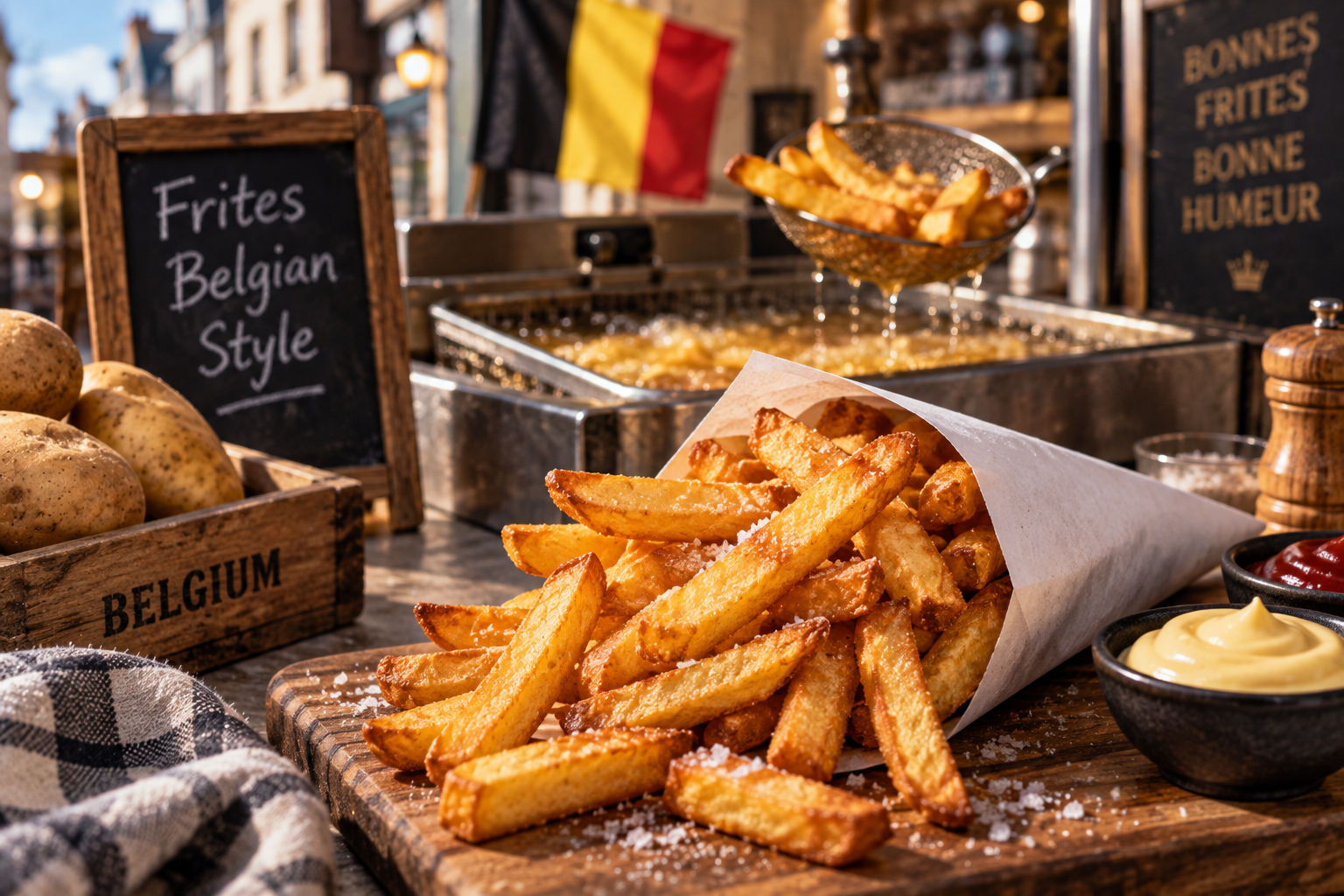
The Paper Cone Has Become Part of the Image

Belgian fries are frequently pictured overflowing from a paper cone or similar takeaway container.

The presentation is simple.

That simplicity is appropriate for the food.

This is not a dish that needs elaborate plating to communicate its identity. A generous portion of freshly fried potatoes, sauce, and a fork can be enough.

The focus remains on temperature and texture.

Fries are at their best when the gap between fryer and first bite is short.

Fresh Fries Have a Limited Crispy Window

This is something almost every fry lover has experienced.

Fresh from the fryer, the exterior is crisp.

Leave the fries sitting long enough and they begin to soften.

Why?

Moisture has not disappeared from the entire potato. The center remains moist, which is exactly what we want. After cooking, moisture can migrate toward the drier exterior while steam becomes trapped around the fries depending on how they are held.

Eventually the crust loses some of its crispness.

This is why takeaway packaging and serving time matter.

Closing Hot Fries Too Tightly Can Work Against Crispness

Put steaming fries into a completely sealed environment and the escaping moisture has nowhere convenient to go.

Steam can condense and increase humidity around the food.

The crisp surface begins absorbing moisture.

This does not mean fries need to become cold before packaging. They are supposed to be served hot.

It simply illustrates why crispness is affected by everything that happens after frying as well as what happens inside the fryer.

Salt Is Best When It Can Stick

Fresh fries arrive from the oil with a surface that makes seasoning easy to distribute.

Waiting too long can make salt adhere less effectively.

Seasoning immediately after frying is therefore common practice.

But the amount still matters.

A well-cooked potato already has flavor. Salt should amplify it rather than completely dominate it.

This is particularly important when fries will also be paired with a strongly flavored sauce.

Can You Recreate Belgian-Style Fries at Home?

Absolutely, although home equipment behaves differently from a commercial fryer.

Start with a potato suitable for frying and cut it consistently. Follow a tested recipe for the oil and temperature range you are using rather than guessing, particularly because deep frying involves very hot fat.

Cook in manageable batches.

Allow the first fry to accomplish its job before moving to the finishing stage. Then fry again at the higher finishing temperature specified by the recipe until the exterior reaches the desired color and crispness.

Most importantly, serve promptly.

Deep Frying Requires Attention to Safety

Hot oil deserves respect.

Use a stable, sufficiently deep pot and avoid filling it excessively. Keep wet utensils and unnecessary water away from the oil. Potatoes that have been rinsed should be properly dried before frying.

Never leave heating oil unattended.

If oil begins smoking heavily, it is too hot and should be handled carefully. Water should never be poured onto an oil or grease fire; appropriate kitchen fire-safety procedures and equipment are essential.

Good fries are not worth careless frying practices.

An Air Fryer Is a Different Cooking Environment

Air fryers can produce enjoyable potatoes with crisp surfaces, but they do not operate exactly like deep fryers.

Deep frying surrounds food with hot fat, creating extremely efficient heat transfer around the potato. An air fryer primarily relies on rapidly circulating hot air with a relatively small amount of oil.

That means a recipe developed for traditional Belgian deep-fried fries cannot simply be copied step-for-step into an air fryer and expected to produce an identical result.

Both can make good food.

They are simply different methods.

Frozen Fries Use Similar Ideas in a More Industrial Process

Commercial frozen fries may already have undergone several preparation stages before reaching a home freezer or restaurant.

Processing can include cutting, blanching, drying, partial frying, freezing, and other steps depending on the product.

That is why many frozen fries are not simply raw potato sticks that happen to be frozen.

The manufacturer has already engineered part of the texture.

When the consumer cooks them, they are effectively completing a process that began much earlier.

Double Frying Is Really About Control

This is the broader culinary lesson behind the technique.

Great cooking often becomes easier when one complicated objective is divided into smaller objectives.

With Belgian-style fries:

the first stage develops the potato;

the second stage develops the crust.

Instead of forcing the outside and inside to reach their ideal states simultaneously, the cook handles them sequentially.

The concept is simple.

The result can be dramatically better.

Why Belgian Fries Can Feel So Different From Ordinary Fast-Food Fries

The phrase “French fries” covers an enormous range of foods.

Thin frozen fries from a fast-food chain, steak fries, shoestring potatoes, skin-on pub fries, and Belgian-style frites may all belong to the same broad family while delivering very different experiences.

Belgian fries commonly emphasize a substantial potato interior surrounded by a crisp exterior.

That gives each piece more textural contrast.

Combine that with fresh frying and sauce culture, and fries stop feeling like an automatic side dish.

They become the thing you went there to eat.

Conclusion

So, why are Belgian fries double fried?

Because the ideal fry asks the potato to do two different things at once. The center should become tender and fluffy, while the outside should become dry enough to form a crisp, deeply flavorful crust.

The first, gentler fry primarily helps cook the potato and prepare its structure. After a resting period, the hotter second fry concentrates on surface dehydration and browning. Separating those stages gives the cook more control than trying to accomplish everything during one continuous fry.

Potato variety, thickness, surface preparation, oil, batch size, temperature, and serving time still matter. Double frying is not magic that can compensate for every other variable.

But it explains something important about Belgian food culture: even one of the world’s simplest foods can become distinctive when generations of cooks take its texture seriously.

After all, a great fry is still only potato, fat, and salt.

The difference is knowing exactly what each trip through the fryer is supposed to accomplish.

Why Cheese Tastes Better at Room Temperature

The Cheese Is Expensive—So Why Does It Taste Like Almost Nothing Straight From the Fridge?

You buy a beautiful piece of cheese from a specialty shop.

It smells promising when the package opens, the texture looks perfect, and everything about it suggests that the first bite should be memorable.

Instead, it tastes surprisingly muted.

The flavor is there, but barely. The texture feels firmer than expected, the aroma seems restrained, and the cheese you were excited to try suddenly feels ordinary.

Then you leave it on the table for a while.

The second bite tastes completely different.

The aroma is stronger. The texture feels richer. Flavors that seemed absent before suddenly become obvious.

Understanding why cheese tastes better at room temperature reveals something important about food: temperature does not simply determine whether something feels hot or cold. It changes the way aroma, texture, fat, and ultimately flavor are experienced.

Flavor Is More Than What Happens on the Tongue

When people talk about taste, they often think about the tongue.

Sweet.

Salty.

Sour.

Bitter.

Umami.

Those sensations matter, but what we casually call “flavor” is much broader.

A large part of the experience comes from aroma.

While chewing, volatile compounds from food travel toward the olfactory system through the back of the mouth. This process contributes enormously to what we perceive as flavor.

That means a cheese can contain plenty of flavorful compounds while still seeming dull if those compounds are not reaching our senses effectively.

Temperature influences that process.

Cold Temperatures Suppress Aroma

Open a container of food directly from the refrigerator and smell it.

Then allow the same food to warm slightly and smell it again.

The second aroma may seem noticeably stronger.

As temperature rises, many volatile aroma compounds become easier to release into the air.

Those compounds are what reach the nose and contribute to the food’s aromatic identity.

Cheese contains an extraordinary range of them.

Depending on the style, you might perceive buttery, nutty, grassy, earthy, mushroom-like, fruity, caramel-like, animal, fermented, or other aromas.

When cheese is very cold, much of that aromatic complexity can seem restrained.

Your Refrigerator Is Designed for Storage, Not Maximum Flavor

Refrigeration is valuable because it slows many processes associated with spoilage and food deterioration.

But the temperature that helps preserve cheese is not necessarily the temperature that makes it most expressive at the table.

These are different goals.

Storage asks:

How do we keep this food in good condition?

Serving asks:

How do we experience its aroma and texture at their best?

A food can benefit from refrigeration for storage while benefiting from some controlled warming before eating.

Fat Changes With Temperature

Cheese contains fat, and fat behaves differently depending on temperature.

When cold, fat becomes firmer.

As the cheese warms, its texture can soften and feel more supple.

That physical change affects how the cheese behaves in your mouth.

A cold cheese may feel dense or waxy.

The same cheese at a warmer serving temperature may coat the mouth differently, release aroma more readily, and create a richer sensation.

This is one reason temperature can make the exact same piece of cheese seem like a different product.

Texture Changes the Way We Judge Flavor

Flavor and texture are deeply connected.

Imagine butter straight from the refrigerator.

Now imagine softened butter.

The ingredients have not changed, but the sensory experience certainly has.

Cheese behaves similarly, although the degree depends on its style.

Soft-ripened cheese may become creamier.

Semi-soft cheese may become more yielding.

Hard cheese may lose some of its refrigerator stiffness and release aroma more clearly as it warms.

When texture improves, we often interpret the entire eating experience as more flavorful.

“Room Temperature” Does Not Mean Leaving Cheese Out All Day

This phrase can be misleading.

The goal is not to abandon cheese on a table indefinitely.

Food safety still matters, and different cheeses have different moisture levels, structures, storage requirements, and tolerances.

Instead, the practical idea is to remove an appropriate amount before serving and allow some of the refrigerator chill to disappear.

You are preparing the cheese for eating.

Not changing its storage method.

Different Cheeses Respond Differently

There is no single perfect serving temperature for every cheese.

A delicate fresh cheese behaves differently from a dense aged cheese.

A creamy washed-rind cheese is not the same as a firm alpine-style cheese.

Moisture, fat, aging, rind, production method, and composition all influence texture and aroma.

That is why rigid rules can be less useful than observation.

Notice what happens as a particular cheese warms.

Smell it.

Touch the texture.

Taste a small piece.

Food itself can tell you when it becomes more expressive.

Soft Cheese Can Change Dramatically

Soft cheeses often demonstrate the effect of temperature very clearly.

Straight from refrigeration, the center can feel firm and the flavor relatively closed.

After losing some chill, the paste may become noticeably softer and more aromatic.

That creamier texture also changes how the cheese spreads across the palate.

For someone who has only tasted a soft cheese extremely cold, trying it slightly warmer can be surprisingly revealing.

It may explain why the cheese seemed underwhelming before.

Hard Cheese Benefits Too

Hard cheese may not transform visually as dramatically as soft cheese, but temperature still matters.

Aged cheeses contain complex aromas created through time, microbial activity, enzymatic changes, and moisture loss.

Serving them extremely cold can mute some of that complexity.

As the cheese warms slightly, nutty, savory, caramelized, fruity, or other mature notes may become easier to notice.

The change is often less about softness and more about aromatic expression.

Aging Creates Flavor, but Serving Determines How Much You Notice

A cheesemaker can spend months or years developing a product.

Milk selection matters.

Cultures matter.

Coagulation matters.

Salting matters.

Humidity matters.

Temperature during aging matters.

Time matters.

Yet the final consumer can still experience only a fraction of that complexity if the cheese is served under conditions that suppress its aroma and texture.

Preparation does not end when the package opens.

Serving is the final stage.

Cut Only What You Plan to Eat

If you have a large piece of cheese, there is no need to warm the entire portion every time.

Cut what you expect to serve.

Keep the remainder stored appropriately.

This reduces unnecessary temperature cycling and makes portion management easier.

It also means the cheese on the table can be enjoyed without worrying about repeatedly returning a large piece to refrigeration.

Good food handling and good sensory experience do not have to compete.

Do Not Microwave Cheese Just to “Bring It to Room Temperature”

There is an important difference between allowing cheese to warm naturally and aggressively heating it.

A microwave can create uneven temperature.

Edges may become oily or melted while the center remains cooler.

The texture may change in ways you did not intend.

For cheese meant to be eaten as cheese rather than melted into a dish, patience is usually the better tool.

Let time do the work gradually.

Aroma Begins Before the First Bite

Part of eating cheese happens before it enters the mouth.

You see the rind.

You notice the texture.

You smell the surface.

Perhaps you detect earthiness, milk, butter, nuts, fermentation, herbs, cellar-like aromas, or something much stronger.

These signals prepare the brain for what comes next.

When cheese is extremely cold, the aromatic introduction can become quieter.

Warming allows the experience to begin before tasting.

Strong Smell Does Not Automatically Mean Bad Cheese

Some cheeses are intentionally aromatic.

Washed-rind styles in particular can produce powerful smells that surprise people unfamiliar with them.

The aroma may be much more aggressive than the actual flavor.

This creates an interesting sensory contrast.

A cheese that smells intense may taste relatively balanced and savory.

Learning about cheese partly involves separating “unfamiliar” from “spoiled.”

They are not the same thing.

But Learn the Difference Between Character and Spoilage

Appreciating strong cheese does not mean ignoring food safety.

Unusual appearance, unexpected mold on a style where it does not belong, abnormal texture, packaging problems, or other signs of deterioration deserve attention.

Cheese is a diverse fermented food, so there is no universal visual rule that applies to every variety.

When uncertain, rely on appropriate storage guidance and trustworthy information for the specific product.

“Cheese is supposed to smell” should never become an excuse to disregard obvious problems.

Cheese Changes as You Eat It

A cheese board is not static.

The first bite and the last bite may happen at different temperatures.

That means the flavor can evolve during the meal.

A cheese that seems restrained at first may become increasingly aromatic.

A creamy cheese may soften further.

Some flavors may become more pronounced.

Instead of seeing this as inconsistency, treat it as part of the experience.

You are tasting the food across a temperature range.

Taste the Same Cheese Twice

One of the easiest ways to understand temperature is through comparison.

Cut two small pieces from the same cheese.

Taste one relatively soon after removing it from refrigeration.

Allow the second piece to lose more of its chill.

Then compare.

Do not search for sophisticated tasting vocabulary.

Ask simple questions.

Which smells stronger?

Which feels creamier?

Which tastes saltier?

Can you notice sweetness?

Nuttiness?

Earthiness?

Does the finish last longer?

Direct comparison teaches more than memorizing rules.

Temperature Can Affect Perceived Saltiness and Sweetness

Our sensory perception changes with temperature.

This is why many foods and drinks seem different when served warmer or colder.

Cheese contains salt, acids, fats, proteins, and numerous aromatic compounds interacting simultaneously.

When aroma and texture become more expressive, other flavor characteristics may also seem easier to identify.

The recipe has not changed.

Your sensory access to it has.

Bread Can Change the Experience Again

Now add bread.

Suddenly texture changes.

A crisp crust contrasts with creamy cheese.

A mild crumb can soften an intense flavor.

A rustic loaf may add toasted or fermented notes of its own.

This is why cheese is rarely experienced in isolation within European food culture.

The surrounding food can reshape how the cheese is perceived.

Pairing is partly about interaction.

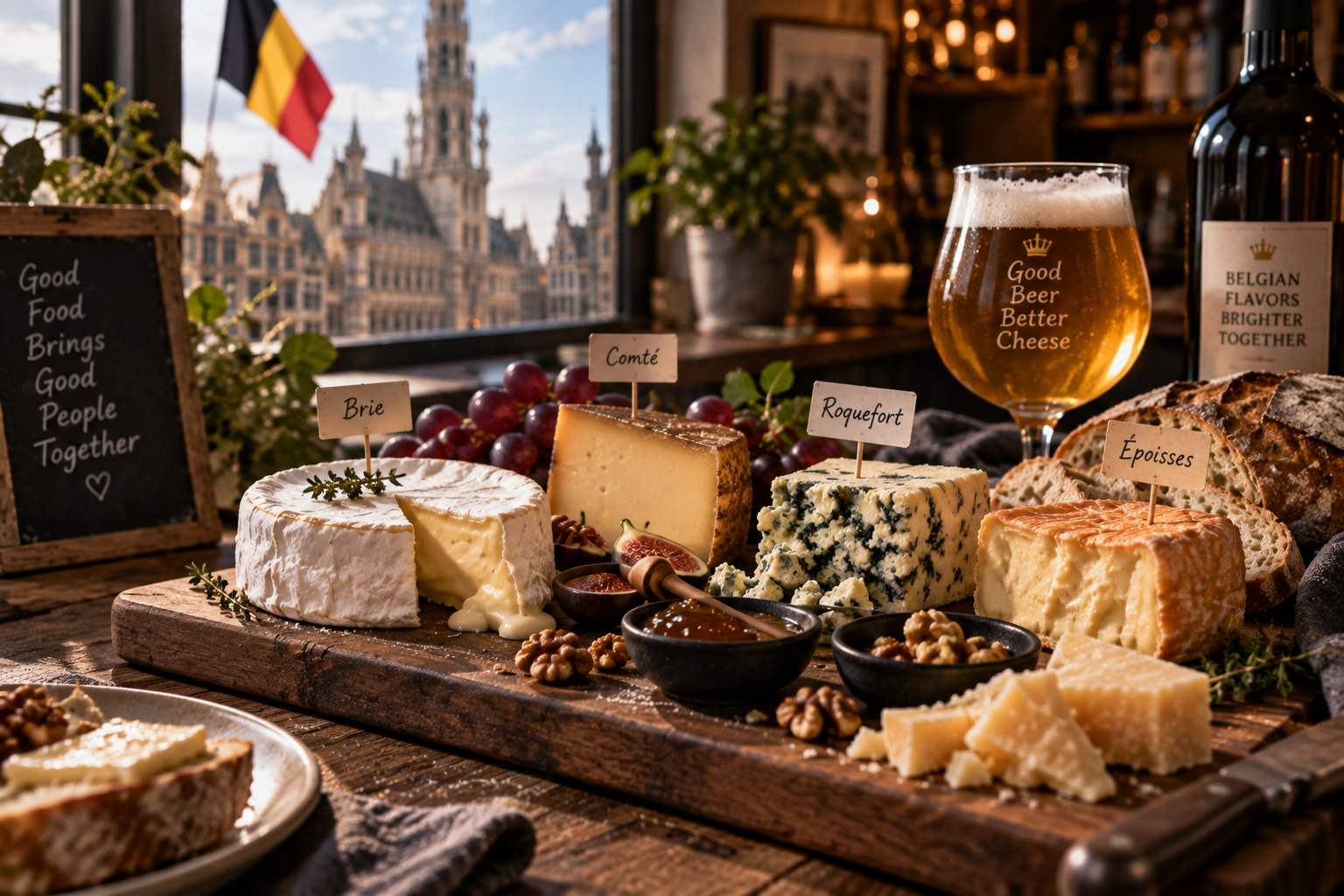
Belgian Bread Culture Makes Cheese Especially Interesting

Belgian food culture has strong relationships with bread, butter, beer, charcuterie, and dairy.

Cheese can move easily between a simple breakfast, a casual lunch, a snack, or a more deliberate tasting experience.

The point does not need to be luxury.

A good piece of bread and well-served cheese can already create a satisfying combination.

At Belgian Chow Club, this is part of what makes everyday European food culture interesting: small serving decisions can dramatically change ingredients that initially appear simple.

Crackers Should Not Overpower the Cheese

A heavily seasoned cracker may be delicious by itself.

But strong herbs, sweetness, salt, or spices can dominate delicate cheese.

If the goal is tasting the cheese, begin with a relatively neutral base.

Then experiment.

There is no law saying cheese must always be paired with bland bread or crackers.

But it helps to know which ingredient you are trying to understand.

Fruit Works Through Contrast

Fresh fruit can introduce sweetness, acidity, juiciness, and fragrance.

Apples and pears are common examples because their crisp texture contrasts nicely with many cheeses.

Grapes can add sweetness and moisture.

Figs and other fruits create different combinations.

The point is not that one pairing is universally correct.

The interesting part is observing what changes when sweetness or acidity enters the bite.

Sometimes the cheese seems saltier.

Sometimes creamier.

Sometimes the fruit becomes more aromatic.

Nuts Add Texture and Complement Aged Flavors

Aged cheeses often develop nutty notes of their own.

Pairing them with actual nuts can reinforce that character while adding crunch.

Walnuts, hazelnuts, almonds, and other varieties can each behave differently.

Again, restraint helps.

The cheese board does not need twenty accompaniments.

A few thoughtful contrasts often make tasting easier than an overcrowded plate.

Honey Changes More Than Sweetness

A small amount of honey can create a strong contrast with salty or tangy cheese.

It can also alter texture by adding viscosity.

But sweetness is powerful.

Too much can cover the subtler character of the cheese.

Try the cheese alone first.

Then add an accompaniment.

This allows you to understand what the pairing actually contributes.

Otherwise, you may only taste the condiment.

Jam and Preserves Can Work the Same Way

Fruit preserves bring sweetness, acidity, and concentrated fruit aroma.

They can pair beautifully with certain cheeses.

But their intensity varies dramatically.

A delicate fresh cheese and a powerful preserve may create a completely different balance from an aged, salty cheese with the same condiment.

Pairing becomes more intuitive when you think in terms of intensity rather than memorized combinations.

Strong with strong can work.

Contrast can work.

Balance is the goal.

Beer and Cheese Have More in Common Than People Realize

Belgium naturally brings beer into the conversation.

Beer and cheese are both products shaped by fermentation.

Each can contain complex aromas, bitterness, sweetness, acidity, roasted notes, fruit-like characteristics, spices, and other flavors depending on style.

Carbonation can also refresh the palate between rich bites.

This creates enormous pairing possibilities.

But “Belgian beer with Belgian cheese” is still too broad to guarantee a good match.

Styles matter.

A Strong Beer Can Erase a Delicate Cheese

Imagine a subtle fresh cheese paired with an extremely intense beer.

The beer may dominate everything.

The opposite problem can also occur.

A powerful aged or washed-rind cheese may overwhelm a very delicate drink.

Think about intensity.

Neither component should disappear completely unless that is deliberately the experience you want.

Good pairing creates conversation between foods.

It should not always be a competition.

Taste the Cheese Before the Drink

When exploring a pairing, try each component independently.

Taste the cheese.

Notice its texture and finish.

Taste the drink.

Then combine them.

What changed?

Did bitterness decrease?

Did the cheese seem sweeter?

Did a fruity aroma appear?

Did the finish become longer?

This method turns pairing from “people say these go together” into an actual sensory experiment.

Cheese Boards Do Not Need Ten Varieties

More cheese does not automatically create a better tasting experience.

A board with three contrasting styles can be more interesting than one containing twelve varieties that blur together.

For example, you might explore differences in texture, milk type, aging, rind, or intensity.

The exact selection can vary.

The principle is to create contrast.

If every cheese is extremely similar, the board may look abundant while teaching the palate very little.

Order Matters When Tasting Multiple Cheeses

If you begin with the most intense cheese on the board, delicate varieties afterward may seem almost flavorless.

A common approach is moving roughly from milder toward stronger cheeses.

This is not an unbreakable rule.

But it helps prevent powerful aromas and flavors from dominating the palate too early.

The same principle appears in many tasting traditions.

Intensity affects what you can perceive next.

Give Each Cheese Enough Space

Crowding cheese tightly together may look abundant in photographs.

But from a practical perspective, space makes cutting and serving easier.

It also helps keep accompaniments from immediately mixing into everything.

A cheese board is food, not merely decoration.

Design should support eating.

Beautiful presentation is useful when it makes the experience easier rather than more complicated.

Use Separate Knives When Flavors Are Very Different

A knife covered in a strong blue or washed-rind cheese can transfer that character to a delicate variety.

For casual eating, this may not matter much.

For tasting, it can.

Separate utensils help preserve contrast.

You do not need restaurant-level equipment.

Even a small practical decision can keep flavors from becoming unnecessarily mixed.

Rind Is Part of the Conversation

Some cheese rinds are intended to be edible.

Others are not.

Even among edible rinds, personal preference matters.

A rind may contribute earthy, mushroom-like, bitter, salty, or other characteristics that alter the bite significantly.

Try it when appropriate.

Then compare with the interior paste.

You may prefer one combination over another.

Cheese tasting is not an exam with one correct answer.

Cutting Technique Can Affect Fairness

Some cheeses have different textures and flavors from center to rind.

If one person receives only the center while another gets mostly rind, they may effectively be tasting different experiences.

When practical, cut wedges in a way that gives portions a representative path through the cheese.

This matters especially when sharing.

Good serving etiquette can also improve sensory consistency.

Do Not Judge Cheese From the First Cold Bite

This may be the most practical lesson.

If a cheese seems boring straight from the refrigerator, give it time before deciding you dislike it.

Temperature may be hiding the qualities you paid for.

Let it warm appropriately.

Taste again.

The difference can be dramatic enough to change your opinion entirely.

Expensive Cheese Can Still Be Served Poorly

Price does not protect food from bad handling.

An expensive cheese served too cold, cut long before eating, stored incorrectly, or paired with something overpowering can be less enjoyable than a modest cheese handled thoughtfully.

This applies far beyond cheese.

Cooking and serving are about respecting the characteristics of ingredients.

Luxury cannot compensate for every mistake.

Affordable Cheese Can Become a Great Experience

The reverse is equally important.

You do not need rare artisan cheese to enjoy thoughtful tasting.

Choose a few accessible varieties with different characteristics.

Serve them well.

Add good bread.

Maybe fruit or nuts.

Compare textures and aromas.

Pay attention.

Food appreciation grows through attention more than price.

Your Palate Develops Through Comparison

People sometimes believe they “do not understand cheese” because they cannot describe flavors with professional vocabulary.

That vocabulary is not required.

Start with differences.

This one is softer.

That one is saltier.

This smells stronger.

That one has a longer finish.

This becomes much better when warmer.

Those observations are already sensory learning.

Over time, patterns become easier to recognize.

Memory Shapes Flavor Too

The same cheese can feel different depending on context.

A cheese eaten during a trip may become connected with a place.

A particular variety may remind someone of family meals.

A smell can trigger memories before the food is even tasted.

Flavor is partly chemical, but the eating experience is also psychological and cultural.

This helps explain why certain foods become emotionally important even when their ingredient list is ordinary.

Good Cheese Encourages Slower Eating

Cheese is dense in flavor.

You rarely need enormous bites to understand it.

Small portions give aroma and texture time to develop.

This is particularly useful when tasting several varieties.

Slowing down also makes temperature changes more noticeable.

The board evolves while you eat.

What tasted one way ten minutes ago may now feel different.

Serving Temperature Is Part of Cooking Even When Nothing Is Cooked

This idea applies to many foods.

Chocolate.

Butter.

Fruit.

Wine.

Desserts.

Bread.

Temperature changes texture, aroma, sweetness, bitterness, and other sensory qualities.

Cheese simply provides one of the clearest demonstrations.

No stove is required.

Yet a small amount of preparation can dramatically improve the result.

The Best Temperature Is the One That Lets the Cheese Express Itself

There is a temptation to search for one exact number.

But home environments differ, cheeses differ, and personal preferences differ.

Instead of obsessing over a universal temperature, learn the underlying principle.

Extremely cold cheese often suppresses aroma and keeps fat and texture firmer.

Allowing it to lose some refrigeration chill can make aroma and texture more expressive.

Then taste.

The cheese itself provides the final answer.

Conclusion

Understanding why cheese tastes better at room temperature begins with realizing that flavor is not locked permanently inside food.

Temperature influences how aroma compounds are released, how fat behaves, how texture feels, and how easily the senses can perceive complexity.

Refrigeration remains important for proper storage. But serving is a separate stage.

Take out an appropriate portion, give it time to lose some of its chill, and notice how the experience changes. Then explore bread, fruit, nuts, preserves, or Belgian beer if you want to understand how pairing creates another layer of flavor.

You do not need sophisticated tasting language.

You only need to pay attention to the difference between the first bite and the next.

Sometimes the expensive cheese was never disappointing.

It was simply too cold to show you what it could taste like.

European home cooking

Why Does Simple European Home Cooking Taste So Good?

You remember the meal, not because it was complicated, but because it was almost suspiciously simple. Fresh bread, butter, cheese, a small salad, perhaps a bowl of soup. Nothing stacked dramatically on the plate and no ingredient that required an explanation before you could eat it.

Yet years later, you can still remember how satisfying it tasted. Then you return home, buy similar ingredients, prepare what seems like the same meal, and somehow the result does not feel quite the same.

This is one of the most useful lessons hidden inside European home cooking. Memorable food does not always come from adding more ingredients or using increasingly complicated recipes. Very often, it comes from choosing a few ingredients carefully, understanding what each one contributes, applying the right technique, and knowing when the dish is already complete.

Why Simple Food Can Be Surprisingly Difficult to Cook Well

Simple food should not be confused with careless food. A dish may contain only five ingredients, but when each ingredient performs an important role, mistakes become much easier to notice.

Bread provides texture and aroma. Butter contributes richness. Cheese brings saltiness and depth. Tomatoes can provide freshness, sweetness, and acidity. Herbs introduce another layer of aroma without necessarily dominating the dish.

When a recipe contains only a handful of ingredients, there are fewer places for a weak ingredient or poor technique to hide. That is why apparently simple cooking can demand more attention than a long ingredient list suggests.

Ingredient Quality Becomes More Important

Consider a basic tomato salad made with tomatoes, olive oil, salt, and perhaps fresh herbs. There is almost nothing available to disguise watery, underripe tomatoes.

Replace them with ripe tomatoes that have good texture, natural sweetness, and noticeable aroma, and the same preparation can taste dramatically different. The recipe has not become more sophisticated. The raw material simply became better.

This does not mean every ingredient in your kitchen must be expensive. It means quality matters most when an ingredient is highly exposed in the final dish.

Start With Ingredients That Already Taste Good

Home cooks sometimes expect cooking to rescue ingredients that were disappointing from the beginning. Technique can transform food, but it cannot create every missing characteristic.

When appropriate, taste ingredients before using them. Check whether fruit is actually ripe, whether cheese has enough character, whether herbs still smell fresh, and whether bread has the texture you want.

The simpler the recipe, the more valuable this habit becomes.

Seasonality Makes Simple Cooking Easier

Seasonality is not merely a romantic culinary idea. Produce harvested at an appropriate stage of maturity can naturally offer stronger flavor, aroma, and texture.

Strawberries are an easy example. They may be available for long periods of the year, yet there is often a season when they suddenly taste sweeter and far more aromatic. At that point, very little intervention is necessary.

This principle appears throughout traditional cooking. When an ingredient already has plenty of character, the cook does not need to bury it beneath layers of additional flavor.

European Home Cooking Is Regional, Not One Single Cuisine

It is important not to treat European food as one uniform culinary tradition. Belgian cooking is different from Italian cooking, just as Polish, Spanish, Greek, French, German, and other regional cuisines have their own histories and identities.

Climate, agriculture, geography, migration, religion, trade, and local availability have shaped these cuisines differently. Coastal communities naturally developed strong relationships with seafood, while dairy-producing regions built traditions around butter and cheese. Colder regions often relied heavily on preservation techniques, while agricultural areas developed dishes around crops that grew reliably nearby.

So there is no single method that defines all European home cooking. What we can identify are recurring principles: using available ingredients intelligently, respecting regional products, building flavor through technique, and preparing food that fits everyday life.

Traditional Food Often Developed Around Practicality

Many traditional dishes were not invented to impress restaurant critics or look attractive on social media. They developed because households needed practical ways to turn available food into satisfying meals.

That explains why the same basic ingredients appear repeatedly within regional cuisines. Potatoes, bread, dairy, cabbage, meat, seafood, grains, and seasonal vegetables could become very different dishes depending on local technique and tradition.

The complexity was often not in the number of ingredients. It was in generations of learning what to do with them.

Technique Can Matter More Than the Number of Ingredients

Bread demonstrates this perfectly. Its ingredient list can be extremely short: flour, water, salt, and yeast or starter.

Yet changing fermentation time, hydration, flour, shaping technique, oven temperature, or baking environment can produce completely different results. A short ingredient list does not mean nothing complicated is happening.

The same principle applies to potatoes, eggs, vegetables, meat, soups, and sauces. Learning what heat, time, moisture, and texture do to food gives a home cook far more flexibility than memorizing hundreds of recipes.

Time Is an Ingredient Too

Modern cooking culture often emphasizes speed. Fifteen-minute dinners and instant recipes can be genuinely useful, especially during busy weeks, but some foods improve specifically because they are not rushed.

Dough ferments. Onions gradually brown. Stews simmer. Meat rests. Vegetables roast until their texture and sweetness change.

Long cooking does not necessarily mean constant work. A stew may remain on the stove for two hours while requiring only occasional attention. Traditional home cooking often relies on preparation followed by allowing heat and time to do most of the work.

Browning Builds Flavor

One common mistake among inexperienced cooks is being afraid of color. Mushrooms begin to brown, so the heat is immediately reduced. Meat starts developing a crust, so it gets moved around the pan.

Proper browning can create deeper and more complex flavors in meat, mushrooms, potatoes, bread, and many vegetables. The goal is not to burn food, but to understand the stages between raw, softened, golden, deeply browned, and actually burned.

This is one of those skills that becomes easier through repetition. Eventually, you begin recognizing the correct color, aroma, and texture without needing a recipe to describe every second.

Stop Moving Food Constantly

Food sometimes needs uninterrupted contact with a hot surface. Constant stirring can prevent proper browning because ingredients never remain in one position long enough to develop color.

The same problem occurs when a pan is overcrowded. Mushrooms, meat, and vegetables release moisture, and when too much food occupies the pan at once, the ingredients may steam rather than brown.

Cooking in batches can take slightly longer, but the improvement in texture and flavor is often worth the extra few minutes.

Seasoning Is About Balance, Not Just Salt

Another major difference between forgettable food and satisfying food is how seasoning is handled.

Beginners sometimes cook an entire dish with very little adjustment and add salt only at the end. More experienced cooks tend to taste during preparation and build seasoning gradually when appropriate.

This does not mean adding large amounts of salt. Ingredients such as cheese, cured meats, stock, olives, and sauces may already contribute significant saltiness. Taste first, then decide what the dish actually needs.

Sometimes the Missing Ingredient Is Acidity

A dish can taste properly salted and still feel strangely flat. When that happens, adding even more salt may not solve the problem.

Sometimes the missing element is acidity. Depending on the recipe, lemon, vinegar, wine, tomatoes, or another acidic ingredient can brighten flavors and balance richness.

The objective is not necessarily to make the dish taste sour. A small amount of acidity can simply make the existing flavors feel clearer.

Fat Contributes More Than Richness

Butter, olive oil, cream, cheese, and animal fats appear differently across European culinary traditions. Their purpose extends beyond making food richer.

Fat affects mouthfeel, aroma, texture, heat transfer, and how flavors are perceived. The lesson is not to add unlimited butter or oil, but to understand why a particular fat belongs in a recipe.

Once you understand its function, it becomes easier to know when more is useful and when enough is already enough.

Texture Can Make Simple Food Memorable

Flavor receives most of the attention in cooking discussions, but texture can completely change how a meal feels.

Imagine a plate where the meat, vegetables, bread, and potatoes are all soft. The flavors may be pleasant, yet the meal can still feel monotonous.

Now introduce crisp bread, fresh greens, crunchy vegetables, or properly browned potatoes. Suddenly the same plate becomes much more interesting.

Belgian Cooking Offers a Useful Example

Belgian home cooking provides many examples of familiar ingredients becoming memorable through preparation. Potatoes, meat, seafood, bread, vegetables, cheese, beer, and sauces are not inherently exotic ingredients.

Consider fries. The basic idea appears extremely simple, yet excellent fries depend heavily on technique. What makes them satisfying is not merely potato meeting hot oil, but the contrast between a crisp exterior and a soft, fluffy center.

This illustrates an important principle of European home cooking: technique can give ordinary ingredients a distinct identity.

Vegetables Should Have an Intentional Texture

Vegetables do not always need to be cooked until completely soft. Depending on the dish, retaining some color, structure, and bite can make them more enjoyable.

Other recipes deliberately cook vegetables for much longer because softness is part of the intended result. Neither approach is automatically better.

The important part is intention. Cook vegetables until they reach the texture the dish needs, rather than simply leaving them on the stove until you remember they are there.

Learn Cooking Patterns Instead of Memorizing Endless Recipes

A useful way to become more confident in the kitchen is to understand recurring structures.

Soup, for example, can often be understood through a simple framework: aromatic base, primary ingredient, liquid, seasoning, and finishing element. Once you understand that pattern, carrot, leek, potato, or pumpkin soup stops feeling like four unrelated recipes.

The same principle applies to roasting, sautéing, braising, sauces, and many other preparations.

Recipes tell you what to do. Technique helps you understand why it works.

Treat Recipes as Maps

A recipe might say to cook something for 18 minutes, but your oven may run hotter than the author’s. Your vegetables may be larger, your pan may retain heat differently, or your stove may produce a stronger flame.

Use the recipe as guidance while continuing to observe the food itself.

Look at color. Smell the ingredients. Check texture. Taste when appropriate. These signals eventually become more useful than blindly following a timer.

Learn How Your Equipment Behaves

Even a well-written recipe can behave differently in two kitchens.

Home ovens do not always maintain exactly the temperature displayed on their controls. If baked and roasted dishes consistently behave differently from expectations, an oven thermometer can help identify whether temperature is part of the problem.

Cookware also matters. Thin pans, heavy pans, cast iron, stainless steel, and nonstick surfaces respond to heat differently. Learning how your equipment behaves makes recipes easier to adapt without assuming every unexpected result is caused by the ingredients.

Control the Heat Instead of Using Only Maximum Power

Many beginners effectively cook with two settings: off and maximum heat.

Different techniques require different temperatures. Higher heat can help produce browning, while gentle heat may be more appropriate for delicate cooking or a slow simmer.

A simmer should not look like a violent boil. Understanding heat control allows ingredients to cook at the rate and intensity the recipe actually requires.

Mise en Place Makes Everyday Cooking Easier

Mise en place simply means preparing what you need before critical cooking begins.

Chop vegetables. Measure ingredients. Put essential utensils within reach. Check that everything required for the next stage is available.

This prevents situations where onions are burning while you search for vinegar at the back of a cupboard.

At home, however, mise en place does not need to resemble a television cooking show. Ingredients that safely enter the pan together do not need individual decorative bowls. The objective is organization, not extra washing up.

Herbs and Cheese Work Best When Used With Purpose

Fresh herbs such as parsley, thyme, rosemary, basil, chives, and dill can transform a simple meal, but they are not interchangeable decorations. Each contributes a different aroma and works better with certain ingredients.

Dried herbs are not automatically inferior. Some work especially well in dishes that cook for longer because they have time to release their flavor. Fresh herbs, meanwhile, may be particularly effective as a finishing element.

Cheese can work similarly. It does not always need to dominate a dish. A modest amount of flavorful cheese can contribute saltiness, fat, aroma, and savory depth without overwhelming everything else.

Spend More Attention Where Quality Is Most Visible

Good European home cooking does not require buying the most expensive version of every ingredient.

Instead, consider how exposed an ingredient will be.

If tomatoes are served raw with only olive oil and salt, their quality is central to the dish. If tomatoes are being incorporated into a long-cooked preparation with several other ingredients, there may be more flexibility.

Bread and butter provide another obvious example. There is almost nowhere for poor bread or flavorless butter to hide because they are the entire experience.

Spend money and attention where differences are actually noticeable.

Traditional Home Cooking Is Naturally Resourceful

Practical cooking also means understanding how ingredients can continue being useful after their first meal.

Yesterday’s bread can become breadcrumbs, croutons, or toast. Cooked potatoes can become the foundation of another dish. Roasted vegetables can be used in sandwiches, salads, pasta, or as tomorrow’s side dish.

This kind of cooking saves money and reduces waste, but it also encourages creativity.

Instead of looking inside the refrigerator and thinking there is nothing to eat, start asking what the available ingredients could become.

Cook Components That Can Be Reused

Preparing slightly more vegetables than you need for dinner can simplify tomorrow’s meal. The idea is not necessarily to eat identical leftovers for four consecutive days.

Think in components rather than finished dishes.

Roasted vegetables can move into a sandwich. Cooked potatoes can become another preparation. Herbs can finish several meals. Good bread can accompany soup one evening and become toast the next morning.

That flexibility is one of the strengths of practical home cooking.

Eggs and Potatoes Are Excellent Teachers

Expensive ingredients are not required to learn cooking fundamentals.

Eggs teach timing, temperature control, texture, and patience. Fried, boiled, scrambled, poached, or turned into an omelet, the same ingredient can produce completely different results.

Potatoes teach a similar lesson. Boiling, roasting, frying, mashing, and baking transform one basic ingredient into dramatically different experiences.

Mastering versatile staples builds skills that transfer into more complicated dishes later.

Build a Small Collection of Reliable Meals

There is no requirement to cook a completely new recipe every night.

In fact, repeating recipes is one of the fastest ways to improve. The second time you cook a dish, you already understand its basic sequence. By the fifth time, you begin noticing details that were invisible during the first attempt.

Start with a small collection of dependable meals: perhaps a soup, a roast, a pasta dish, an egg-based meal, and a simple combination of protein and vegetables.

Once those become comfortable, expand gradually.

Repetition Builds Intuition

Cooking the same dish several times teaches things that written instructions struggle to communicate.

You learn how onions look when they are properly softened, how much seasoning you prefer, how your stove behaves, and exactly when a particular texture feels right.

Eventually, you stop merely reproducing someone else’s recipe.

The recipe becomes part of your own cooking vocabulary.

Learn One Basic Sauce and Understand Why It Works

A basic sauce can transform ingredients you already know how to cook.

Instead of memorizing many unrelated sauces, begin by understanding the balance between fat, liquid, acidity, seasoning, and, where relevant, emulsification.

Once the structure makes sense, variations become easier.

At the same time, remember that sauce should usually support the main ingredients unless the dish intentionally makes sauce the star. Covering good vegetables, meat, or bread in unnecessary quantities can hide exactly what made those ingredients appealing.

Simple Meals Still Need Balance

A satisfying dinner does not always require several pans and hours of preparation.

Good bread, cheese, fresh vegetables, fruit, something pickled, and a straightforward protein can already form a memorable meal.

Think about contrast rather than complexity. Something rich may benefit from something acidic or fresh. A soft stew can work beautifully with crusty bread. Roasted meat can feel more balanced alongside fresh vegetables.

You do not need every possible texture and flavor on every plate. You simply need enough contrast to prevent the meal from feeling one-dimensional.

Restaurant Cooking and Home Cooking Have Different Purposes

Trying to reproduce restaurant-level presentation and complexity every evening can make home cooking unnecessarily exhausting.

Restaurants can dedicate more labor, preparation, equipment, and ingredients to individual dishes. Everyday cooking has to coexist with work, family, errands, and normal life.

A good home recipe is therefore not necessarily the most impressive recipe.

Often, it is the one that tastes good, fits your routine, uses ingredients intelligently, and is realistic enough that you will actually cook it again.

Food Culture Lives in Ordinary Meals

Culinary culture is not preserved only by famous chefs and celebrated restaurants.

It also survives through family recipes, weekday dinners, local markets, seasonal ingredients, holiday traditions, and techniques passed between generations.

When exploring regional cuisine, do not ask only, “What dish should I try?”

Also ask how people normally eat it. Is it everyday food or celebration food? What usually accompanies it? When is it served? Why did that particular combination become common in the region?

Understanding those details turns food into more than a recipe.

Explore European Cooking One Region at a Time

Trying to “learn European cuisine” is too broad to be particularly useful.

Start with one region.

Explore Belgian home cooking, northern Italian food, Spanish regional dishes, Greek cooking, Polish comfort food, or French countryside cooking. Prepare several dishes from the same culinary tradition and notice which ingredients and techniques keep returning.

Afterward, move to another region and compare.

You may discover that different cuisines use many of the same basic ingredients—potatoes, bread, dairy, seafood, meat, cabbage, or grains—but transform them through different seasonings, techniques, preservation methods, and historical influences.

That comparison is where culinary culture becomes especially interesting.

A Practical European-Inspired Home Cooking Formula

When you are unsure what to cook, a simple structure can make the decision easier.

Choose One Main Ingredient

Start with fish, chicken, eggs, beans, cheese, or another ingredient that can become the center of the meal.

Do not immediately think about ten supporting ingredients. Decide what the meal is actually built around first.

Add a Seasonal Vegetable

Keep the preparation appropriate to the ingredient. Roast it, sauté it, steam it, or serve it fresh when that makes sense.

Good vegetables often require less intervention than we assume.

Add a Satisfying Carbohydrate

Potatoes, bread, rice, pasta, or grains can provide substance and complement the main ingredient.

Choose something that makes sense with the rest of the plate rather than adding complexity simply for variety.

Create Contrast

If most of the meal is rich and soft, introduce something fresh, crisp, acidic, or herbal.

Contrast can make a simple meal feel much more complete without increasing the ingredient list dramatically.

Taste Before Adding Anything Else

Check the seasoning.

Consider whether acidity would help.

Add herbs or a finishing element if they have a clear purpose.

Then stop.

One of the most valuable cooking skills is recognizing when the dish is already finished.

Conclusion

The memorable meal from a European trip may not have tasted special because somebody discovered a secret ingredient. Perhaps the bread was simply good, the butter had character, the tomatoes were ripe, the cheese was flavorful, and the potatoes were cooked properly.

That is one of the enduring strengths of European home cooking. Instead of assuming improvement always means adding more, it encourages us to pay attention to ingredients, heat, time, seasoning, texture, and regional context.

Before asking, “What else should I add?”, ask a better question: “Have I made the ingredients already here taste as good as they can?”

Buy thoughtfully. Learn a few reliable techniques. Control the heat. Season gradually. Create texture and balance. Repeat dishes until you understand them instead of constantly chasing new recipes.

Memorable home cooking does not always come from doing more. Sometimes it comes from doing a few simple things extremely well.

food culture

Food Culture in Small European Villages: Hidden Culinary Gems

Food Culture in Small European Villages: Hidden Culinary Gems

Beyond Europe’s famous restaurants and crowded food markets, small villages preserve some of the continent’s most memorable flavors. These quiet destinations may not appear in popular travel guides, yet their kitchens reveal recipes, ingredients, and traditions shaped by generations.

Exploring European village food is not only about tasting unfamiliar dishes. It is an opportunity to understand how local people live, celebrate, farm, and maintain a close relationship with their surroundings. In many villages, food remains deeply connected to the seasons and the land.

Why Small Villages Offer a Different Culinary Experience

Food in a small European village often feels more personal than a meal in a major tourist destination. Restaurants may be family-owned, vegetables may come from nearby gardens, and recipes are often prepared according to traditions passed down through several generations.

Menus are usually influenced by what is locally available. Mountain communities may specialize in aged cheese, smoked meat, and hearty stews. Coastal villages tend to serve fresh fish, shellfish, olive oil, and simple dishes inspired by the daily catch.

These regional differences make traditional European village cuisine especially rewarding to explore. Even neighboring villages can have different versions of the same dish, each shaped by family customs and locally produced ingredients.

Local Ingredients Tell the Story of the Land

The character of village cooking begins with its ingredients. Instead of relying on products transported across long distances, many rural kitchens continue to use seasonal produce grown or made within the surrounding region.

In southern European villages, tomatoes, herbs, citrus fruits, and olive oil frequently form the foundation of local meals. Northern and central European communities may depend more heavily on potatoes, cabbage, grains, dairy products, mushrooms, and preserved meat.

These ingredients are rarely used merely because they are traditional. They developed naturally in response to local climates, farming conditions, and the need to preserve food through colder months.

Travelers searching for authentic food culture can learn a great deal by visiting a village market early in the morning. The products on display often provide a clear picture of what residents will be cooking at home that week.

Family Kitchens Preserve Regional Recipes

Some of Europe’s most meaningful dishes are not found in professional cookbooks. They survive through handwritten notes, shared memories, and repeated preparation inside family kitchens.

A grandmother may teach younger relatives how to shape dumplings, prepare a particular sauce, or determine when bread dough is ready without measuring the ingredients. These small techniques give traditional recipes their distinctive identity.

Family-run taverns and guesthouses provide visitors with a chance to experience these customs. The meal may appear simple, but its preparation can involve years of knowledge. A bowl of soup, a slice of savory pie, or a serving of roasted vegetables may represent a tradition unique to that community.

This personal connection is one reason why hidden culinary gems in Europe often feel more memorable than elaborate meals created primarily for visitors.

Bread, Cheese, and Preserved Foods

Bread is central to the food culture of many European villages. Depending on the region, it may be made from wheat, rye, corn, or a mixture of locally available grains.

Village bakeries often begin working before sunrise. By morning, their shelves may be filled with rustic loaves, flatbreads, filled pastries, and regional specialties prepared according to long-established methods.

Cheese is equally important. Small dairies continue to produce varieties influenced by local milk, temperature, humidity, and aging traditions. Some cheeses are soft and mild, while others are firm, earthy, or intensely aromatic.

Preserved foods also reveal how villagers adapted to the seasons. Cured meat, pickled vegetables, dried mushrooms, fruit preserves, and fermented products allowed communities to enjoy local ingredients long after the harvest.

Sampling regional European specialties together creates a meal that reflects both practical rural knowledge and centuries of culinary development.

The Importance of Seasonal Cooking

Seasonal cooking is not a fashionable concept in small villages. It has always been part of everyday life.

Spring may bring wild greens, young vegetables, fresh herbs, and soft cheeses. Summer tables become brighter with ripe fruit, tomatoes, peppers, and outdoor grilling. Autumn introduces mushrooms, nuts, pumpkins, grapes, and newly harvested grains. Winter meals are usually built around preserved ingredients, root vegetables, stews, and baked dishes.

Following the seasons keeps village menus constantly changing. A traveler returning to the same place at a different time of year may encounter an entirely new selection of dishes.

This natural rhythm gives rural European cooking traditions a sense of place that is difficult to reproduce elsewhere. The food is inseparable from the weather, landscape, and agricultural calendar.

Village Festivals and Communal Meals

Food becomes especially meaningful during local festivals. Harvest celebrations, religious holidays, weddings, and village anniversaries often bring entire communities together around long shared tables.

For these occasions, residents may prepare dishes that are too time-consuming or expensive for ordinary days. Large pans of rice, slow-roasted meat, handmade pasta, ceremonial breads, and elaborate desserts are commonly shared among families and visitors.

More Than a Tourist Attraction

Although village festivals can attract travelers, their original purpose is usually communal. Food strengthens relationships, preserves local identity, and creates a connection between older and younger generations.

Visitors who participate respectfully can experience a side of European culture that is rarely visible in commercial tourist districts. They are not simply ordering a meal; they are witnessing how food contributes to community life.

These celebrations are among the best places to discover lesser-known European dishes prepared in the environment where they have existed for generations.

How to Find Genuine Village Food

Finding a satisfying local meal does not require an extensive itinerary. In many cases, the most promising places have short menus, modest dining rooms, and opening hours shaped around the routines of local residents.

Look for restaurants filled with people from the surrounding area. Bakeries, weekly markets, farm shops, and small family-run inns can also provide a more genuine introduction to local flavors than establishments designed mainly for passing tourists.

Ask Simple and Respectful Questions

Asking what is seasonal or locally produced can lead to excellent recommendations. Restaurant owners and market vendors are often proud to explain where an ingredient comes from or why a particular dish matters to the community.

It is also helpful to remain flexible. A traditional dish may sell out, a restaurant may close between lunch and dinner, or a menu may change depending on what was harvested that morning.

Approaching European countryside food experiences with curiosity rather than a strict checklist often leads to unexpected and rewarding discoveries.

Supporting the People Behind the Food

Eating locally has a direct impact on rural communities. Choosing an independent restaurant, buying cheese from a village producer, or purchasing bread from a neighborhood bakery helps traditional food businesses continue operating.

This support is particularly important in villages where younger generations are moving toward larger cities. Small producers often face difficulties competing with industrial food systems, even when their products represent valuable regional knowledge.

Responsible food travel means appreciating more than flavor. It involves recognizing the time, labor, and cultural history behind every product. Travelers should ask permission before photographing people at work, respect local dining customs, and pay fair prices for handmade goods.

A Slower and More Meaningful Way to Taste Europe

The greatest pleasure of exploring small European villages is the opportunity to slow down. Instead of rushing between famous attractions, travelers can spend time observing a morning market, talking with a baker, or enjoying a meal prepared from ingredients grown nearby.

The hidden culinary gems Europe offers are rarely defined by luxury. Their appeal comes from honesty, local character, and a strong connection between food and everyday life.

A village meal can reveal the geography of a region, the history of its families, and the practical creativity of previous generations. For travelers willing to leave the busiest routes behind, European village food offers something increasingly rare: an authentic taste of place that cannot be separated from the people who created it.

Why Your Homemade Fries Never Taste Like Belgian Fries: The Small Details That Change Everything You buy potatoes.

You buy potatoes.

Cut them into neat sticks.

Heat the oil.

Drop them in.

Wait until golden.

Take them out.

Salt.

Taste.

They are fine.

Maybe even good.

But something is missing.

The outside is not quite crisp enough.

The center does not have that soft, almost fluffy texture you remember from really good fries.

Five minutes later, half the batch is already going limp.

So you try again.

Hotter oil.

Thinner potatoes.

Longer frying.

Now they are definitely crunchy.

Unfortunately, some of them also taste like potato-flavored crackers.

At this point, it is tempting to blame the potato.

Or the oil.

Or the fryer.

But great fries are surprisingly technical for something made from such simple ingredients.

Belgian-style fries are a perfect example.

Learning how to make Belgian fries at home is less about discovering a secret ingredient and more about understanding what happens to a potato between the knife and the plate.

The potato matters.

The thickness matters.

Moisture matters.

Oil temperature matters.

And most importantly:

one trip through the fryer is often not enough.

Belgian Fries Are More Than Just “French Fries from Belgium”

Call them fries.

Frites.

Frieten.

Whatever name you use, fries occupy a particularly important place in Belgian food culture.

They are not treated only as a side dish next to a burger.

A cone or paper tray of hot fries with sauce can be the event itself.

That is part of what makes Belgian fry culture interesting.

The food is simple.

The expectations are not.

Good fries should offer contrast.

Outside:

crisp.

Inside:

soft.

And neither part should overwhelm the other.

The Real Goal Is Texture Contrast

Imagine biting into a fry.

If the entire thing is soft?

Disappointing.

If the entire thing is hard and dry?

Also disappointing.

The sweet spot is the contrast between a properly cooked interior and a crisp exterior.

That contrast explains much of the cooking process.

You are not simply trying to:

cook a potato until brown.

You are trying to create two different textures in one small piece of potato.

Start with the Potato

This sounds obvious.

But not every potato behaves exactly the same in hot oil.

Potatoes vary in:

starch,

moisture,

density,

and texture.

For fries, varieties with a relatively high dry-matter or starch content are often preferred because they can produce a fluffy interior while developing a crisp exterior.

A very waxy potato may behave differently.

The Potato Variety Available to You May Be Different

A Belgian recipe might recommend a variety that is difficult to find where you live.

That does not mean the recipe is impossible.

Instead of obsessing over one exact name, understand the characteristic you are looking for.

You generally want a potato suitable for frying rather than one primarily valued for holding a firm waxy texture in salads.

Local varieties differ.

Ask what is commonly used for fries in your area.

Old and New Potatoes Can Behave Differently

Potatoes are agricultural products.

Their water and sugar content can vary depending on:

variety,

season,

storage,

and age.

This is one reason two batches made with seemingly identical technique can brown differently.

Cooking is chemistry happening to ingredients that are not manufactured to identical specifications.

Too Much Sugar Can Mean Faster Browning

When potatoes contain more reducing sugars, their surfaces can darken quickly during frying.

That can create an annoying situation:

the outside looks done,

but the texture is not where you want it.

If your fries consistently become very dark unusually quickly, the potato itself may be part of the equation.

Refrigerating Raw Potatoes Is Not Always Ideal for Frying

Cold storage can affect the sugar balance of potatoes.

For home cooks, the bigger lesson is simple:

store potatoes appropriately for the variety and intended use rather than automatically treating them like every other vegetable.

And always discard potatoes that show serious spoilage or unsafe deterioration.

Uniform Cutting Matters More Than Perfect Cutting

You do not need restaurant-level knife skills.

But you do want the fries to be reasonably similar in size.

Why?

Because a thin fry and a thick fry placed in the same oil for the same amount of time will not cook identically.

The thin one may become dark and dry while the thick one is still developing its interior.

Consistency makes timing easier.

Belgian Fries Are Usually Not Shoestring Fries

Very thin fries have their own appeal.

But the classic Belgian-style experience generally benefits from a more substantial cut.

A thicker fry gives you enough interior potato to create that fluffy center.

If the fry is extremely thin, crispness dominates.

You lose some of the contrast.

Do Not Chase Millimeter Perfection

You are cooking dinner.

Not manufacturing microchips.

If one fry is 11 mm and another is 12 mm, life continues.

The goal is simply to avoid a bowl containing:

tiny matchsticks,

medium fries,

and enormous potato logs.

Keep the batch reasonably consistent.

Should You Peel the Potatoes?

You can find strong opinions on both sides.

Peeling creates a more uniform classic appearance.

Leaving some skin can provide a more rustic result.

For a Belgian-inspired batch, peeling is common, but the more important factors are:

potato quality,

cut,

cooking technique,

and temperature control.

The peel is not the secret that makes or breaks everything.

Rinse the Cut Potatoes

After cutting potatoes, you will often see starch on their surfaces.

Rinsing them in cold water helps remove some of that loose surface starch.

The water may initially look cloudy.

That is normal.

Continue until you are satisfied with the rinse.

Some Cooks Soak Their Fries

Soaking cut potatoes in cold water is another common technique.

It can help remove additional surface starch.

Depending on the potato and method, this may contribute to the final texture.

But soaking introduces one very important requirement:

dry the potatoes thoroughly afterward.

Water and Hot Oil Are Not Friends

This deserves its own section.

Wet potatoes going into hot oil can cause aggressive bubbling and splattering.

Before frying, remove excess surface moisture carefully.

Use clean towels or another appropriate method.

Your fries need to be dry on the outside.

This is about texture.

More importantly, it is about safety.

Never Rush Around Hot Oil

Deep frying deserves respect.

Use a stable pot or fryer.

Do not overfill it with oil.

Keep water away.

Do not leave hot oil unattended.

Keep children and pets away from the cooking area.

And if cooking oil catches fire, never pour water onto it.

Good fries are not worth a kitchen emergency.

Now We Get to the Important Part: Double Frying

This is where homemade fries often improve dramatically.

Instead of frying the raw potato once until brown, use two cooking stages.

The first fry primarily cooks the potato.

The second fry develops the crisp exterior.

Think of them as two different jobs.

The First Fry Is Not About Color

This feels wrong the first time.

You put fries into oil.

Cook them.

Take them out.

And they look…

pale.

Almost unfinished.

Good.

That is largely the point.

During the first stage, you are developing the interior without trying to create the final dark golden crust.

The Inside Needs Time to Become Tender

A thick raw potato stick contains plenty of moisture.

If you immediately attack it with very high heat until the outside is dark, the exterior can race ahead of the center.

The first fry allows heat to penetrate and cook the potato more gently.

The result should be tender rather than deeply browned.

Do Not Expect First-Fry Fries to Be Delicious Yet

Take one out.

Taste it.

You may think:

“This is terrible.”

Correct.

You are halfway through the process.

Judging a fry after stage one is like judging bread dough before baking.

Let it finish its journey.

Let the Fries Rest Between Frying Stages

After the first fry, remove the potatoes and allow them to rest.

This interval is part of what makes the technique useful.

The exact rest time varies by recipe and workflow.

The main idea is:

do not treat the two frying stages as one continuous cook.

Give the fries a break.

They have been through enough.

The Second Fry Is Hotter

Now the goal changes.

The inside is already largely cooked.

What do we want?

Color.

Crispness.

A satisfying exterior.

So the second fry is generally performed at a higher temperature than the first.

This is when pale potato sticks transform into recognizable fries.

A Thermometer Makes This Much Easier

Can experienced cooks judge frying oil without a thermometer?

Sure.

Can you learn?

Sure.

But a kitchen thermometer removes a lot of guessing.

Instead of:

“Looks hot.”

you know:

how hot.

For something as temperature-sensitive as frying, that information is useful.

Oil Temperature Drops When Food Goes In

Set oil to the correct temperature.

Add a huge mountain of cold potatoes.

Temperature crashes.

Now the fries are cooking in significantly cooler oil.

This is one of the biggest reasons batch size matters.

Do Not Crowd the Fryer

We understand the temptation.

There are 800 grams of potatoes.

Why fry four batches when you could dump everything in at once?

Because oil has thermal capacity.

A large amount of relatively cool food lowers its temperature.

The result can be:

slower cooking,

more uneven texture,

and less crisp fries.

Smaller batches give you more control.

More Fries at Once Does Not Mean Faster Dinner

This is one of those annoying cooking truths.

Trying to save time by overcrowding can make each batch worse.

Sometimes the faster route to good food is:

accepting that there will be three batches.

Put on music.

You’ll survive.

Oil Choice Matters

Traditional Belgian fry culture is famously associated with particular frying fats, including beef fat in some traditional preparations.

But home cooks use various suitable frying oils and fats depending on:

availability,

dietary preferences,

flavor,

smoke point,

and cooking setup.

The key is choosing a fat appropriate for deep frying.

Traditional Does Not Always Mean Practical at Home

You may want the most historically faithful result possible.

Great.

But if a particular fat is unavailable, unsuitable for your diet, or inconvenient, that should not stop you from practicing the technique.

A good frying oil plus proper temperature control can still produce excellent fries.

Technique matters enormously.

Neutral Oil Keeps the Potato Flavor Clear

Oils with relatively neutral flavors are popular for frying because they do not dominate the food.

However, make sure the oil is appropriate for the temperatures you plan to use.

Not every culinary oil is designed for the same job.

Old Frying Oil Changes

Oil does not remain identical forever.

Repeated heating and exposure to:

food particles,

air,

moisture,

and high temperatures

gradually changes it.

Commercial fry shops manage oil carefully for a reason.

At home, do not keep reusing frying oil indefinitely.

Filter Reusable Oil Carefully

If the oil is still suitable for reuse, filtering out food debris after it has cooled can help keep it cleaner.

Store it appropriately.

And if the oil develops unusual:

odor,

appearance,

smoke behavior,

or degradation,

replace it.

Saving a few dollars is not worth ruining every future batch.

The Famous Question: What Temperature?

Recipes vary.

Equipment varies.

Potato varieties vary.

But the overall structure is more important than memorizing one magical number:

first fry = lower temperature

second fry = higher temperature

A common home approach is roughly in the neighborhood of the mid-100s °C for the first stage and around the high-100s °C for finishing.

Follow a tested recipe and adjust based on your equipment and potatoes.

Why I Would Not Obsess Over One Exact Temperature

You might see:

Recipe A: 150°C.

Recipe B: 160°C.

Recipe C: something else.

Then the internet starts a civil war.

Cooking temperatures are useful guides, but actual results depend on:

potato thickness,

starting temperature,

batch size,

fryer recovery,

oil,

and desired color.

Learn to combine thermometer readings with visual and textural feedback.

Temperature Recovery Is More Important Than People Think

Oil reads 180°C.

Potatoes go in.

Now it reads 160°C.

What happens next?

A powerful fryer may recover quickly.

A small pot on a weak burner may take longer.

This affects the batch.

Pay attention not only to starting temperature but also to what happens after food enters the oil.

Use Enough Oil for Stable Frying

Too little oil can experience larger temperature swings when a batch goes in.

But more oil also requires a larger safe vessel and careful handling.

Never fill a pot dangerously high.

Oil expands and bubbles dramatically when food is added.

Leave generous headroom.

Golden Is Better Than Burnt

The second fry moves quickly.

Pale.

Golden.

Beautiful.

Then suddenly:

dark.

Do not walk away to answer messages.

Stay nearby.

Watch the batch.

Remove it when it reaches the color and texture you want.

Drain the Fries Properly

When fries leave the oil, excess fat needs somewhere to go.

A wire rack can work well.

Paper can also be used depending on your setup.

The important part is not letting fries sit in a deep pool of oil.

Do Not Pile Hot Fries into a Steaming Mountain

Imagine perfect crisp fries.

Now stack them tightly in a deep bowl.

Steam rises from every fry.

The moisture becomes trapped between them.

Five minutes later:

soft.

If possible, give freshly fried food some breathing room.

Steam Is the Enemy of Crispness

This is why takeout fries can be difficult.

They leave the fryer crispy.

Then go into:

a closed container.

Steam accumulates.

By the time they reach home, texture changes.

The restaurant may have made them perfectly.

The box changed the experience.

Salt While the Fries Are Hot

Seasoning freshly fried potatoes while they are still hot helps salt adhere to the surface.

You do not need an enormous amount.

Start modestly.

Taste.

Add if needed.

Salt Is Not the Only Seasoning Option

Classic fries need very little.

But at home you can experiment with:

fine salt,

seasoned salt,

herbs,

spices,

or other dry seasonings.

Just remember:

if the seasoning overwhelms the potato, you are tasting seasoning with a side of fries.

Belgian Fries and Sauce Are a Serious Relationship

Ketchup is only the beginning.

Belgian fry culture is well known for its variety of sauces.

Mayonnaise is an obvious classic.

But fry shops may offer a much wider selection.

Sauce becomes part of the experience rather than a small afterthought.

Mayonnaise Makes More Sense Than Some People Expect

If you grew up eating fries almost exclusively with ketchup, mayonnaise can initially sound strange.

Then you try it.

Hot salty fry.

Cool creamy sauce.

Suddenly:

Oh.

The richness works remarkably well with crisp potatoes.

Make a Simple Fry Sauce at Home

You do not need twenty ingredients.

A basic combination can begin with:

mayonnaise,

a little mustard,

some acidity,

seasoning.

From there, adjust.

Garlic.

Herbs.

Spice.

Whatever fits the meal.

Sauce Should Complement the Fry

If the fry is already excellent, sauce is an addition.

Not emergency repair.

A soggy fry covered in sauce is still a soggy fry.

Get the potato right first.

Then have fun.

The Paper Cone Is Not Just Cute

Belgian fries are strongly associated with fritkot or frietkot culture, where fries are commonly served in portable containers such as cones or trays.

There is something satisfying about eating fries this way.

No complicated plating.

No garnish architecture.

Just:

hot fries,

sauce,

fork,

done.

Food Culture Is Often About Context

You can recreate the technique at home.

But food is more than ingredients.

A portion of fries eaten:

outside,

late at night,

from a neighborhood fry shop,

with friends,

has a different emotional experience from the same potato served beside a steak at home.

That does not make one better.

It shows why food traditions become cultural traditions.

Why Are Belgian Fries Sometimes Called French Fries?

This question can start arguments surprisingly quickly.

The exact historical story surrounding the origin and naming of fries is more complicated than a single viral explanation.

Belgium has a deeply established fry culture, but competing origin stories and terminology exist.

So it is safer to appreciate the culinary tradition than pretend one neat internet anecdote settles centuries of food history.

“French” May Describe More Than Geography

Food names do not always map neatly to national borders.

Languages travel.

Cooking terminology changes.

Dishes evolve.

People migrate.

Recipes cross borders.

Food history is messy.

That is what makes it interesting.

Belgium Takes Fry Shops Seriously

A dedicated fry shop is not merely a place that happens to sell potatoes.

The concept is culturally recognizable.

People have preferences.

Favorite shops.

Favorite sauces.

Favorite fry texture.

This is everyday food with a surprisingly strong identity.

Great Street Food Is Often Technically Demanding

Street food looks simple because the final product is simple.

Fries:

potato + fat + salt.

But consistency requires control.

Imagine producing hundreds of portions every day while managing:

potato preparation,

oil,

temperature,

batch timing,

service speed,

and customer preferences.

Simple food is not necessarily easy food.

Homemade Fries Have One Major Advantage

You can eat them immediately.

No delivery driver.

No 20-minute car ride.

No sealed takeaway container.

No waiting for everyone to sit down while someone takes photos.

Second fry.

Salt.

Sauce.

Eat.

That is almost unfair to restaurant delivery fries.

Timing Matters More Than Fancy Plating

If you are serving fries with other food, plan backwards.

Do not finish fries first and then begin cooking everything else.

They will sit.

And wait.

And soften.

Ideally, fries are among the last components finished.

Prepare the Sauce Before Frying

This is such a small thing.

But it helps.

Make sauce.

Set plates.

Prepare salt.

Finish the rest of dinner.

Then fry.

When the fries come out:

everything is ready.

Do Not Start Looking for Salt After Frying

Fries leave oil.

You:

“Where’s the salt?”

Open cabinet.

Move spices.

Find salt.

Phone rings.

Someone asks a question.

Three minutes later the fries are sitting there reconsidering their life choices.

Mise en place matters even for potatoes.

A Simple Home Belgian-Style Fry Workflow

If you want the entire process without overcomplicating it:

Step 1: Choose suitable potatoes

Use a variety recommended for frying where you live.

Step 2: Cut evenly

Aim for relatively substantial, uniform fries.

Step 3: Rinse

Remove excess loose surface starch.

Step 4: Dry thoroughly

Do not introduce unnecessary water into hot oil.

Step 5: First fry

Cook at a lower temperature until the interior becomes tender without developing the final deep golden color.

Step 6: Rest

Remove and allow the fries to cool/rest.

Step 7: Raise the oil temperature

Prepare for the finishing fry.

Step 8: Fry again

Cook until crisp and attractively golden.

Step 9: Drain and season

Salt while hot.

Step 10: Eat immediately

This may be the most important step.

Why Did My Fries Turn Out Greasy?

Several things can contribute.

Oil temperature may have dropped too far.

The fryer may have been overcrowded.

The cooking process may have taken too long at an unsuitable temperature.

The potato or preparation method may also play a role.

Start by checking temperature and batch size.

Why Are My Fries Brown Outside but Hard Inside?

The exterior may be cooking faster than the center.

Possible factors include:

oil too hot too early,

fries too thick for the timing,

or skipping an effective first cooking stage.

This is exactly why staged frying is useful.

Why Are My Fries Soft?

Potential causes include:

insufficient finishing temperature,

overcrowding,

too much surface moisture,

poor draining,

or trapping steam after frying.

Soft fries are a symptom.

Look at the entire workflow.

Why Do My Fries Become Soft After Five Minutes?

Some softening over time is normal.

Fries contain moisture internally.

Steam continues moving after they leave the oil.

If they are piled tightly or sealed in a container, that moisture has nowhere to escape.

Serve quickly and avoid trapping steam.

Why Are Some Fries Burnt While Others Are Pale?

Check your cutting.

If the pieces vary dramatically in thickness, they will cook at different speeds.

Also make sure the oil circulates around the fries rather than having them packed into one dense mass.

Why Are My Fries Hollow?

Texture problems can relate to potato variety, storage, preparation, temperature, and frying conditions.

If the issue repeats across batches, change one variable at a time.

Do not change:

potato,

oil,

temperature,

thickness,

and timing

all in one experiment.

You will learn nothing.

Treat Your Kitchen Like a Tiny Fry Lab

Batch one:

150°C first fry.

Result?

Write it down.

Batch two:

slightly different timing.

Result?

Compare.

This sounds obsessive.

But after a few attempts, you stop needing notes because you understand how your potatoes and equipment behave.

Change One Variable at a Time

This principle works across cooking.

Fries too soft.

Next batch:

different potato,

different thickness,

different oil,

different temperature,

different timing.

They are better.

Great.

Why?

No idea.

Instead, isolate variables.

That is how recipes become reliable.

Your Stove Is Not the Recipe Writer’s Stove

Burner output differs.

Pot thickness differs.

Fryer design differs.

Thermometer accuracy differs.

This is why recipes provide frameworks, not magical universal reality.

Observe your equipment.

Your Potato Is Also Not Their Potato

Even if the variety name matches, agriculture varies.

Growing conditions.

Storage.

Age.

Moisture.

Food is biological.

Consistency comes from learning to adjust.

Frozen Fries Are Not Automatically Inferior

Let’s be fair.

Good commercially prepared frozen fries can be extremely convenient and consistent.

They are designed specifically for cooking performance.

Homemade fries offer:

control,

freshness,

and the satisfaction of making them yourself.

Both can have a place in a kitchen.

Do Not Feel Guilty for Using Frozen Fries on Tuesday Night

You worked all day.

Dinner needs to happen.

Frozen fries exist.

Use them.

Food culture should make life richer, not turn every meal into a culinary morality exam.

But Making Fries from Scratch Teaches Useful Cooking Skills

You learn:

knife consistency,

moisture control,

temperature management,

batch cooking,

seasoning,

timing.

All from a potato.

That is a pretty good cooking lesson.

The Best Fries Do Not Need Twenty Toppings

Loaded fries can be delicious.

Cheese.

Meat.

Sauce.

Everything.

But if you want to evaluate your frying technique, eat a few plain first.

Salt only.

Can the fry stand on its own?

If yes, you have done the important part.

Crispness Should Not Mean Tooth-Breaking

Some people chase maximum crunch.

Cook longer.

Darker.

Harder.

Eventually the fluffy center disappears.

The goal is not to turn potato into glass.

Remember the contrast:

crisp outside,

soft inside.

Pale Is Not Automatically Undercooked

Color depends partly on the potato’s sugar content and frying conditions.

Texture is also important.

A fry can be relatively light and properly cooked.

Another can be dark but poorly cooked inside.

Use multiple signals.

Dark Brown Is Not Automatically “Extra Crispy”

Sometimes it simply means:

too far.

Especially if the interior has dried out.

There is a window where color, crispness, and interior texture meet.

That is the target.

Salt Size Changes the Experience

Very coarse salt may fall off.

Extremely fine salt distributes differently.

Experiment with what adheres well and tastes balanced.

Seasoning is a small detail that becomes noticeable on simple food.

Sauce Temperature Changes the Bite

Hot fry.

Cool sauce.

Nice contrast.

A sauce straight from an extremely cold refrigerator can feel different.

There is no strict rule.

But serving temperature affects perception.

Serve Sauce on the Side If Crispness Is the Priority

Pour sauce over everything.

Looks great.

Five minutes later:

the fries underneath are soaking.

If you like crisp fries, dipping keeps more surface dry.

If you prefer loaded fries?

Ignore this and enjoy your life.

Do Not Make Guests Wait for One Perfect Instagram Photo

Fries are declining in real time.

Take the picture.

Quickly.

Everyone eats.

There is no need for a 12-minute photography session while steam slowly destroys the thing you just worked to make crisp.

The Best Fry Is Often the One You Steal First

Second batch comes out.

You are “testing seasoning.”

One fry.

Then another.

Then five.

By the time the plate reaches the table:

“Why is this batch smaller?”

Quality control.

Obviously.

Belgian Food Is Worth Exploring Beyond Fries

Fries may be internationally recognizable, but Belgian cuisine offers much more.

Depending on region and tradition, you can explore:

waffles,

mussels,

stews,

beer-based cooking,

chocolate,

speculoos,

and many other dishes.

Food culture becomes more interesting when we stop reducing a country to one famous item.

Fries Are Still a Great Starting Point

Why?

The ingredients are accessible.

The technique is educational.

The result is immediately understandable.

You can compare your first batch with your fifth and genuinely see improvement.

That makes fries a perfect entry point into Belgian culinary culture.

A Simple Fry-Tasting Checklist

Next time you make a batch, ask:

Is the exterior crisp?

Is the center fluffy rather than dry?

Is the color even?

Does it taste excessively oily?

Is the salt balanced?

Does it remain pleasant for the first few minutes?

That tells you more than:

“Good” or “bad.”

Do Not Aim for Restaurant Perfection on Attempt One

Your first batch may be:

too pale.

Second:

too dark.

Third:

actually pretty good.

That is cooking.

Recipes shorten the learning curve.

They do not eliminate learning.

Eventually You Stop Watching the Clock So Closely

At first:

timer.

thermometer.

notes.

stress.

Later:

you recognize the appearance.

You feel how the batch behaves.

You understand your stove.

The numbers remain useful, but experience adds context.

That is how cooking skill develops.

FAQ

What makes Belgian fries different from ordinary fries?

Belgian-style fries are strongly associated with a two-stage frying process that aims to produce a tender interior and crisp exterior. Belgian fry culture also has a distinctive tradition of dedicated fry shops and numerous sauces.

Why are Belgian fries fried twice?

The first fry primarily cooks and softens the potato, while the hotter second fry develops the golden, crisp exterior.

What potatoes are best for Belgian fries?

Potatoes suited to frying and with relatively high dry matter or starch are commonly preferred. Exact varieties vary by country, so look for locally available potatoes recommended for frying.

Should potatoes be soaked before frying?

Many cooks rinse or soak cut potatoes to remove some surface starch. If you soak them, dry them thoroughly before putting them near hot oil.

Why should fries be dried before frying?

Surface water can cause dangerous splattering when it contacts hot oil. Removing moisture can also help the frying process and final texture.

What oil should I use for Belgian fries?

Use an oil or frying fat appropriate for deep-frying temperatures. Traditional Belgian preparations may use specific animal fats, while many home cooks use suitable vegetable oils.

Why do my homemade fries become soggy?

Possible causes include overcrowding the fryer, low oil temperature, excess surface moisture, insufficient second frying, or trapping steam after cooking.

Should I salt fries before or after frying?

Fries are generally seasoned after frying while they are still hot so the salt adheres well.

Can I make Belgian-style fries without a deep fryer?

Yes. A sufficiently deep, stable pot can be used with appropriate safety precautions and temperature monitoring. Never overfill the pot and be extremely careful around hot oil.

What sauce is traditionally eaten with Belgian fries?

Mayonnaise is one of the most recognizable choices, but Belgian fry shops are known for offering many different sauces.

Conclusion

Let’s return to the first batch.

Potatoes cut.

Oil hot.

One fry.

Golden.

Done.

They looked right.

But five minutes later?

Soft.

The next attempt was hotter.

Crunchy.

But dry.

Then we changed the approach.

Suitable potato.

Even cuts.

Rinse.

Dry thoroughly.

First fry.

Rest.

Second fry.

Salt.

And suddenly the same basic ingredients behaved completely differently.

That is what makes fries such a good cooking lesson.

The ingredient list barely changed.

The process did.

There was no secret powder.

No expensive equipment.

No mysterious chef trick.

Just better control of:

moisture,

temperature,

timing,

and texture.

And once you understand that, fries stop being something you simply throw into oil until brown.

You start noticing the details.

How quickly the oil recovers.

How the potato feels after the first fry.

How the surface changes during the second.

How steam affects crispness.

How much salt is actually enough.

Then comes the dangerous part.

You taste one directly from the fresh batch.

Crisp outside.

Soft inside.

Hot enough that you probably should have waited another ten seconds.

Dip it into mayonnaise.

Taste again.

Look at the bowl.

And realize:

you were supposed to be making these for everyone else.

European dinner party

How to Host a European Dinner Party at Home

How to Host a European Dinner Party at Home

Hosting a European dinner party at home can be an elegant way to bring friends and family together without the formality of a restaurant. A European-style gathering focuses less on rushing through a meal and more on conversation, atmosphere, thoughtful food, and genuine hospitality.

With the right preparation, you can create a memorable European dinner party that feels refined yet relaxed. From planning the menu to setting the table and welcoming guests, every detail can contribute to an experience that feels warm, sophisticated, and distinctly European.

Start With a Thoughtful Dinner Party Plan

The foundation of successful hosting dinner at home is preparation. Rather than attempting an elaborate menu at the last minute, decide on the overall mood, guest list, menu, and schedule several days before the event.

Consider whether you want a casual Mediterranean-inspired evening, a classic French-style dinner, or a more traditional Central European gathering. Your choice of food, table decoration, music, and drinks can then follow the same theme.

Keep the guest list manageable. A smaller group often creates a more intimate atmosphere and gives everyone an opportunity to participate in conversation.

Choose a Simple but Sophisticated Menu

A European-inspired dinner does not need to contain complicated dishes. Instead, focus on quality ingredients and balanced courses.

A simple progression might include a light appetizer, a main course with seasonal vegetables, a modest side dish, and dessert. Fresh bread, cheese, herbs, olive oil, and seasonal produce can add character without requiring excessive preparation.

You can also explore European-inspired recipes that emphasize traditional flavors while remaining practical for a home kitchen.

Create a Welcoming Dining Atmosphere

The atmosphere is just as important as the food. European dining culture often places strong emphasis on enjoying the surroundings and spending meaningful time at the table.

Before guests arrive, make sure the dining area is clean and comfortable. Avoid excessive decoration that makes the table feel crowded.

A simple centerpiece, fresh flowers, linen napkins, and attractive dinnerware can create an elegant setting without looking overly formal.

Soft lighting can also transform the room. Candles or warm lamps generally create a more intimate mood than bright overhead lighting.

Set the Table With Intention

A beautifully arranged table does not have to follow strict luxury standards. The key is consistency.

Place plates neatly, provide appropriate cutlery, and make sure every guest has enough space. Cloth napkins can immediately make an ordinary dinner feel more special.

For additional inspiration, consider incorporating European table setting ideas that emphasize simplicity, balance, and natural materials.

Avoid filling the table with unnecessary decorations. Guests should be able to see one another easily and reach shared dishes comfortably.

Prepare the Menu Before Guests Arrive

One of the most important rules of successful hosting dinner at home is avoiding unnecessary kitchen stress once your guests arrive.

Choose dishes that can be partially prepared in advance. Sauces, desserts, salads, and some side dishes can often be completed earlier in the day.

The main course should ideally require only minimal finishing when everyone is seated.

This approach allows you to remain part of the evening rather than constantly disappearing into the kitchen.

Balance Familiar and Special Dishes

A successful dinner party menu should feel interesting without becoming intimidating.

If you are serving an unfamiliar European dish, balance it with something recognizable. For example, a traditional main course can be paired with a simple green salad and freshly baked bread.

When selecting European dinner recipes, think about texture, color, temperature, and portion size rather than simply choosing as many dishes as possible.

A smaller number of well-prepared courses will usually create a more polished experience than an overloaded menu.

Welcome Guests With European-Style Hospitality

The first few minutes can establish the tone for the entire evening. Welcome guests personally, offer them a comfortable place to settle, and give everyone time to arrive before beginning the meal.

An aperitif or small appetizer can help create a natural transition between arrival and dinner.

Do not immediately rush everyone to the table. Allow guests to socialize, enjoy a drink, and settle into the atmosphere.

This relaxed approach is an important part of European hospitality, where meals often become an extended social experience rather than a quick occasion focused solely on eating.

Follow Thoughtful Dinner Party Etiquette

Good dinner party etiquette is less about enforcing complicated rules and more about making guests feel comfortable.

As the host, introduce guests who may not know one another. Conversation should flow naturally, and you can gently encourage discussion if the room becomes unusually quiet.

Avoid discussing topics that could make guests uncomfortable. Politics, personal finances, and highly controversial subjects may not be suitable for every gathering.

It is also courteous to consider dietary restrictions when planning the menu. Asking guests about allergies or dietary preferences in advance demonstrates consideration and prevents awkward situations during dinner.

Serve Courses at a Comfortable Pace

Do not feel pressured to serve every course immediately after the previous one.

A short pause between courses gives guests time to finish their food and continue conversations. The meal should feel leisurely rather than scheduled like a restaurant service.

Pay attention to the table. If everyone is still talking enthusiastically, there may be no reason to hurry to the next course.

This relaxed rhythm is one of the easiest ways to make a home dinner feel more sophisticated.

Pair Food and Drinks Carefully

Drinks can complement the meal, but they should never dominate it.

Wine is often associated with European dining, but it is not essential. Sparkling water, fruit-based beverages, herbal infusions, and non-alcoholic cocktails can all work beautifully.

When choosing a drink, consider the flavors of the food. Light beverages tend to work well with delicate appetizers, while richer dishes may benefit from fuller flavors.

You can also create a European-inspired dining experience by serving beverages in appropriate glassware and presenting them thoughtfully.

The goal is balance rather than excess.

Make Conversation Part of the Experience

A memorable dinner party is rarely remembered only for its food. Guests often remember the conversations, laughter, and feeling of connection.

Encourage discussion by asking open-ended questions about travel, food, hobbies, books, art, or memorable experiences.

Avoid turning dinner into a formal interview. The host’s role is to create opportunities for conversation while allowing guests to take the discussion in their own direction.

If several guests are meeting for the first time, prepare a few neutral conversation topics in advance. This can make introductions feel much more natural.

Finish With Dessert and Coffee

Dessert provides a natural transition toward the final part of the evening.

You do not need an elaborate pastry to end the meal beautifully. A seasonal fruit dessert, chocolate-based treat, cake, or selection of cheese can provide a satisfying conclusion.

After dessert, consider serving coffee or tea. This encourages guests to remain at the table while conversations continue.

For a particularly elegant touch, serve small portions rather than overwhelming guests after a multi-course meal.

End the Evening Naturally

One of the principles of good dinner party etiquette is recognizing when the evening is beginning to wind down.

You do not need to abruptly announce that dinner is finished. Gradually clearing dessert dishes, offering coffee, and moving the conversation to another comfortable area can create a natural transition.

Thank your guests for coming and, if appropriate, offer them a small homemade treat or leftover dessert to take home.

These simple gestures can make the evening feel personal rather than overly formal.

Add Personal Details Without Overdoing It

The most successful European-style gatherings rarely depend on expensive decorations or complicated menus.

Instead, they rely on thoughtful details. Handwritten place cards, seasonal flowers, vintage serving pieces, family recipes, or locally sourced ingredients can give your dinner personality.

You can also draw inspiration from European dining traditions while adapting them to your own home and culture.

The objective is not to recreate a restaurant or imitate another country perfectly. It is to capture the spirit of relaxed hospitality, beautiful presentation, and shared enjoyment.

A Simple Timeline for Hosting Dinner at Home

For an effortless evening, organize your preparation around a simple timeline.

A day or two before the event, finalize the guest list and menu. Purchase ingredients, check your dinnerware, and prepare anything that can safely be made ahead.

On the day of the dinner, prepare desserts, sauces, side dishes, and other components that can be stored before serving.

A few hours before guests arrive, set the table and arrange the dining room. Chill appropriate beverages and organize serving dishes.

About 30 minutes before arrival, finish the final cooking preparations and change into something comfortable but polished.

Once guests arrive, stop worrying about perfection. Welcome them, enjoy the conversation, and let the evening develop naturally.

The Secret to an Elegant European Dinner Party

The essence of a memorable European dinner party is not perfection. It is hospitality.

Good food matters, but so do comfortable seating, thoughtful conversation, attractive presentation, and enough time to enjoy everything without rushing.

When you combine careful preparation with a relaxed attitude, hosting dinner at home becomes far less stressful and much more enjoyable.

Whether you are preparing a sophisticated weekend gathering or an intimate dinner for close friends, focus on creating an atmosphere where people feel welcome. That is ultimately what turns an ordinary meal into an elegant evening worth remembering.

Why Are Belgian Fries Fried Twice? The Simple Technique Behind Their Famous Crunch

At first glance, Belgian fries do not look particularly complicated.

They are potatoes.

They are cut into sticks.

They are fried.

Add salt, choose a sauce, and eat them while they are hot.

Simple.

But bite into a really good portion of Belgian-style frites and the difference becomes obvious.

The outside is crisp.

The center is soft and fluffy.

The fries feel substantial rather than thin and hollow.

Most importantly, they remain distinctly potato-like instead of tasting only of hot oil and salt.

One of the secrets behind that texture is surprisingly straightforward:

the potatoes are fried twice.

The first frying cooks the potato.

The second frying creates the crust.

That separation of jobs is one of the most important ideas behind traditional Belgian fries.

And once you understand what happens during those two frying stages, a lot of common problems with homemade fries suddenly make sense.

What Are Belgian Fries?

Belgian fries, commonly called frites or frieten, are thick-cut fried potatoes deeply associated with Belgian food culture.

They are commonly served in paper cones or containers and paired with sauces.

You can find them alongside meals, but fries can also be the main event.

Specialized fry shops are traditionally known as friteries in French-speaking contexts and frituren or frietkoten in Dutch-speaking contexts.

That already tells us something important.

In Belgium, fries are not simply a side dish attached to another food.

They have their own culture.

Are Belgian Fries the Same as French Fries?

They belong to the same broad family of fried potato dishes, but the labels are not always useful for describing one exact cooking method.

“French fries” can refer to many styles.

Thin shoestring fries.

Fast-food fries.

Steak fries.

Frozen fries.

Hand-cut restaurant fries.

Belgian-style frites are generally associated with a thicker cut and a two-stage frying method designed to create a crisp exterior while keeping the inside tender.

So instead of asking whether one is technically a “French fry,” the more useful question is:

How was the potato prepared and cooked?

That is where the meaningful difference appears.

Why Fry Potatoes Twice?

Because cooking the inside and crisping the outside are not exactly the same task.

Imagine dropping a raw potato stick into very hot oil and trying to finish everything in one aggressive frying session.

The exterior begins browning quickly.

But the interior still needs time to cook.

Leave it long enough and the outside may become too dark before the center reaches the texture you want.

Use a lower temperature instead and the potato can cook through, but you may struggle to develop the crisp exterior associated with great fries.

Double frying solves this by separating the process.

The First Fry Is About Cooking the Potato

During the first frying stage, the potatoes are cooked at a relatively lower oil temperature.

The goal is not deep golden color.

The goal is to cook the interior.

Heat moves into the potato.

Its structure softens.

Starch changes as it heats in the presence of moisture.

The fry begins developing the fluffy interior we eventually want.

At this stage, the potatoes may look disappointing.

Pale.

Soft.

Not particularly crispy.

That is normal.

They are not finished yet.

Think of the First Fry as Preparation

The potato is being transformed internally before the final crust is created.

Trying to make it beautifully brown during the first stage defeats the purpose of separating the two fries.

Then the Fries Are Allowed to Rest

After the first fry, the potatoes are removed from the oil.

This resting period is more important than it looks.

Steam continues moving.

The surface loses some moisture.

The internal structure settles.

By the time the fries return to hotter oil, their exterior is better positioned to become crisp.

The Second Fry Is About the Exterior

The second frying stage uses hotter oil.

Now the goal changes.

The potato is already largely cooked.

What we want is:

color,

crispness,

and a more rigid outer shell.

Surface moisture is driven away rapidly.

Browning reactions accelerate.

The fry develops its familiar golden exterior.

Two Frying Temperatures, Two Different Jobs

That is the basic logic.

First fry: cook and soften.

Second fry: brown and crisp.

Instead of forcing one frying temperature to accomplish two competing objectives, the Belgian method separates them.

Why Does Moisture Matter So Much?

A raw potato contains a lot of water.

When potato enters hot oil, water near the surface begins turning into steam.

This escaping steam is one reason frying bubbles so vigorously.

As cooking continues, the surface becomes progressively drier.

And a relatively dry surface is essential for crispness.

Crisp Food and Surface Water Do Not Get Along Very Well

If too much moisture remains on the exterior, the surface tends to stay softer.

That is why many frying techniques involve controlling moisture before or during cooking.

The Rest Between Fries Helps

The first fry cooks the potato.

Resting allows heat and moisture distribution to change.

Then the second fry aggressively removes surface moisture and builds the crust.

Why Not Just Fry Longer?

Because “longer” and “hotter” do not produce identical results.

Cooking is about both:

time

and

temperature.

A lower-temperature first stage gives the interior time to cook without excessive browning.

The hotter second stage can then focus on the exterior because the inside no longer needs the same amount of cooking time.

Potato Choice Matters Too

You can use the perfect frying technique and still get mediocre fries if the potato is poorly suited to the job.

For crisp fries with a fluffy interior, cooks generally prefer potatoes with relatively high starch and lower moisture compared with waxier varieties.

Why?

Because potato composition affects texture.

High-Starch Potatoes Tend to Produce a Fluffier Interior

Their cooked texture breaks apart more readily rather than remaining dense and waxy.

This makes them useful for foods such as:

fries,

baked potatoes,

and mashed potatoes.

Waxy Potatoes Behave Differently

They tend to hold their shape well and can remain firmer after cooking.

That makes them excellent for other dishes, but not necessarily the first choice when the goal is a fluffy-centered fry.

Potato Variety Depends on Where You Live

Belgian fry shops have traditionally used varieties suited to frying, but consumers in different countries may not have access to exactly the same cultivars.

So rather than obsessing over one name, look for a potato marketed as suitable for:

frying,

roasting,

or baking,

with a floury or starchy texture.

Size Matters

Belgian fries are generally not paper-thin.

A thicker cut gives us enough potato interior to create a contrast between:

crisp shell

and

fluffy center.

If the fries are extremely thin, most of the eating experience becomes crust.

That can be delicious too.

It is simply a different style.

Consistency Matters More Than Perfect Measurement

Whatever thickness you choose, cut the potatoes as evenly as possible.

Why?

Because a thin fry and thick fry placed in the same oil do not cook at the same rate.

One may burn while the other remains undercooked.

Uneven Fries Create an Impossible Cooking Problem

The oil cannot know which potato needs more time.

Uniform cutting gives every piece roughly the same cooking conditions.

Should You Peel the Potatoes?

That depends on the style you want.

Traditional presentation and individual fry shops vary.

Peeled potatoes produce a cleaner, more uniform fry.

Leaving some skin can provide a more rustic appearance and additional texture.

The more important issue is preparation.

Wash the Potatoes

Potatoes naturally carry soil and surface starch.

Clean them thoroughly before cutting.

If you leave the skin on, washing becomes even more important.

Should Cut Potatoes Be Rinsed?

Rinsing cut potatoes can remove some loose surface starch.

This can help prevent pieces from sticking together and can influence the finished surface.

Some cooks also soak cut potatoes in cold water.

But There Is One Critical Rule

If potatoes have been soaked or rinsed:

dry them thoroughly before they go near hot oil.

Water and hot frying oil are a dangerous combination.

Wet Potatoes Can Cause Violent Splattering

This is not just about crispness.

It is a kitchen-safety issue.

Drain the potatoes and dry the surfaces carefully using clean kitchen towels or paper towels before frying.

Never Drop Obviously Wet Food into Deep Hot Oil

And never add water to a grease or oil fire.

What Oil Should You Use?

Historically, Belgian fries have been associated with animal fats such as beef fat in some traditions.

Modern fry shops and home cooks may also use vegetable frying oils.

The important practical considerations include:

neutral or suitable flavor,

heat stability,

and an appropriate smoke point for frying.

Oil Choice Changes Flavor

A neutral vegetable oil keeps the potato flavor relatively clean.

Certain animal fats create a more distinctive savory character.

Neither approach needs to be treated as the only legitimate option for a home cook.

Use an Oil Designed for High-Heat Cooking

Avoid choosing an oil simply because it is expensive or considered premium for another purpose.

An excellent salad oil is not automatically an excellent deep-frying oil.

Temperature Control Is the Heart of Double Frying

Without temperature control, “fried twice” can simply become “fried badly twice.”

A kitchen thermometer is extremely useful.

First Fry: Lower Temperature

For home cooking, many double-fry methods begin somewhere around the mid-150s to 160°C range.

The exact temperature varies by recipe, potato, thickness, equipment, and desired result.

The goal is to cook the fries until tender while keeping them relatively pale.

Second Fry: Higher Temperature

The oil is then brought to a higher frying temperature, commonly somewhere around the high-170s to 190°C range depending on the method.

The fries return briefly until:

golden,

crisp,

and finished.

Do Not Treat Those Numbers as Sacred

A home fryer, heavy pot, induction hob, and commercial fryer behave differently.

Potato thickness also matters.

Use the temperatures as a working range rather than pretending there is one magical degree at which Belgian identity suddenly appears.

What Happens When You Add Potatoes to Oil?

The oil temperature drops.

This matters a lot.

If you put a huge batch of cold potatoes into a small pot, the temperature can fall dramatically.

Then the Fries Cook Differently

Instead of vigorous frying at the intended temperature, the oil spends time recovering.

The result can be:

greasier-feeling fries,

uneven cooking,

or poor crust development.

Fry in Batches

Do not overcrowd the pot.

Give the potatoes room.

This helps maintain temperature and allows steam to escape more effectively.

Bigger Pot Does Not Mean Fill It with Oil

Deep frying requires generous empty space above the oil.

Oil can bubble and rise when food is added.

Overfilling a pot increases the risk of dangerous spills.

Never Leave Frying Oil Unattended

Keep:

children,

pets,

water,

and loose flammable materials

away from the frying area.

If you are uncomfortable deep frying at home, use an appliance designed for the task and follow its manufacturer instructions.

How Do You Know the First Fry Is Done?

Do not wait for deep golden color.

Instead, look for fries that are:

cooked,

pale,

and flexible or tender enough internally.

The exact timing depends heavily on thickness and potato type.

Test One

Remove a fry.

Allow it to cool enough to handle safely.

Check the center.

It should no longer feel raw.

Then Let the Batch Rest

Place the fries on a rack or suitable tray so steam can escape.

Avoid piling them into a dense mountain if possible.

Why a Rack Can Help

Air circulation allows moisture to escape from multiple sides.

If hot fries sit directly in a wet pile, steam can soften their surfaces.

How Long Should They Rest?

There is flexibility here.

Some cooks rest them until cooled.

Others prepare the first fry well ahead of the second.

For home cooking, the key idea is simply:

do not rush directly from the first fry into the second without giving the surface some opportunity to dry and settle.

Can You Refrigerate Fries Between Fryings?

Some recipes use chilling between stages.

Cooling can further alter moisture distribution and structure.

It can be useful when preparing fries in advance.

But food-safety practices still apply.

Do not leave cooked potatoes sitting indefinitely at unsafe temperatures.

Then Comes the Second Fry

Raise the oil temperature.

Return the fries in manageable batches.

This stage is faster.

Now you are watching for:

golden color,

crisp exterior,

and the texture you prefer.

Listen to the Frying

At the beginning, vigorous bubbling indicates significant moisture escaping.

As the fries become drier at the surface, the behavior changes.

Experienced cooks often use:

appearance,

sound,

and movement

alongside temperature and timing.

Do Not Wait Until They Look Dark Brown

Remember that food can continue changing slightly after leaving the oil.

Remove the fries when they reach the color and crispness appropriate to your method.

Drain Immediately

A rack can help excess surface oil drip away.

Paper towels are also commonly used, although leaving fries piled on absorbent paper for too long can trap steam underneath.

Season While Hot

Salt adheres well when fries are freshly removed from the fryer.

This is the moment to season.

Belgian Fries Are Also About the Sauce

For many people, Belgian frites without sauce feel incomplete.

And mayonnaise is only the beginning.

Belgian fry culture includes a wide range of sauces.

Depending on the shop, you may encounter options built around:

mayonnaise,

ketchup,

mustard,

herbs,

onions,

curry flavors,

or spicy sauces.

Sauce Is Part of the Experience

The fry provides:

heat,

crunch,

salt,

and potato.

The sauce adds:

fat,

acidity,

sweetness,

spice,

or savory complexity.

Why Is Mayonnaise So Good with Fries?

Because the contrast works.

Hot crisp potato.

Cool creamy sauce.

Salt.

Acidity.

Fat.

It is simple food chemistry translated into pleasure.

But Do Not Drown the Fries Too Early

If crispness matters, sauce can be served alongside or on top immediately before eating.

Moisture from sauce eventually softens the crust.

Belgian Frites Are Best Eaten Fresh

This is not food designed to spend 45 minutes inside a sealed delivery container.

Steam is the enemy.

Why Delivery Fries Become Soft

Fresh fries release steam.

Put them into a closed container and that moisture becomes trapped.

The humidity around the fries increases.

The crust absorbs moisture.

Crisp becomes limp.

Ventilation Helps

Packaging designed to let steam escape can preserve texture better than a completely sealed container.

But nothing quite reproduces fries eaten moments after leaving the fryer.

This Explains the Appeal of the Friterie

You order.

The fries are finished.

They are salted.

Sauce is added.

You eat them immediately.

There is very little time for the crust to deteriorate.

Belgian Fry Culture Is Street-Food Culture

Part of the identity comes from how the food is eaten.

Standing outside.

Walking.

Sharing.

Late at night.

After an event.

During a casual meal.

The experience is informal.

Great Food Does Not Need Formal Dining

A paper cone filled with potatoes can carry as much cultural identity as an elaborate restaurant plate.

Are Belgian Fries Actually From Belgium?

The historical origin of what English speakers call “French fries” is famously debated, and simple origin stories are difficult to prove conclusively.

Belgium has a particularly strong cultural relationship with fried potatoes, but repeating a neat story about one village inventing fries on one exact date would oversimplify the historical evidence.

Food History Is Often Messy

Recipes evolve.

Cooking techniques travel.

Names change.

Stories become national myths.

For Belgian Chow Club, that complexity is actually more interesting than forcing a definitive invention story.

Why Are They Called “French Fries” Then?

There are several popular explanations, but the linguistic and culinary history is more complicated than the viral claim that American soldiers simply confused Belgium with France.

The safest conclusion is that the English term “French fried potatoes” has a history connected to culinary terminology and usage that predates many modern internet origin stories.

Belgian Identity Does Not Depend on Winning the Naming Argument

Belgium’s fry culture is distinctive regardless of who first dropped a potato into hot fat.

What matters culturally is how deeply frites became embedded in everyday Belgian eating.

What Makes a Great Belgian-Style Fry?

Not one ingredient.

It is the combination.

A suitable potato.

Consistent cut.

Controlled moisture.

First fry.

Rest.

Second fry.

Correct oil temperature.

Immediate seasoning.

And eating while fresh.

Miss One Step and the Result Changes

Too much moisture?

Less crisp.

Oil too cool?

Texture suffers.

Overcrowded fryer?

Temperature collapses.

One-stage frying?

Different interior-to-crust relationship.

Fries sit covered for 30 minutes?

Steam softens them.

The Technique Looks Simple Because the Variables Are Hidden

That is true of many great foods.

Bread is flour, water, salt, and fermentation.

Pasta can be flour and water or egg.

Fries are potatoes and fat.

Simple ingredient lists do not mean simple execution.

A Basic Belgian-Style Fries Method at Home

For a straightforward home version, begin with starchy potatoes suitable for frying.

Peel them if desired.

Cut into evenly sized thick fries.

Rinse if your chosen method calls for it.

Then dry them extremely well.

Heat suitable frying oil to the lower first-fry temperature.

Cook in small batches until the potatoes are tender but still pale.

Remove and allow them to drain and rest.

Increase the oil temperature.

Fry each batch again until crisp and golden.

Drain.

Salt immediately.

Serve hot with your preferred sauce.

The Biggest Mistake: Impatience

The potato looks almost done after the first fry.

So we increase the heat and keep going.

That eliminates the separation between stages.

Remove It

Let it rest.

Then fry again.

The waiting is part of the recipe.

Mistake Two: Wet Potatoes

Aside from creating a safety hazard, excess surface water interferes with the frying process.

Dry thoroughly.

Mistake Three: Overcrowding

Trying to finish everything in one batch saves very little time if the oil temperature collapses.

Small batches are usually more predictable.

Mistake Four: Guessing Oil Temperature

Experienced cooks can estimate oil behavior reasonably well.

Beginners usually benefit from a thermometer.

Mistake Five: Using Random Potatoes

If one variety consistently produces dense or waxy fries, changing technique may not solve everything.

Try a more suitable frying potato.

Mistake Six: Making the Fries Too Thin

If you want the classic contrast of fluffy center and crisp shell, give the potato enough thickness to create an interior.

Mistake Seven: Seasoning Too Late

Salt sticks better immediately after frying.

Do it while the surface is still hot.

Mistake Eight: Covering Them

Fresh fries release steam.

Do not trap that steam unless soft fries are your goal.

Can You Make Belgian Fries in an Air Fryer?

You can make very good potato fries in an air fryer.

But the cooking mechanism is different from deep frying.

An air fryer circulates hot air around food while deep frying surrounds food with hot oil.

The Result Will Not Be Identical

That does not make air-fryer fries bad.

It simply means we should not pretend two different cooking methods produce exactly the same texture.

Can Frozen Fries Use the Same Principle?

Many commercial frozen fries have already undergone processing before reaching your freezer, sometimes including partial frying.

That is why simply cooking them once at home can still produce a crisp result.

Frozen Fries Are a Different Product System

They may include specific potato varieties, processing methods, coatings, or industrial controls designed for consistency.

Comparing them directly with raw hand-cut potatoes is not always useful.

Why Restaurant Fries Often Taste Better

Commercial kitchens may have advantages:

dedicated fryers,

stable temperatures,

high-volume oil,

consistent potato preparation,

and rapid service.

But Restaurants Can Also Serve Bad Fries

Equipment cannot rescue poor process.

Old oil.

Overcrowding.

Holding fries too long.

Incorrect temperature.

All can ruin the result.

Frying Oil Condition Matters

Oil changes with repeated heating and exposure to food, oxygen, moisture, and high temperature.

Extremely degraded oil can produce unpleasant flavors and poor frying performance.

Restaurants Manage Oil as Part of the Process

Filtering, topping up, temperature control, and replacement schedules all affect consistency.

At home, avoid repeatedly heating the same oil indefinitely.

Dispose of Used Cooking Oil Properly

Do not pour large quantities down the sink.

Allow it to cool safely and follow local waste or recycling guidance.

Fries Are a Good Lesson in Cooking Science

The technique demonstrates several important principles at once:

heat transfer,

moisture migration,

starch behavior,

browning,

temperature recovery,

and texture contrast.

Understanding Those Principles Helps Beyond Fries

The same thinking applies to many foods.

Ask:

What needs to happen inside?

What needs to happen outside?

Do those processes require the same conditions?

Sometimes the Best Technique Separates Them

Belgian fries are a perfect example.

First:

build the interior.

Then:

build the exterior.

FAQ

What are Belgian fries?

Belgian fries, or frites, are thick-cut fried potatoes strongly associated with Belgian food culture. They are commonly cooked using a two-stage frying process and served hot with a variety of sauces.

Why are Belgian fries fried twice?

The first fry primarily cooks and softens the potato, while the hotter second fry develops the golden, crisp exterior. Separating these stages helps create the contrast between a fluffy center and crunchy shell.

What is the difference between Belgian fries and French fries?

“French fries” is a broad term covering many styles. Belgian-style frites are particularly associated with thicker cuts, double frying, and Belgium’s distinctive fry-shop culture.

What potatoes are best for Belgian fries?

Starchy or floury potatoes suited to frying generally work well because they can produce a fluffy interior. Available varieties differ by country, so look for potatoes recommended for frying, roasting, or baking.

Do potatoes need to be soaked before frying?

Some methods rinse or soak cut potatoes to remove loose surface starch. It is not the only possible technique, but if potatoes are exposed to water they must be thoroughly dried before entering hot oil.

What temperature should Belgian fries be cooked at?

Double-fry recipes commonly use a lower temperature for the first cooking stage and a higher temperature for the final crisping stage. Exact temperatures vary with potato variety, thickness, equipment, and recipe.

Why do homemade fries become soggy?

Common causes include excess surface moisture, overcrowding the fryer, low oil temperature, trapping steam after cooking, or using potatoes poorly suited to the desired texture.

Why should fries rest between frying?

Resting allows the first cooking stage to finish settling while moisture continues moving away from the surface. The second fry can then create a drier, crispier exterior.

What sauce is traditionally eaten with Belgian fries?

Mayonnaise is strongly associated with Belgian fries, but Belgian fry shops commonly offer many different sauces, including mayonnaise-based, spicy, tomato-based, curry-flavored, and other varieties.

Are Belgian fries actually Belgian?

Belgium has a deeply established culture surrounding frites, although the precise historical origin of fried potatoes is disputed. Claims assigning the invention to one exact place or event should therefore be treated cautiously.

Conclusion

A potato does not need many ingredients to become memorable.

But it does need the right process.

That is what makes Belgian fries such a useful example of how simple cooking can still involve careful technique.

The first fry is not trying to create the final appearance.

It prepares the inside.

The potato cooks.

Its texture changes.

Then it rests.

The second fry has a different mission.

Drive away surface moisture.

Build color.

Create crunch.

The result is the contrast that makes great frites so satisfying:

crisp outside, fluffy inside.

But double frying is only part of the story.

Potato variety matters.

Cut size matters.

Surface moisture matters.

Oil temperature matters.

Batch size matters.

And serving the fries immediately matters.

That is why two cooks can start with the same basic ingredients—potatoes, frying fat, and salt—and end up with completely different results.

Belgian fry culture turns that simple combination into something much bigger than a side dish.

It is cooking technique.

Street-food tradition.

Sauce culture.

And a reminder that some of the world’s most recognizable foods become special not because they contain dozens of ingredients, but because people learned how to handle a few ingredients extremely well.

So the next time someone says:

“They’re just fries.”

Take one straight from the second fry, add a little salt, dip it into sauce, and let the potato make its own argument.